

London’s FTSE 100 traded in a tight range on Friday and headed into the close down around 0.2%, as investors stayed cautious amid the ongoing Middle East conflict and unresolved uncertainty around the Strait of Hormuz. Weak metal prices weighed heavily on miners, while firmer oil prices supported energy names but also kept inflation concerns alive.
The session extended Thursday’s mining-led weakness. Antofagasta shed about 5.2%, following its earlier production downgrade tied to the shutdown at Los Pelambres. The stock remained under pressure as investors reassessed copper output expectations and the wider outlook for industrial metals. Glencore fell 2.7%, Anglo American lost 2.1%, and Rio Tinto, Endeavour Mining and Fresnillo dropped between 1.5% and 1.7%.
The mining sell-off has become a key problem for the FTSE. Earlier in August, miners helped support the index when hopes of a Hormuz reopening encouraged global risk appetite. But that support has faded as metal prices lost momentum, the dollar firmed, and company-specific pressure from Antofagasta spread across the sector. With both industrial and precious metal miners weakening, the FTSE lost one of its most important cyclical pillars.
Energy stocks moved in the opposite direction as oil prices climbed. That helped cushion the index, but the rally in crude is not an uncomplicated positive. Higher oil supports BP, Shell and related cash flows, yet it also revives the inflation pressure that has kept investors nervous about the Bank of England’s policy path. The same oil move that helps energy shares can hurt consumers, retailers, travel names, manufacturers and rate-sensitive sectors.
That trade-off has defined the week. Hopes for progress on U.S.-Iran talks and a reopening of the Strait of Hormuz have repeatedly lifted sentiment, but fresh complications have kept the risk premium in oil. Markets are not pricing a clean de-escalation. Instead, they are moving between relief rallies and renewed inflation anxiety.
Among the weaker names, GSK fell 2.3%, while Marks & Spencer, Imperial Brands, British American Tobacco, St. James’s Place, Segro, Burberry, Smith & Nephew, Halma and Metlen Energy & Metals also posted notable losses. The weakness was spread across healthcare, retail, tobacco, property, luxury, medical technology and industrial names, suggesting investors were trimming exposure rather than simply reacting to one sector headline.
Healthcare remains under pressure after a volatile few weeks. AstraZeneca was previously hit by reports of possible merger talks with Bristol Myers Squibb, Smith & Nephew cut its revenue growth forecast due to weaker U.S. hip and knee implant demand, and GSK’s decline on Friday added to the sector’s drag. Defensive characteristics are not enough when investors are questioning earnings momentum or sector-specific risks.
Retail and consumer names also remained fragile. Marks & Spencer and Burberry’s losses followed soft UK retail signals earlier in the week, when British Retail Consortium data showed like-for-like retail sales rose just 1% year-on-year in July, below expectations and the weakest growth since February. Higher oil prices threaten to squeeze disposable income further, particularly if fuel and household energy costs remain elevated.
There were strong pockets of resilience. Experian rose more than 6.5%, making it one of the standout gainers. The move helped support sentiment toward data, analytics and information-services names. Sage, RELX, Entain, Auto Trader, Pershing Square, IG Group, Computacenter, Pearson and ICG gained between 1.5% and 4.3%.
That strength showed that investors are still willing to buy quality growth, digital platforms, financial technology, software, data and selected investment names when earnings visibility or structural growth remains attractive. After July’s record run and August’s choppier trading, the market is increasingly favouring companies with resilient margins, recurring revenues or clear capital-light growth profiles.
Aviva rose about 1% after first-half results beat estimates and the insurer said it remained on track to meet its three-year group targets. The reaction was modest but positive, especially after insurers and asset managers had weakened earlier in the week. Aviva’s update helped stabilise sentiment toward the sector by reinforcing capital discipline and target delivery.
The broader market, however, remained focused on next week’s packed UK economic calendar. Tuesday brings fresh labour-market and wage data. Pay growth is expected to continue slowing, although the pace of deceleration may be limited by base effects. Employment indicators are likely to remain subdued, but recent surveys have shown slight improvement, including the KPMG/REC report showing permanent staff appointments stabilising after a 45-month downturn.
The wage data will be crucial for the Bank of England. The BoE has been trying to look through external energy shocks while watching for second-round effects in wages and prices. If pay growth slows convincingly, it would support Governor Bailey’s message that the Bank is not edging toward a hike. But if wage growth proves sticky, markets may maintain or increase expectations of a later-year move.
Wednesday’s CPI release may be even more important. Headline inflation is expected to rise to around 3.0% year-on-year, from 2.6%, largely due to the increase in the Ofgem price cap. Lower petrol prices and possible food disinflation may provide some offset, while core inflation is expected to edge lower modestly.
That mix would be awkward but not necessarily alarming. A rise in headline CPI caused mainly by regulated energy prices would be less concerning than a broad-based acceleration in services, wages and core components. For the BoE, the key question is whether underlying inflation trends remain contained even as headline inflation moves higher.
Friday will bring public borrowing, retail sales and preliminary PMI data. Public borrowing will matter for fiscal credibility, especially after Prime Minister Andy Burnham acknowledged the UK faces a “difficult financial outlook” while promising to do what he can to lower business costs. Retail sales will show whether household spending is holding up after soft BRC figures. PMIs will help determine whether the economy’s recent resilience is continuing into August.
The GDP backdrop has changed the policy debate. The UK economy grew 0.4% quarter-on-quarter in Q2, above the BoE’s 0.3% forecast, following a strong 0.6% gain in Q1. Household consumption and business investment led the expansion, suggesting better momentum than expected. That is positive for earnings and fiscal receipts, but it also lowers the threshold for the economy to beat the BoE’s forecasts again.
This creates a delicate problem for policymakers. If growth is stronger than expected while headline inflation rises and oil remains supported by Middle East risk, the case for a prolonged hold becomes more complicated. The market has already started to price a meaningful chance of a BoE rate hike by December. Next week’s wage and CPI data will determine whether that pricing fades or becomes more entrenched.
The BoE’s expected September decision on quantitative tightening also remains in the background. Survey expectations point to around £50 billion of QT over the next year, likely split between roughly £30 billion of passive runoff and £20 billion of active sales, skewed away from long gilt sales. Even if designed carefully, QT could keep gilt-market sensitivity elevated at a time when fiscal policy, inflation and growth are all under scrutiny.
Finish Line: The FTSE 100 headed into Friday’s close down around 0.2%, with miners dragging the index lower as Antofagasta fell 5.2% and Glencore, Anglo American, Rio Tinto, Endeavour and Fresnillo also weakened. Energy stocks found support from higher oil, but crude strength kept inflation risks alive. Experian surged more than 6.5%, while Sage, RELX, Auto Trader, Pearson and other data or platform names gained. Aviva rose after beating first-half estimates and reaffirming three-year targets. Next week is critical: labour data, CPI, borrowing, retail sales and PMIs will test whether stronger Q2 GDP is a helpful sign of resilience or a problem for the BoE as headline inflation heads toward 3% and Middle East-driven oil risks persist.
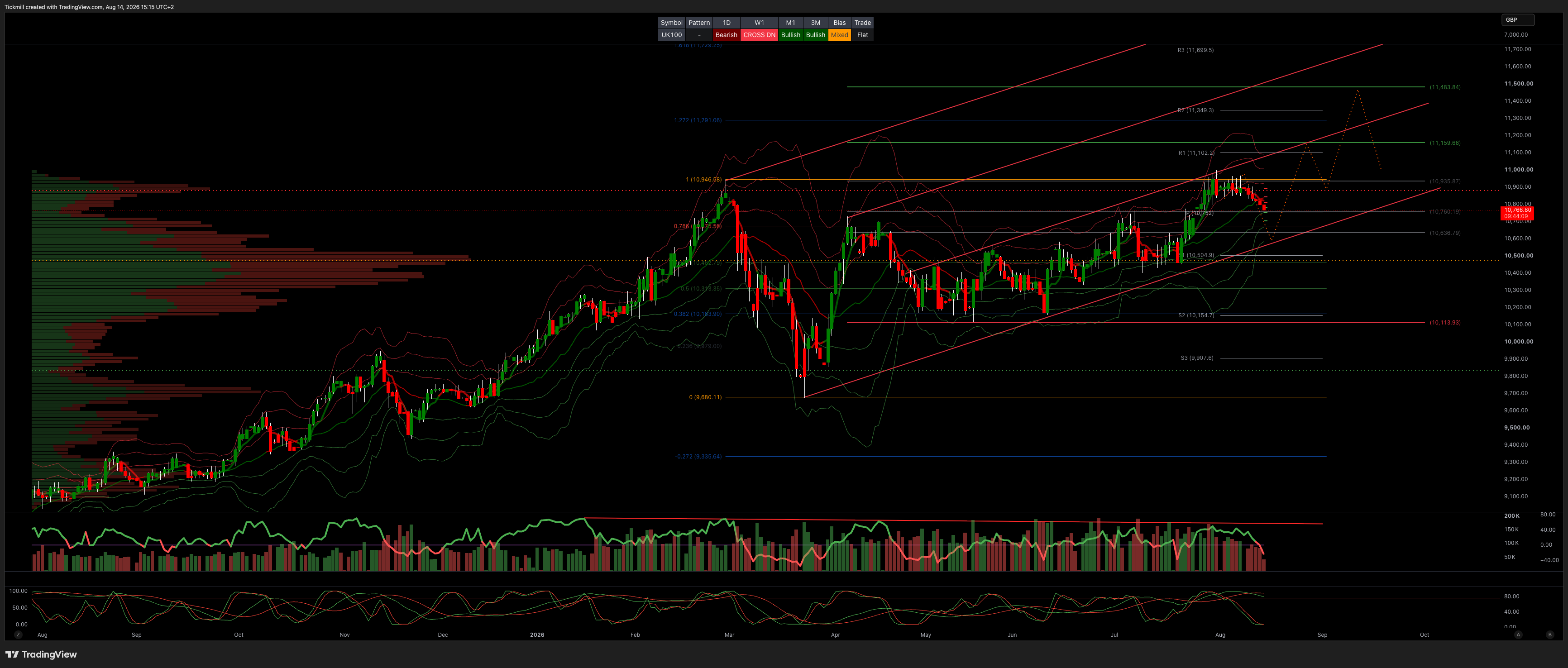
TECHNICAL & TRADE VIEW – FTSE100
Daily VWAP Bearish
Weekly VWAP Bullish>Bearish
Above 10700 Target 11150
Below 10400 Target 9500


Comments
Log in or sign up to join the conversation.