

The Federal Reserve these days seems to want to focus on employment as a reason to justify rate normalization, hinting just this week about an "active" June meeting coming up.Of course, there are many reasons put forth to dismiss the reported numbers as being phony as a three dollar bill, with Shadowstats reporting a real unemployment rate at around 23%.But let's take the government reporting at its word for a moment and view this employment recovery in the context of past employment recoveries from recessions: (click on images to enlarge).
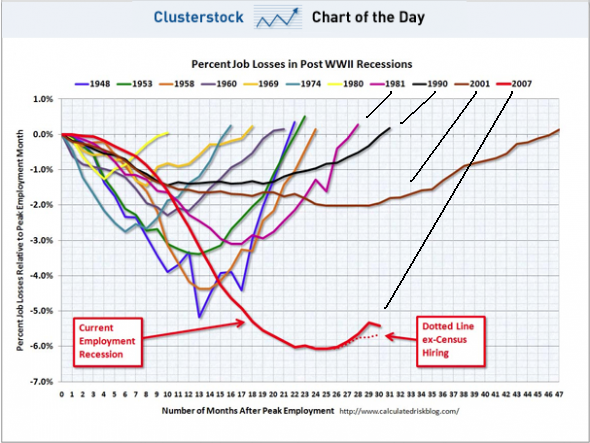
This chart shows that there seems to be some growing problem with each subsequent employment recovery that slows it down from what a normal downturn and recovery in the economy should look like.What has been growing in recent decades with regard to economic downturns?I'll give you three hints - "F" "E" "D" - and its middle initial is Federal Reserve Board.
What's the problem with these ever slowing recoveries?With our high-powered Fed, now more high-powered than ever, you would think we could snuff out a nagging problem like this. But maybe that's just the problem.Our Fed has been busy snuffing out problems for so long that it has created a problem that can't be snuffed out - the mountain of debt left over from all the snuffing:
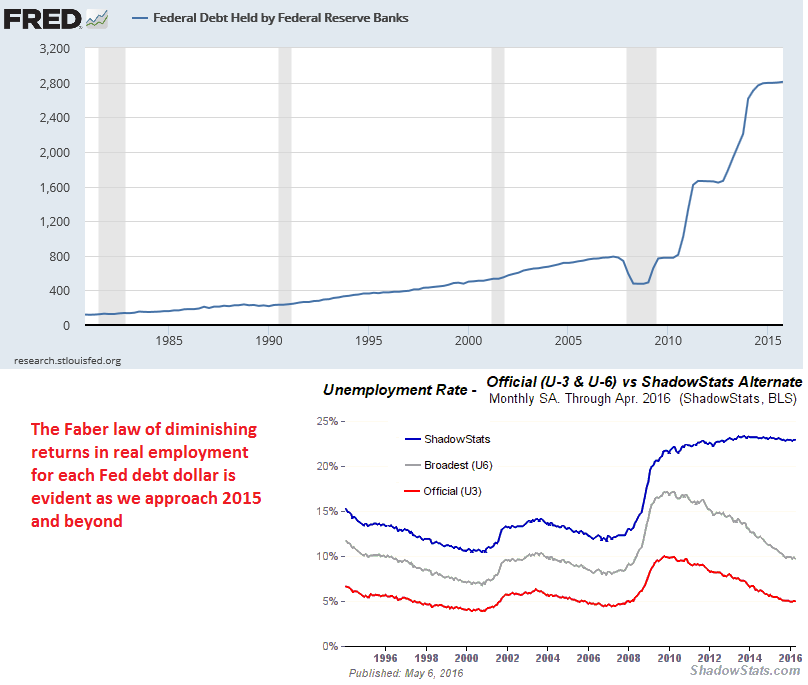
If you compare the above charts, you can see that the sharply growing employment lag back to normal in each recession recovery from 1980 onward in chronological order correlates well with the sharply growing debt level.As we attempt to normalize from our last recession, we appear to be going up against some kind of wall with real employment as measured by Shadowstats actuallyclimbing even as the Fed frantically mashes its machinery into a screaming over-heated condition.
We hear a lot about all the Fed's largess going to repair the mortgage ravaged balance sheets of banks, making them hesitant to lend. But the mortgage ravaging was the left-over of the Fed's previous snuffing project, loose money home ownership. I guess these repairs get to be a bigger job each time.
For all the trouble the Fed's debt creation causes, we are getting less and less bang for the debt dollar as the decades roll by:

This Marc Faber chart formulated 15 years ago shows the diminishing positive effect of each debt dollar on GDP growth.Clear back then, he projected "zero hour" - when piling on new monetary debt gets us nothing but pathetic real economic growth. This was projected to come at around the year 2015. Fifteen years ago, few could find fault with the wonderful help from the Fed's activity.Here in 2015ville the feeling is quite different.This out-of-control debt dynamic is nothing new in history. A fascinating article over at Zerohedge points out the math of debt creation vs the math of economic growth and how previous civilizations have had to deal with this diminishing return on debt path.We may be approaching such a point now in America.
What we need to normalize isn't interest rates, that appears to be impossible now.What we need to normalize is the economic cycle, where blundering managements have their properties taken away from them and handed over to whole new teams in bankruptcy courts.Jim Rogers has been saying this for a long time, and he is finding lots of company these days.We need to stop subsidizing incompetence.Capitalism can't work this way.That's the way it worked for hundreds of years before the Fed, and no sword of Damocles debt burden swept over the whole world.It was just isolated countries going through the debt binge/bust exercise with limited global collateral damage. Now the eight major central banks have extended this to the global village.

The Fed is talking higher interest rates to cool down this overheating economy while we suffer at nano% growth with virtually every reliable lead indicator pointing down:
- The ECRI Weekly Lead Index chart
- The transports
- The small caps
- The banks, especially Europe
- Aggregate corporate SPX revenue
- Copper
And there are more, but you don't have to look very far beyond the dismal fact that 20% of Americans are on food stamps and similar aid, up 25% since 2004, and most are living paycheck to paycheck - the worst real economy since the Depression.But I guess the questionable employment numbers mean all is well.
In case you haven't noticed, there is a growing resentment against the Fed's business as usual.The Tea Party this time is a revolt not against England's meddling with our colonies, but against another foreign entity meddling with our freedoms - the government in general and the Federal Reserve System in particular. I always used to think Jim Rogers' call for abolishing the Fed to be a little extreme.Now I see a poll out from 2010 with the stunning title "More Than Half Of Americans Want The Fed Reined In Or Abolished".
Since then, this feeling has only grown with several recent presidential candidates, including one still in the race right now, calling for public disclosure of full FOMC transcripts within six months, not the secretive five years now being done.This current candidate claims that if we had made this change in the early 2000s, Americans would have been dismayed by the housing bubble well in advance of the financial crisis, perhaps in time to avert it. I won't say who this candidate is because I am Disenchanted Voter and I do not approve of their message.
This same politician, by the way, is the only serious candidate for the presidency ever to advocate reinstating Glass-Steagall.This banking run/failure inspired safeguard from the 1930s would put a serious crimp in the banker's dangerous toying with depositors' money developing today and with their Fed gifted toys in general.
One thing is certain, the Fed is not viewed the same as in years past.Most Americans don't want too-big-to-fail anymore, and they don't want too-big-to-bail either.The Fed model has run into the ditch, and we may not be too excited about pulling it back onto the road.
Comments
Log in or sign up to join the conversation.