

It doesn’t much matter how you measure monetary stimulus, the Fed hasn’t done much of it during 2020:
1. They cut rates by 150 basis points. That’s very little compared other recessions. Some would argue they could not cut rates further. I disagree, but even so that just means they haven’t done much stimulus because they cannot do much stimulus.
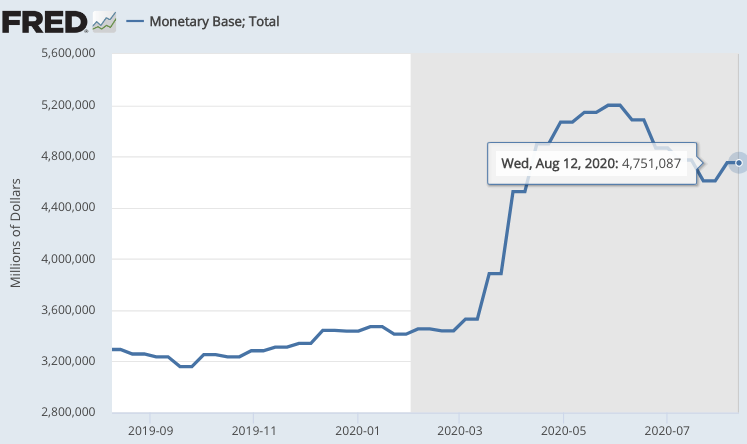
2. The monetary base is about $4.75 trillion. That’s up less that 20% from the summer of 2014. NGDP grew by more than 20% between mid-2014 and 2020:Q1. Thus in relative terms the base is not particularly large.
3. The monetary base is up about $1.3 trillion from February. That’s the same increase as from September 2008 to February 2010 (i.e. QE1) and it’s smaller than the increase during QE3. And of course NGDP was far smaller back in 2008. You can certainly argue that $1.3 trillion is “a lot”, but in relative terms the Fed’s basically done less than during two of the three QE programs during the Great Recession.
4. Using the Bernanke criteria, monetary policy has been contractionary (due to disinflation and falling NGDP.)
You can certainly argue the Fed’s done lots of “other stuff”, such a bail out the bond market and facilitate the provision of credit. But “other stuff” is not monetary policy. If you look strictly at monetary policy as usually defined (interest rates and the money supply) the Fed has not done all that much.
Fiscal stimulus actually has been unprecedented (for peacetime), even as a share of GDP. Far more expansionary than anything the supposedly “socialist” Obama could have imagined in 2009, and all done with a GOP president and senate.
So why does almost everyone assume that monetary policy has been highly expansionary? Because they don’t actually pay attention to what the Fed does. Deep down they don’t think the monetary base matters, and hence they assume based on media accounts that the Fed must have injected vast quantities of base money into the economy. As an analogy, no one paid attention when growth in the monetary base came to a screeching halt during August 2007 to May 2008, because people don’t care about the base. But then these same people will tell you that QE is evidence of easy money. Sigh.
Back during the Great Recession, the Fed bought most of the budget deficit. (I hate to use the term ‘monetized’ because with IOR the Fed no longer actually monetizes debt, except for the portion bought with currency.) This time around, the Fed is only buying up a modest portion of this years $3.7 trillion budget deficit, much less than half. Unless I’m mistaken, that’s not the impression people have, because it’s not the impression the media is providing.
So why doesn’t the Fed do much more? Maybe because they think we are in a good place, with adequate AD given the fact that people are reluctant to shop. But then why do Fed officials keep asking for fiscal stimulus? Why not do more monetary stimulus?
The Fed never really answered that question during the early 2010s, and they are again refusing to answer the question. The first time around it was exasperating. Today it’s even more exasperating. Will the press ever demand that the Fed ANSWER THE QUESTION?
PS. And why has the Fed been reducing the base in recent months?

Comments
Log in or sign up to join the conversation.