

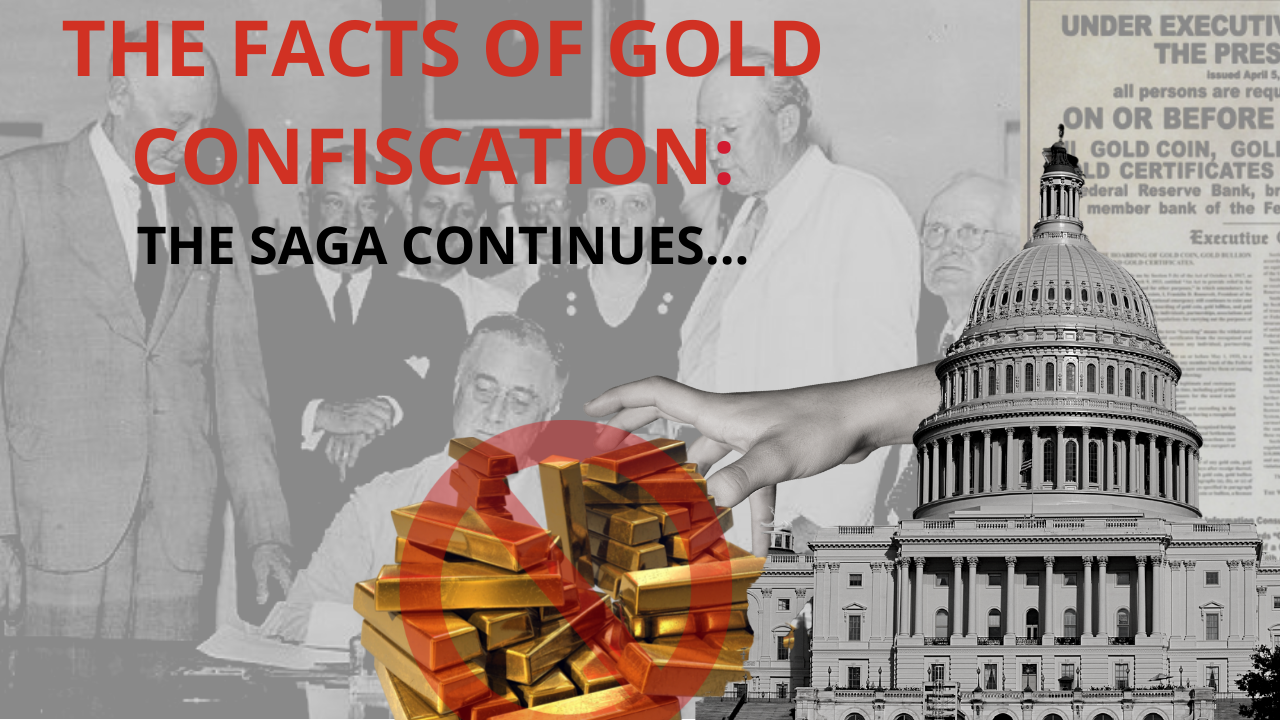
This is the second in a series of posts looking at the confiscation experience of the 1930s.
In our post Gold Confiscation: Will History Repeat Itself?
On March 31 we looked at the gold confiscation experience in America during the 1930s.
To recap we mentioned that then gold was official money according to the government. Also, the government needed gold inside the banking system to relaunch banks following the years of the Great Depression.
Since gold is not government-sanctioned money today governments do not have the same need to call in physical metals.
Importantly last week we also mentioned that no gold was stolen. Banks and governments paid for every ounce of gold.
This week we expand on further threads of the confiscation story.
Firstly -Why were some gold coins not called in while most were?
And second, if a government did want to call in gold during the decade of the 2020s, could it even be accomplished? If so, how?
Numismatic Gold Coins Exemption
Turning to the first question of why some gold coins were exempt from the Executive Order to turn in gold to banks; Numismatic gold coins were exempt because they were considered objects of art or history. However, not functioning as money during the 1930s.
As with wedding rings numismatic gold coins were not considered vital gold for relaunching America’s banking sector after the depression of the 1930s.
The distinction between numismatic gold coins that were exempted from President Roosevelt’s Executive Order for gold versus general circulation gold coins can be slightly complex.
An example of a numismatic coin that would be exempt is the oldest known gold coin in existence which was found in 2014 by a scuba diver off Bulgaria’s Black Sea coast. Read more on the accidental discovery of this coin here.
Since this coin is both extremely rare and artfully beautiful it would have been considered numismatic and exempt from the 1933 Executive Order.
Being 2,700 years old and being literally one of a kind makes clear that such a coin would not have been turned into a bank.
Nor would any government agent be rightful in asking for this coin.
In fact, the President, or any government agent, who tried confiscating this coin would have intense dramatic unanswerable questions put to it by political opponents and the free press.
Politicians during the crisis will attack the large middle section of any solution while exempting the difficult problems of special cases found in small amounts.
Thus, Roosevelt’s Executive order called for the general circulation of coins and gold bars to be turned in. However, avoided battling over such items as historically significant or exceptionally emotional items like wedding rings and art.
No gold leaf picture frames were called in by Roosevelt the Executive order.
And yes, President Trump’s golden toilet in Manhattan would have been safe Roosevelt under the exemption.
So a single 2,700-year-old historic gold coin is numismatic. But what about a single gold coin purchased in 2020 from a dealer selling part of a 10,000-coin production run of collectible coins?
Nope probably not numismatic.
Not if Roosevelt’s litmus test from the 1933 Executive Order was applied on an art basis alone.
Keep in mind that the Roosevelt litmus test of whether a coin was exempt did not care what premium was paid for the gold coin above its ounce value.
Gold Confiscation: Can it Happen Today?
Now to the second point – could governments even carry out a confiscation today?
The confiscation will not happen again. This is because bank bailouts by the government are now preplanned using living wills and contingent capital bonds.
But if we were today to make an ideological assumption that confiscation was possible for some reason, how could it be done?
As mentioned above governments like to avoid complaints from citizens and the media.
Therefore, it seems to us that the easiest place for government to get its hands on large amounts of gold are the futures market and the exchange-traded fund market.
Any 2022 government trying to call in silver and gold would be smart to padlock the doors of LBMA and CME warehouses.
There are close to 10,000 tonnes in these warehouses of gold owned not by small investors but by giant investment banks.
The hue and cry would be minimal since investment banks and government work together frequently already. Futures markets for gold did not exist in the 1930s.
If they had you can be sure Roosevelt would have started [and finished?] there instead of inviting discord from individual citizens.
Another important pot of gold exists today which did not exist in the 1930s.
Exchange Traded Funds [or ETFs] began in 2003 when the World Gold Council sponsored the very first one.
Today the dozen or so ETFs in existence collectively own more than 3,200 tonnes of gold.
ETFs hold more than 27,000 tonnes of silver.
The title to this gold rests not with individual investors but with corporate trusts controlled by lawyers and bankers.
Certainly, Roosevelt would have claimed this ETF gold into the financial system during 1933 before bothering to call in coins and bars from individuals.
Confiscation as a historical event is worthy of study.
But we have shown it is not a worthy reason to fear the government stealing physical gold and silver held by individuals in this century.


Comments
Log in or sign up to join the conversation.