


The ETF industry is breaking one record after another, and this is reflected in the headlines one reads in the newsletters in their mailboxes and on social media. This raises the question of whether all these records are really newsworthy, or if all these headlines are just noise.
First of all, reaching a new all-time high in assets under management for a whole industry is definitely worth a mention, but when this happens at the end of literally every month it might become a side note rather than a headline. The same is true for monthly estimated net flows. Fund flows are normally compared on a quarterly, semi-annual, and annual basis; monthly flows have only a limited significance, as they can change massively from one month to the other. So, the longer the evaluation period becomes, the more can be said about the trend path of the estimated net flows.
Graph 1: Global ETF Industry – Assets Under Management December 31, 1991 – June 30, 2026 (in bn USD)
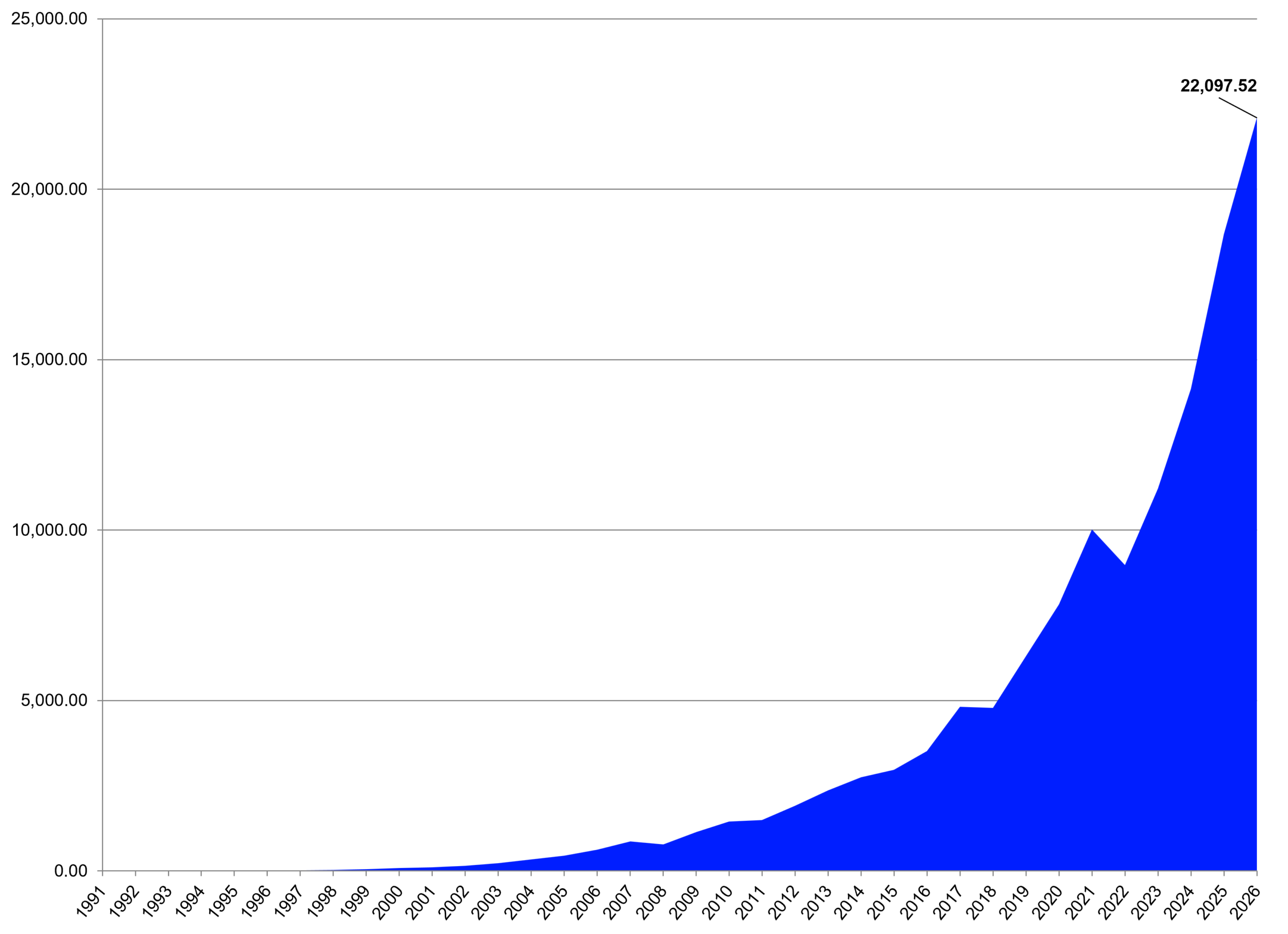
Reporting about single events such as an ETF hitting a milestone (like the Vanguard S&P 500 ETF (VOO) which hit the $1.0 trn in assets under management milestone in June, but could not hold this level of assets under management until the end of the month) may sound newsworthy. I understand that nobody wants to be late reporting about these developments, but a bit more patience may make the better story, as the examples of VOO or the race for the crown of the largest ETF promoter in the U.S. have shown.
I have learned that a good story with an equally high quality headline has a longer shelf life than a few days because it might be relevant for a long period of time. I have to admit that in a world where page impressions and clicks are measures for success, producing catchy headlines might be a valid approach to survive in an environment where authors and market analysts are fighting for the attention of readers. The question is, when do the readers get annoyed by catchy headlines followed by content which does not hold up to their expectations and start to ignore the respective authors/market analysts?
Since I have no answer to this question, I leave this open for discussion.



Comments
Log in or sign up to join the conversation.