

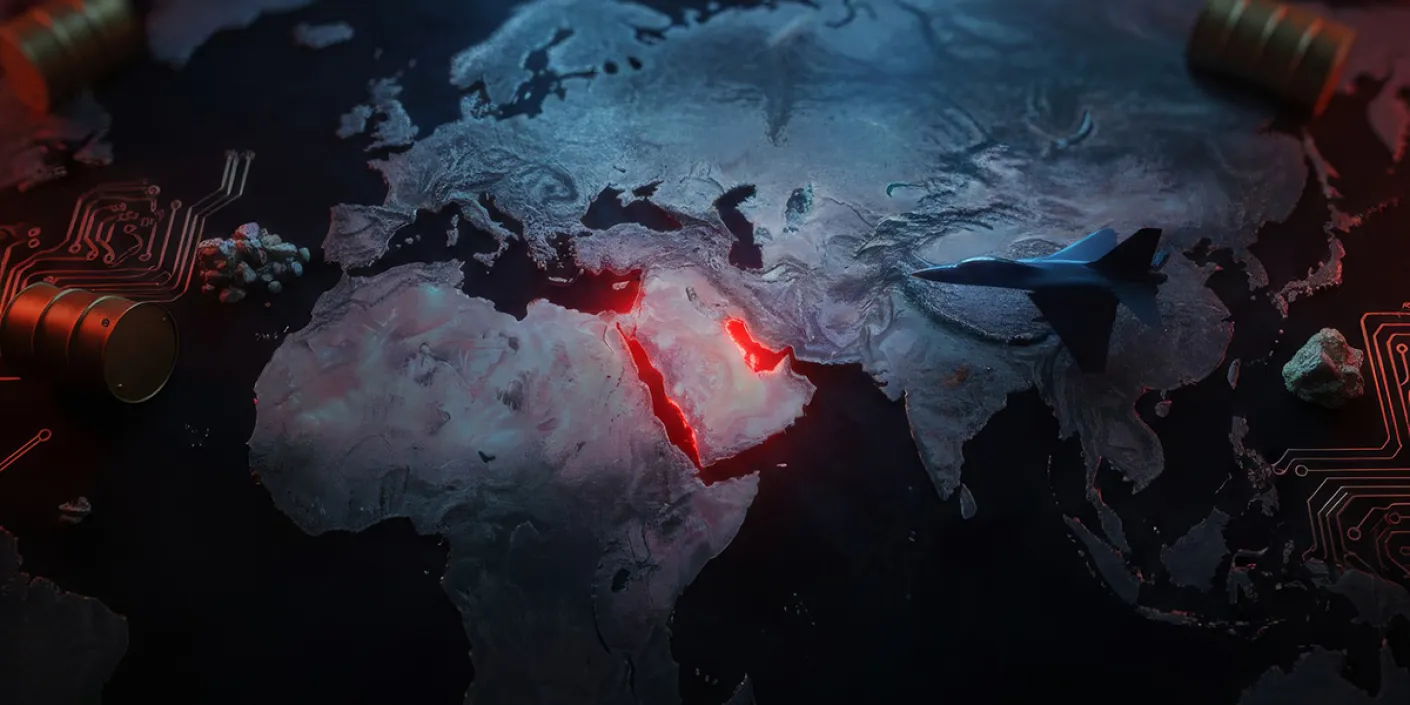
For thirty years, Western thought was captivated by the "weightless" economy—an era where software and the cloud seemed to render physical limitations obsolete. We treated material constraints as dusty artifacts of the industrial age, but by 2026, that delusion has crumbled. The intensifying conflict in the Middle East has forced a stark reality back into focus: the absolute primacy of commodities.
As the Straits of Hormuz face a functional blockade, the world is receiving a harsh education. While central banks can print currency and leaders can draft white papers, there is no legislating against the laws of chemistry. From the rare earth minerals essential for advanced defense systems to the raw energy required to keep the lights on, the tangible world is reclaiming its throne from the digital one.
The Invisible Chokehold: Rare Earths and Warfare
Modern military might is often discussed in terms of "stealth" and "connectivity," but Puplava argues that we must look at the literal weight of these machines. An F-35 jet contains 920 pounds of rare earth magnets; a Virginia-class submarine requires 4.6 tons of critical minerals. The U.S. currently faces an "invisible chokehold" because these materials are largely controlled by global rivals.
"We have a problem—they [Iran] have unlimited access to rare earth minerals, while we have limited access, because China basically embargoes those to the U.S. military," Puplava explains. This material insolvency means that even with the best technology in the world, the U.S. cannot build its way out of a conflict if the supply chain for raw materials remains under enemy influence.
The Missile Math Problem
Perhaps the most alarming insight shared by Puplava is the disparity in production rates between the U.S. and Iran. Citing data from the Center for Strategic and International Studies (CSIS), he highlights a dangerous imbalance in "missile magazine" depth. While Iran was producing roughly 100 ballistic missiles a month last summer, U.S. production of THAAD interceptors—the primary defense for Israel and Gulf allies—was stuck at a mere six or seven per month.
"Essentially, they're building a lot more ballistic missiles and tons of drones than we are able to build interceptors... The U.S. could not afford to sit and catch ballistic missile attacks over and over again."
This mathematical reality forced a "preventive war" strategy. The U.S. could not risk a long-term war of attrition where the enemy produces missiles faster than the West can produce the shields to stop them.
Force Majeure at the Straits of Hormuz
The conflict is no longer just a "geopolitical event"; it has evolved into the most severe supply shock in modern history. The Straits of Hormuz serve as a 21-mile-wide jugular vein for the global economy, carrying 20% of the world’s oil, natural gas, and fertilizer.
Puplava warns that the current situation has triggered "force majeure" clauses across the globe—a legal declaration that superior forces have made contract fulfillment impossible. Unlike oil, which can be released from strategic reserves as a "temporary band-aid," commodities like natural gas and fertilizer have no such buffer. This structural shortage threatens to push the global economy into a 1970s-style stagflationary period if the blockade persists.
The Bottleneck in the Arsenal
A startling revelation in Puplava's analysis is the fragility of the American defense industrial base. He points out that the U.S. Navy is currently firing SM-6 interceptors faster than they can be manufactured, largely due to a single chemical plant in Utah that acts as a bottleneck for the entire national arsenal.
This is the "just-in-time" inventory model failing in a "just-in-case" world. Puplava argues that the West’s obsession with efficiency and lean manufacturing has left it vulnerable during kinetic shifts. The inability to rapidly scale production is not a failure of will, but a failure of industrial infrastructure.
Strategic Options: From Convoys to "Gallipoli"
As the U.S. seeks to reopen the shipping lanes, several high-stakes strategies are being weighed. These range from the "convoy strategy"—escorting tankers through the 2-mile-wide shipping lane—to the more aggressive "Gallipoli option," which involves a massive campaign to neutralize Iranian shore-based missile launchers and drone plants.
The ultimate objective remains preventing Iran from achieving nuclear capability. With the IAEA estimating Iran has enough uranium for 10 bombs, Puplava suggests that "boots on the ground" may be the only way to neutralize canisters buried too deep for conventional "bunker-buster" bombs.
Investing in the Commodity Supercycle
From an investment perspective, Jim Puplava suggests that the prior decade’s focus on "growth at any cost" software is likely shifting toward strategically important physical assets and commodities. Because of this, his firm has been steadily increasing exposure to companies producing things like oil, copper precious metals, fertilizer, or even water utilities.
Puplava asserts that, regardless of prevailing enthusiasm for technological innovation, the ultimate trajectory of progress is fundamentally limited by access to strategic minerals; in their absence, even the most advanced technologies inevitably reach an impasse. He contends that current U.S. initiatives to reindustrialize and fortify the nation’s defense infrastructure may well serve as the ignition point for what he characterizes as an ongoing “commodity supercycle.”
According to his analysis, this supercycle—which first manifested in precious metals earlier in the decade—now appears to be broadening into a decisive strategic pivot, driving institutional capital away from digital-centric allocations and back toward resource-based investments poised to define the next phase of global competition.



Comments
Log in or sign up to join the conversation.