

The global economy may be in a regrettable tailspin experiencing a second round of lockdowns in many major countries, but some industries are proving surprisingly resilient totally.
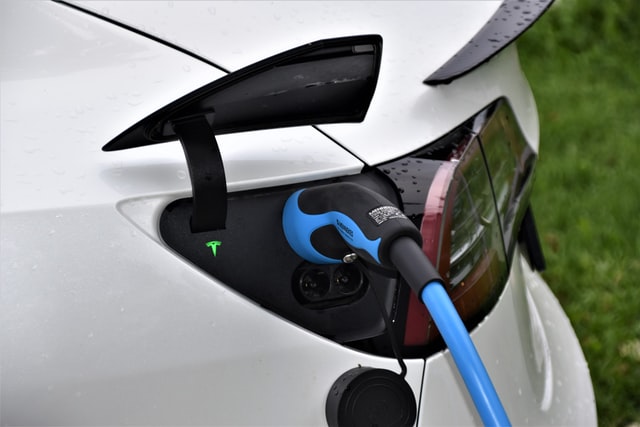
Photo by Waldemar Brandt on Unsplash
While global GDP was busy plummeting by as much as a third last quarter, remarkably, electric vehicle sales have managed to hold their own through the carnage.
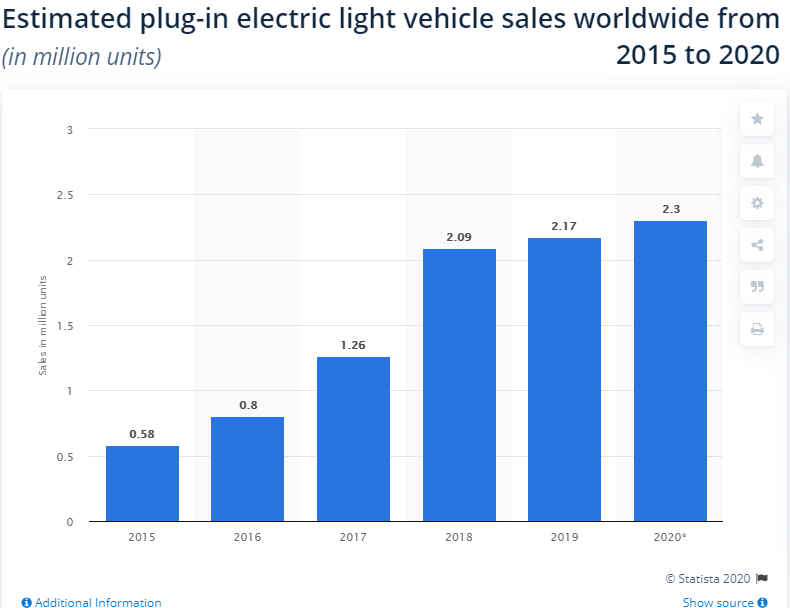
You may not have guessed it from the constant flow of negative headlines on the economy these days, but EV sales growth for 2020 has already eclipsed growth for 2019, and the data above is only current through July. We can always engage in theoretical counterfactuals, wondering what the EV industry could have been at this point had global lockdowns never occurred, but what we can see at least from the chart above is that EV has been, to say the least, extremely durable in the face of serious economic adversity.
And EV stocks have reflected this resilience recently in a big way. Tesla’s (TSLA) monster rally that began in December is lost on nobody, but even Chinese competitors such as NIO Limited (NIO) rocketed higher in 2020 without so much as a dent during the wider panic selloff as the first wave of lockdowns took effect. Interest in EV offshoot companies has also sprung on the scene. Blink Charging (BLNK) for example, the largest EV charging network in the United States, has rocketed higher since May by over ten times.
It’s mostly guesswork to try to explain timing in these cases, but fundamentally, what can be said is that investors are realizing that the EV industry has actually stood firm up to now, unlike many others that have suffered. Any successful vaccine that could put the lockdowns behind us, could then unleash a year’s worth of pent up growth in the industry that investors are just now trying to get in front of.
Luckily, there are companies that haven’t yet climbed to all-time highs for newcomers in the space to look at. Recently joining the scene is Medigus (MDGS), which just last week announced its intention to enter the EV market through a joint venture with private company EMuze for the development and commercialization of micro-mobility vehicles in urban settings for last-mile and cargo delivery. The timely announcement has drawn attention to Medigus as a new player in the field, in a niche setting within EV that isn’t getting as much focus.
Medigus isn’t strictly a speculative play on the EV sector though. The company is invested in 7 other firms across the tech and healthcare sectors as well that serve to spread out exposure for investors who want more than just the next EV play. Here are a few of the notable ones.
ScoutCam (SCTC), for example, which Medigus owns a 50.1% stake in, manufactures the world’s smallest cameras and already has contracts in place with Fortune 500 companies. Used in car engines for remote diagnostics, aerospace and defense, and surgical procedures ScoutCam’s cameras are 1mm in diameter.
Also active in COVID-19 and other disease prevention, Medigus owns a 20% stake in Polyrizon, a company trialing a biogel nasal spray designed to protect respiratory pathways against exposure to COVID-19, among other viruses and bacteria.
Medigus has also taken stakes in the Fulfillment By Amazon (AMZN) space, which accounts for about 45% of Amazon sales through the Amazon marketplace. This sub-industry has grown markedly in the pandemic era as people turn more towards online shopping. Independent Amazon stores grow quickly on Amazon Marketplace in this type of environment, which tends towards sprawling and unfocused retail outlets. Medigus’s SmartRepair Pro acquires smaller Amazon stores already showing profitability and optimizes them. Current annual sales are $3.5M with $9.8M expected by 2022, ensuring a decent revenue stream to support the growth of its other businesses.
For those who want to take a stake in an area of EV not getting much attention yet but also want a more rounded approach, Medigus may be one to look at before the world fully opens back up again and the EV industry once again meets a fully functional economy.
Comments
Log in or sign up to join the conversation.