

Markets traded roughly 2% lower late Tuesday night, led lower by the Nasdaq, as results pointed to the Democrats taking Congress. The next morning, markets reversed course, with the S&P 500 opening about 1% higher. That is a three-point round trip in twelve hours, on identical information.
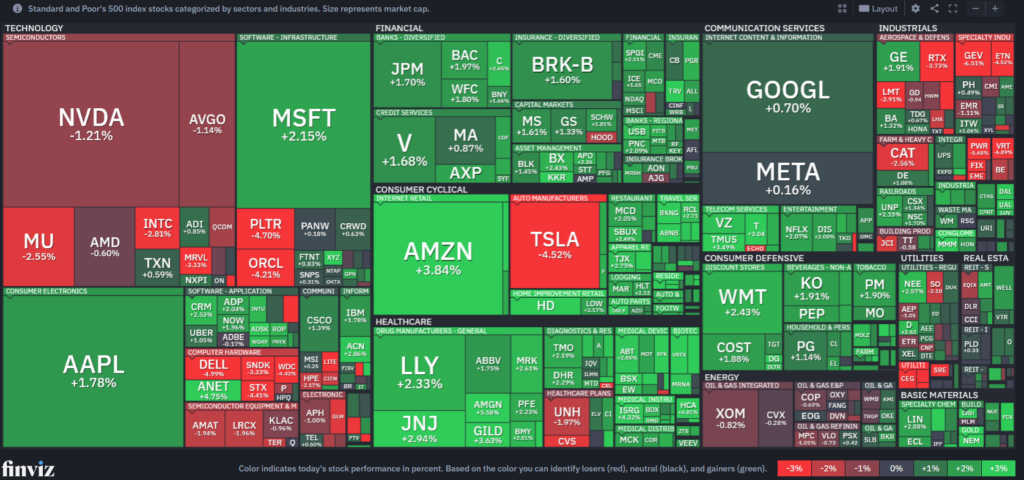
This short missive focuses on patience, but first let’s see the markets’ initial gut reaction to the results. As we share below, the value rotation reasserted itself, with banks, healthcare, and staples leading the way. The Magnificent 7 stocks were higher, except for Nvidia and Tesla. The losses were concentrated and specific. The data center power complex took the biggest hit, with Vertiv down 6.8%, GE Vernova down 6.3%, Quanta down 5.5%, and Eaton down 4.7%. Oracle fell 4.3% and Palantir 4.0%. Defense stocks also declined, with Lockheed off 4.1% and RTX off 3.2%. Semiconductors were weaker, with Nvidia, Broadcom, Intel, and Micron trading lower.
Those initial moves are guesses about which policies will emerge from the new Congress and, equally important, how Trump will work with the Democrats. Investors must have patience because market guesses often prove wrong. Remember when S&P 500 futures fell over 5% on the night Trump won his first term only to finish the following day green? Initial reaction trades are much more about positioning, forced covering, and reflex than political analysis. Nobody is pricing in a utility’s regulatory outlook or change in healthcare at two in the morning. The quote below from Trump’s 2016 victory sums up why patience matters.
Now, looking at it just a few hours later, that was all wrong — 100 percent wrong. – Nick Colas
The market votes slowly. It needs committee assignments, a legislative calendar, and the time between what gets proposed and what gets passed. That takes weeks and months. The useful question is not what moved last night or in the coming days but which of those moves is still there in a month.
What To Watch Today
Earnings
Economy
Market Trading Update
Yesterday, in Oracle Sells Cheap Stock As Its Debt Window Narrows, we asked whether the midterm technology sell-off was a warning or a setup. We also said we’d add technology in tranches. Today, the follow-up question is where that money comes from. The answer may be the defensive sector rotation that has quietly become one of the most crowded trades in the market.
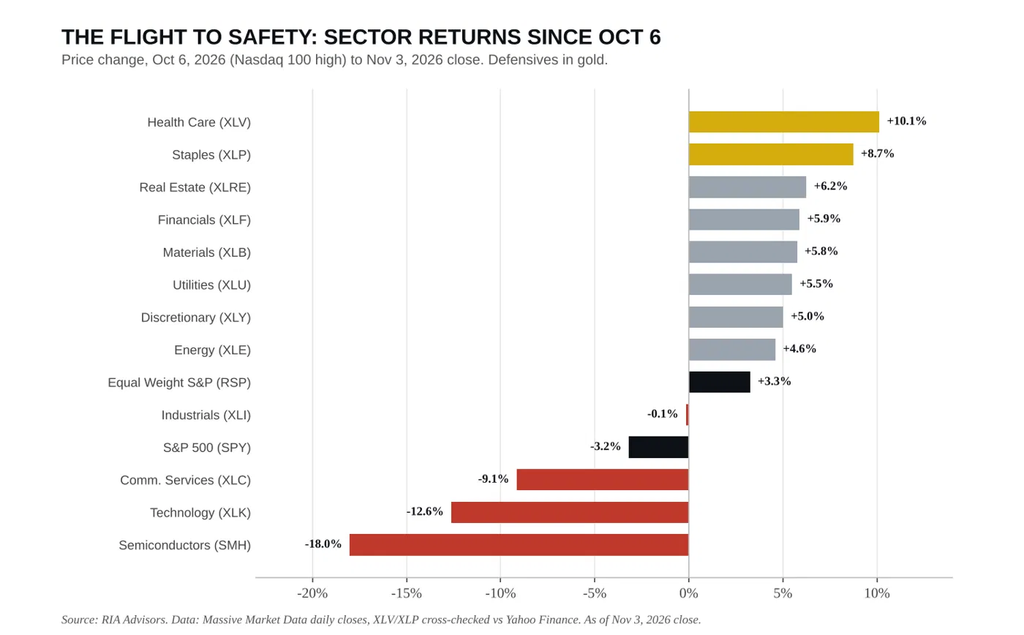
Notice what has happened in the chart below since the Nasdaq 100 peaked on October 6. Semiconductors fell 18%, and technology dropped 12.6%. Meanwhile, health care (XLV) gained 10.1%, and consumer staples (XLP) rose 8.7%. The S&P 500 slipped just 3.2%. That’s NOT a market in a panic. It’s investors rearranging the furniture.
Here’s where it gets interesting. “Safety” stopped being cheap. XLV closed Tuesday at $184.02, which is 15.8% above its 200-day moving average near $158.95. It also sits 6.6% above its 50-day average near $172.60. The 14-day RSI is at 69 after pushing above 70 last week. Since 2005, XLV has closed 15% or more above its 200-day average in only two other stretches, late 2009 into early 2010 and the spring of 2013.
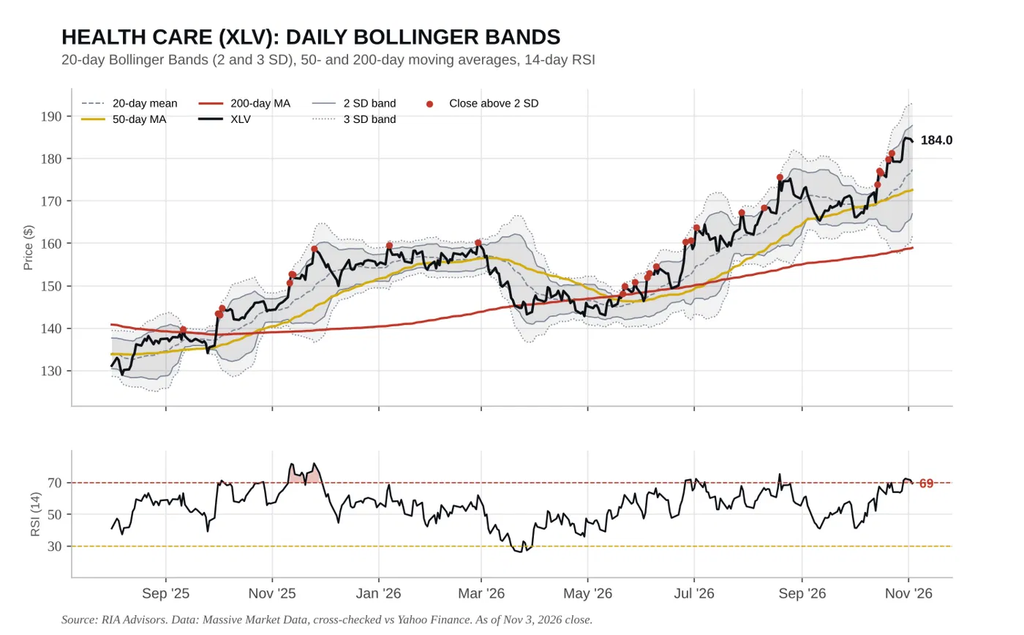
However, while history is a guide, it doesn’t hand us a clean answer. Six months after the 2010 readings, XLV was 6% to 9% lower. After 2013, it was 5% to 12% higher. Stretched is not broken. However, a 10% gain in four weeks for a sector that usually moves at a crawl suggests positioning drove the buying more than earnings did. Bob Farrell’s Rule #2 warns that an excess in one direction leads to an opposite excess in the other. The tech unwind was one excess. The rush into defensives looks like the other.
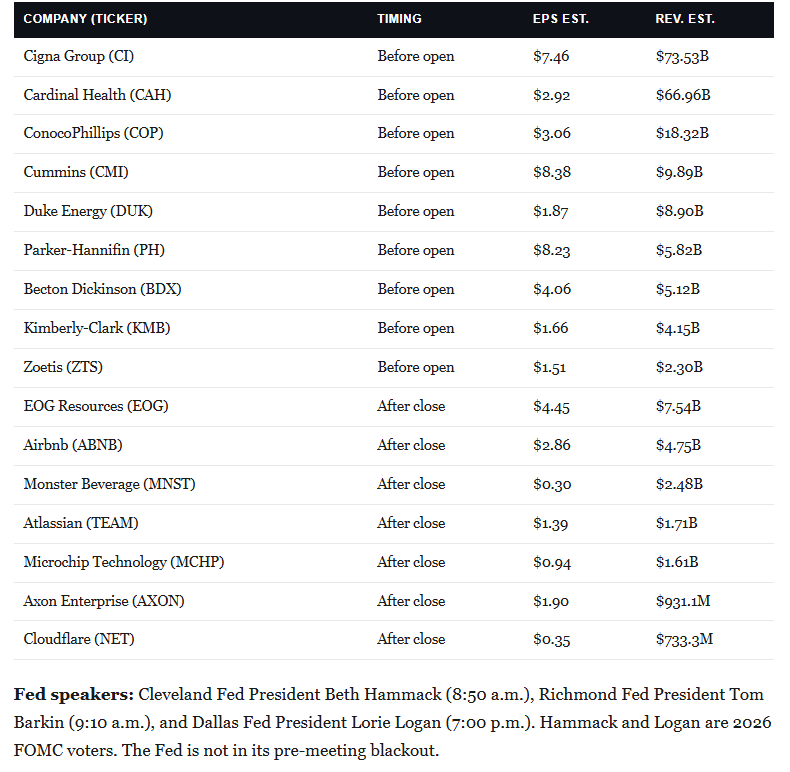
A skeptic might ask, “Isn’t health care exactly where you want to be if the economy rolls over?” The answer is yes, and that’s why we aren’t selling it outright. But defensive doesn’t mean riskless. Thursday morning brings Cigna, Cardinal Health, Becton Dickinson, and Zoetis before the open. A sector priced for safety tends to get punished hard for any disappointment.
Such is the problem with crowded trades. They feel safest right before the exit narrows.
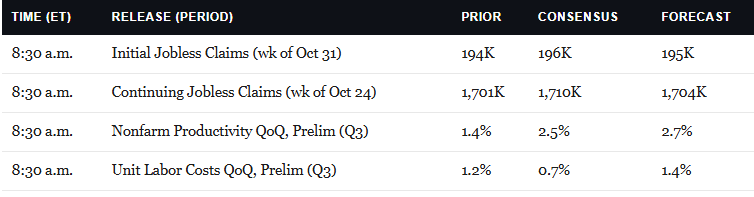
JOLTS Report Signals Hope For The Labor Market
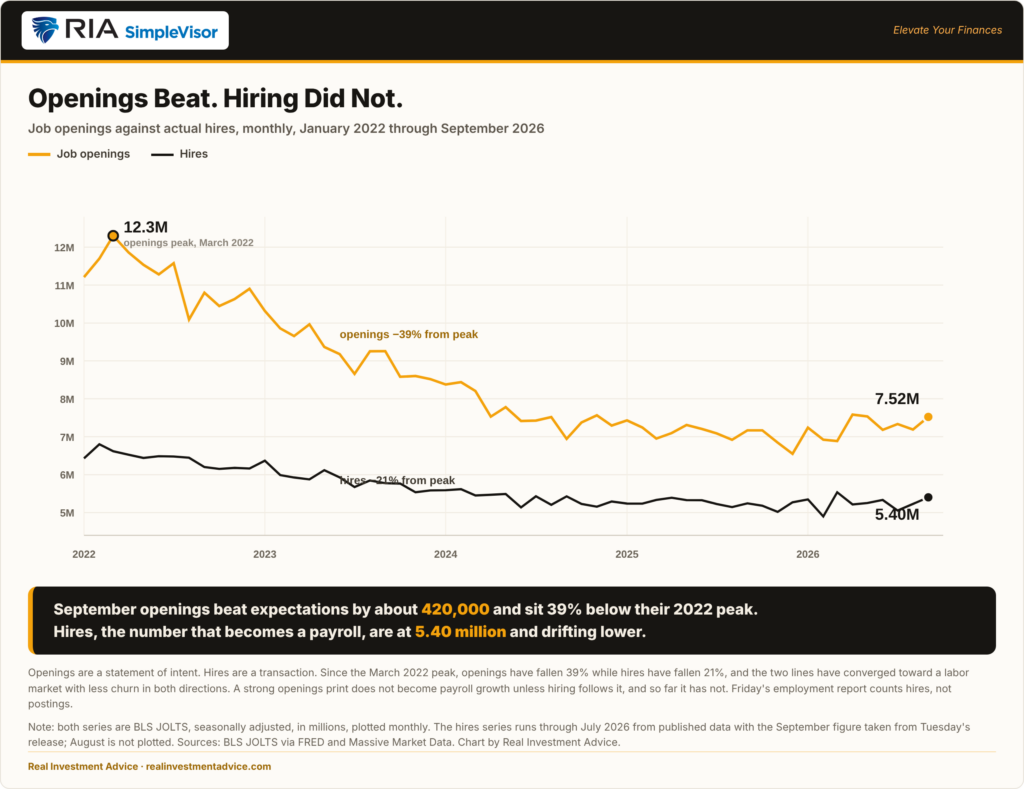
Tuesday’s JOLTS report was strong, with September job openings rising to 7.52 million versus expectations of 7.10 million. Quits climbed to 3.37 million, lifting the quits rate to 2.1% and above 2% for the first time since June 2025. The quits rates tend to rise when workers believe another job is available.
The increase in openings is a first step toward improving labor market health, but actual hires show intent. Hiring ran at a 3.4% rate in September, the slowest pace since 2013, and total separations have barely moved in two and a half years. Simply, employers are advertising more jobs without filling more of them. Roughly 104,000 of the openings came from state and local government outside education, which is not cyclical private demand.
So what does JOLTS portend for Friday’s BLS employment report? We’ll likely see another modest payroll number rather than a breakout. The JOLTS report was for September, and we know the BLS September report added just 29,000 jobs, and the three-month average is near 51,000.
It’s worth adding that the JOLTS layoff rate has held steady at 1.0% within its range since mid-2024. The frozen labor market has produced small positive payroll prints so far, not negative ones.
Expect low hiring and low firing again on Friday, but the strong job openings may portend a better market in the months ahead.
Credit Spreads: Calm On The Surface, Concern At The Bottom
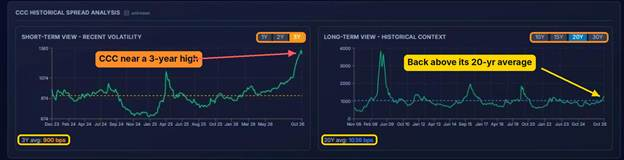
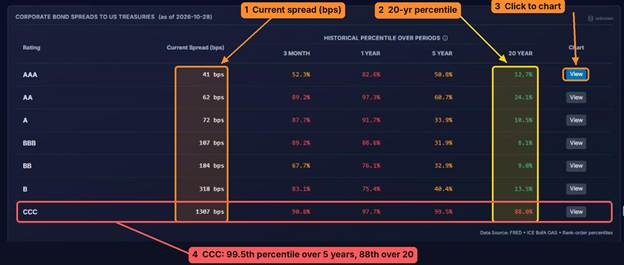
Taken together, the credit market is sending a nuanced message. On the surface, spreads are historically tight. Investment-grade companies are borrowing at spreads that are near the bottom of their 20-year ranges, and the high-yield index is near the middle of its long-term range. That suggests little fear of a broad-based recession or a meaningful tightening of financial conditions.
Beneath the surface, CCC spreads are flashing a warning. Their sharp widening tells us investors are making a sharp distinction between companies that can handle rising yields and those that cannot. The weakest borrowers tend to feel higher rates first because they rely most on refinancing. Encouragingly, the stress has not migrated to BB- and B-rated bonds. If CCC stress begins to move up the ratings ladder into B, BB, and eventually investment-grade BBB credits, it would be a far more meaningful signal for the economy and the stock market.
Learn about corporate credit spreads, why they are a great liquidity and economic gauge for stocks, and how to use our new SimpleVisor tool pack to stay on top of them.
Tweet of the Day


Comments
Log in or sign up to join the conversation.