

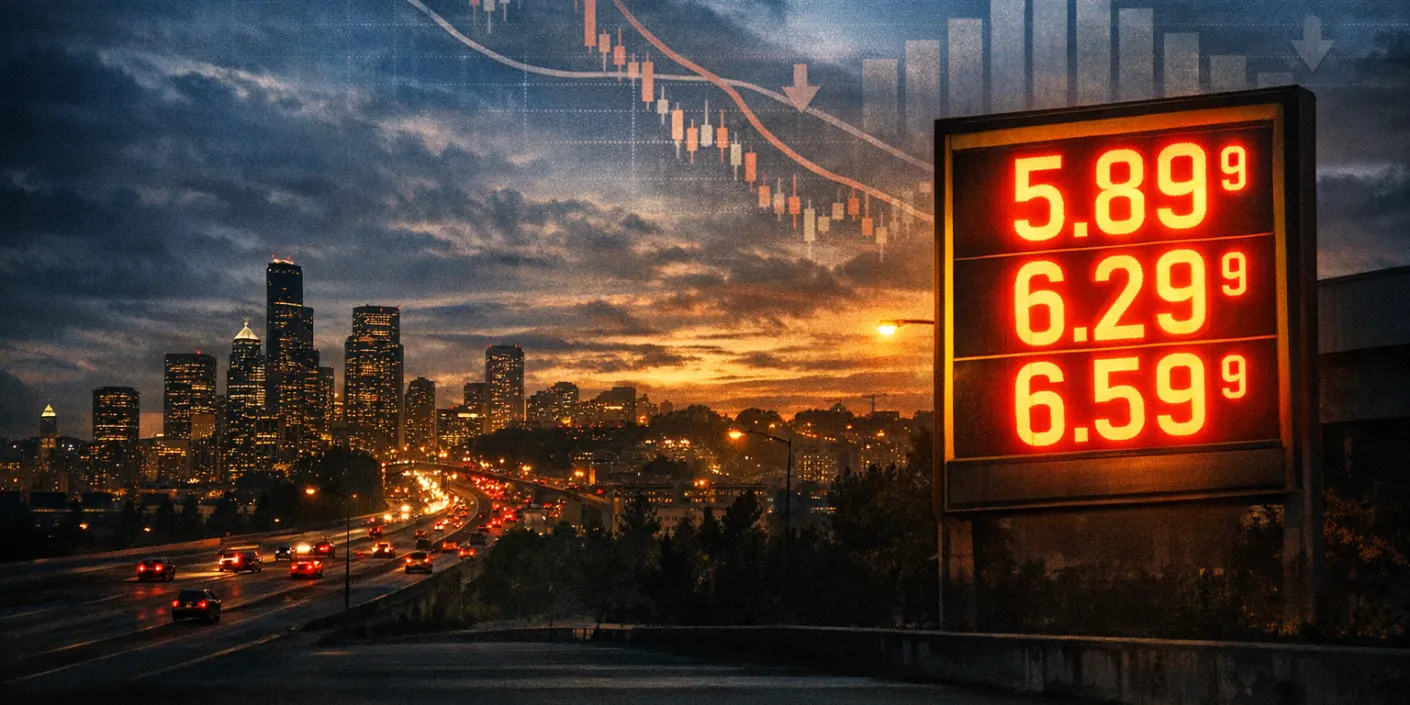
With oil hovering near $90-100 per barrel and geopolitical tensions over Iran continually in the news, it’s easy to feel a flashback to the 1970s. Gas prices are climbing. Food costs are rising. Growth has slowed. The word “stagflation” is creeping back into headlines.
One positive factor worth keeping in mind: today’s U.S. consumer is far more insulated from energy shocks than in prior decades—and in inflation-adjusted terms, oil prices would need to climb substantially from current levels to rival the true crisis levels of past spikes.
That’s not to dismiss the strain people feel at the pump. It’s to put it in perspective.
Economist Lauren Saidel-Baker at ITR Economics sees a slowing economy, yes—but not one on the verge of collapse. The service sector remains resilient. Manufacturing is stabilizing. And while inflation isn’t vanquished, it’s not spiraling out of control either.
The real risks, she argues, lie deeper—and further down the road.
Here’s how she sees the road ahead unfolding.
Oil Shock? Today’s Consumers Are More Insulated
At first glance, $90-100 oil feels ominous. But Saidel-Baker argues that energy simply doesn’t pack the same punch it once did.
“One metric we calculate is the personal consumption expenditures devoted to energy goods and services,” she explains. “In total, this now accounts for just 3.7% of our total spending.”
That’s a dramatic shift. For comparison, the peak in oil prices during the late-1970s/early-1980s oil shock would be equivalent to roughly $145–$150 per barrel in today’s dollars, while the 2008 peak would translate to about $215–$220. In other words, past energy shocks were not just psychologically jarring—they were larger in real terms as well.
Furthermore, in past decades—especially during the oil shocks of the 1970s and 1980s—energy consumed between 5% and 10% of household budgets. Today, thanks to higher incomes, better fuel efficiency, electrification, and improved home insulation, consumers are less exposed.

Source: ITR Economics, posted with permission
“It’s an entirely different world,” she says. “We are just more efficient overall.”
That doesn’t mean no one gets hurt. Lower-income households still feel the squeeze. But from a macroeconomic standpoint, the reduced share of spending on energy makes today’s price spikes far less recessionary than in the past.
For a downturn to materialize, oil would need to rise significantly higher—and stay there. “If we see $140 per barrel oil,” she says, “I might start to get nervous.”
A Two-Speed Economy: Services Strong, Manufacturing Subdued
The broader economy, meanwhile, is growing—but unevenly.
Saidel-Baker describes it as “two different sides of the coin.”
On one side is the service sector, which continues to expand. Consumers are still spending on travel, entertainment, and experiences. “They’re holding in relatively well and really focusing more on services than on goods,” she says.
On the other side is manufacturing and the industrial economy. Here, growth is returning—but only modestly. “We are in an early accelerating growth trend,” she explains, “but these are much more modest growth rates, and they’re really coming off of a period of stagnation.”
In other words, the factory floor is improving—but from a low base.
Put it together, and the picture is one of slow but steady expansion. The economy isn’t booming. But it’s not collapsing either.
“Profitless Prosperity” and Stagflation Lite
Looking ahead three to five years, Saidel-Baker expects moderate growth paired with stubborn inflation.
Her firm projects consumer inflation averaging between 2% and 4% over the next three years—above the Fed’s preferred 2% target. Beyond that, she sees inflation potentially moving into the mid-single digits.
Not runaway 1970s-style inflation. But persistent.
She has a term for what this could mean for businesses: “profitless prosperity.”
“The top line will be easier to grow; all pricing is going up,” she says. “But… if I’m only focused on my top-line sales or revenue number, it’s possible to grow that, but at what cost? How are your own margins keeping pace?”
In other words, revenue may rise simply because prices are rising. But if costs rise just as quickly—or faster—profits get squeezed.
This environment, she warns, will separate disciplined operators from the rest. Margin resilience, cost control, and financial prudence will matter more than flashy growth.
She likens the outlook to “stagflation lite”—slower growth combined with inflation that refuses to fade.
The Real Storm: Demographics and Debt
If the near term looks manageable, the long term looks far more troubling.
Saidel-Baker and her colleagues have long forecast a major downturn around 2030, driven by aging populations, soaring entitlement costs, and mounting government debt.
“We haven’t had a balanced budget in this country since Clinton,” she notes. Meanwhile, baby boomers are retiring, drawing more heavily on Social Security and Medicare.
“This is doing terrible things to our debt profile,” she says, especially as higher interest rates increase the cost of servicing that debt.
At some point, she warns, “our creditors—I don’t know how they don’t lose faith in the US Government.”
Her metaphor is stark: “If you kick the can down the road, in 2030 that road ends, and it ends in a brick wall.”
Something, she believes, will have to give.
The Question for Today
For now, Saidel-Baker’s message is not one of panic—but of preparation.
Energy shocks are manageable. Growth will continue, albeit sluggishly. Inflation will linger. Businesses must focus on margins, not just revenue.
But the deeper structural challenges—debt, demographics, entitlement spending—require foresight and action long before 2030 arrives.
The real question isn’t whether the economy will survive the current rise in oil prices.
It’s whether we’ll use this relatively stable period to strengthen our financial foundations—or wait until we hit that brick wall.
Comments
Log in or sign up to join the conversation.