

Is the “normalizing monetary policy musical chairs” trend now moving in the European Central Bank’s (ECB) direction? The Federal Reserve (Fed) started the process in December 2015 by beginning to remove its zero interest rate policy and followed the process to its next step, paring down its balance sheet starting in October. The Bank of Canada joined the rate-hike party in July, while the Bank of England is widely expected to follow suit at one of its remaining two policy meetings in 2017. All eyes within the global financial markets are now on the ECB, and the question becomes: Is the result of its recent meeting the beginning of its normalizing process (tapering) or just an adjustment to its existing bond buying program (moving the goalposts)?
Heading into the most recent ECB convocation, comparisons were being made to the Fed’s Ben Bernanke-induced taper tantrum here in the U.S. However, there are certainly a host of differences that stand out as the markets reacted to this announcement—namely, the level of the respective 10-Year yields. The U.S. Treasury 10-Year yield pre-taper tantrum in 2013 was 1.93%, while the German bund yield prior to the ECB’s latest meeting was .47%. Perhaps the biggest difference between these two episodes is that when Bernanke first spoke of possible tapering in May 2013, it was widely unexpected (thus the negative reaction), while the ECB’s decision was very much expected and became more a matter of what the tapering plan would look like, not whether it was going to scale back its asset purchases.
Global Central Bank Balance Sheets
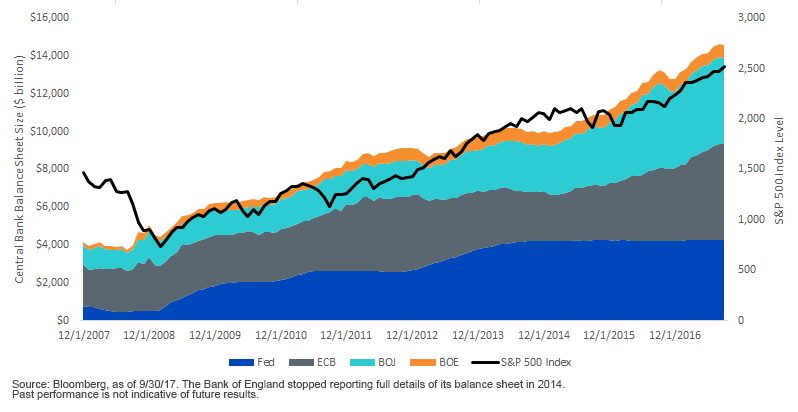
Prior to the October 26 meeting, the markets essentially were operating under three different possible scenarios (the current pace of buying is €60 billion/month through December 2017):
1. Pace reduced to €40 billion/month through December 2018.
2. Pace reduced to €30 billion/month through September 2018.
3. Pace reduced to €20 billion/month through June 2018.
Scenario #1 was expected to be viewed as a dovish outcome, with the 10-year bund yield either remaining unchanged or falling; Scenario #2 was viewed as more of a neutral event, with the 10-year bund being little changed; Scenario #3 was expected to be a hawkish development and the 10-year bund would sell off. In our opinion, the bottom line message is that despite this ECB decision, global central bank balance sheets (Fed included) are going to remain bloated for the foreseeable future, and in the case of the eurozone, this trend will continue to expand into next year.
In the end, the ECB decided on Scenario #2. Interestingly, the global bond markets went into the meeting expecting a bit more of a hawkish outcome. As a result, there was some knee-jerk buying in the German bund, but that was more of a relief rally. In addition, much like the Fed prior to its reinvestment pay-down plan, the ECB stated it will reinvest maturing debt for an extended period after quantitative easing (QE).
Thus, in aggregate, global balance sheets are still expanding, an important factor driving the appreciation of global equity markets. The quantitative tightening by the Fed continues to be more than offset by an expansion in the monetary base in Europe and Japan. Japanese stocks may actually be the big beneficiary of ECB tapering. Once bond investors believe the European Central Bank will play a smaller role in European bond markets, market forces should gradually play a greater role in the pricing of European debt. This process, set to play out over many months, could begin to push up rates in the region, particularly for eurozone nations that have both high debt loads and low GDP growth rates. If European yields begin to inch up as U.S. rates creep higher, foreign bond purchases may become more attractive to Japanese institutional investors, who today receive only 5 basis points (bps) in yield for buying 10-year Japanese government bonds. If both the dollar and the euro appreciate relative to the yen, that could create advantages for Japanese exporters selling into Europe and for U.S. investors who invest in Japanese stocks.
Conclusion
The initial reaction for the U.S. dollar was to strengthen a bit versus the euro, as the worst fears were not realized. With respect to the yen, continued euro strengthening relative to the yen could be an additional catalyst for the bull market in Japanese stocks.



Comments
Log in or sign up to join the conversation.