


The dollar’s ascent continues today. It has reached new highs for the year against half the G10 currencies (euro, Danish krone, Canadian dollar, Swiss franc, and the Swedish krona). The dollar’s resilience in the face of the equity market slide is unexpected. Both the S&P 500 and Nasdaq Composite settled below their 200-day moving averages yesterday, before Nvidia’s earnings. It appears that the better-than-expected October jobs growth reported November 6 and the hotter than expected inflation gauges have offset the initial concerns about the weakening of the equity market. However, the two-year Treasury yield has begun taking notice and is lower for the fourth consecutive session today.
Separately, the US new restrictions on Chinese companies using data centers in Singapore, Malaysia, Thailand, Indonesia, and Brazil, which run on US high-end chips is seen as an escalation by Beijing on the eve of the APEC summit. The US argues that the move closes a loophole and is not a new restriction. Lastly, Canada and China announced an extension of their trade deal, and this will surely irk the Trump Administration. This could put the USMCA at greater risk.
Prices
G10
• The euro dropped to a little below $1.0970, a new low for the year, in early North American trading. It recovered as US equities extended their sharp decline. It reached almost $1.1020, new session highs as European trading wound down. The euro snapped a five-session decline yesterday, but the downside pressure remains. It has not traded above $1.10 today, where options for 1.66 bln euros expire today. The euro was sold to a marginal new low of $1.0960. The $1.0880 area corresponds to the (61.8%) retracement of the euro’s rally that began early last year.
• Softer US rates, as US stocks remained under pressure, helped cap the greenback against the yen yesterday. The dollar briefly traded above JPY160 at the end of last week and was greeted with new warnings by Japanese officials. The greenback was sold to a three-day low yesterday in Europe, slightly below JPY158.90. The 200-day moving average (~JPY158.80) held. The dollar is in about half of a yen range today below JPY159.65.
• Sterling was initially sold yesterday to about $1.3170, its lowest level in a month, before recovering. It pushed above Monday’s high (~$1.3225). Although it did not close above it to form a technical key reversal and the selling pressure resumed today despite the firm CPI. Sterling slipped through $1.3150, a new low since the low for the year was recorded on October 14 (~$1.3135). It recovered in the European morning to around $1.3175. The intraday momentum indicators give it scope to recover toward $1.3190-$1.3200.
• The Canadian dollar fell to a marginal new low for the year before consolidating in North America yesterday. The greenback rose to about CAD1.4315 and its gains have been extended to CAD1.4330 today. The next resistance area is seen near CAD1.4400. We note that the US two-year premium over Canada has risen from a little below 130 bp in late October and has straddled the 150 bp area in recent days.
• The Australian dollar was sold slightly below $0.6715 today, its lowest level since January. Stabilized in the European morning and reached about $0.6735. It settled slightly firmer yesterday and snapped a five-day slide. Options for around A$930 mln struck at $0.6760-65 expire today.
EM
• Mexico’s has approved next year’s budget. The market expects the budget deficit to fall to about 3.9% of GDP in 2027 from 4.3% this year. Most emerging market currencies rose yesterday, and the Mexican peso was among the strongest (~0.55%). The dollar finally closed below MXN18.50 and settled at its lowest level in nearly a month. However, given the peso is under pressure today. Most emerging market currencies are softer today, but we thought that given the Canada-China deal that will irk the US, USMCA may be at risk, which makes the peso particularly vulnerable.
• The offshore yuan has been trading in a narrow range against the US dollar for the past two weeks, which means it has appreciated against the other G10 currencies. The dollar’s range is roughly CNH6.66-CNH6.68. The PBOC has lowered the dollar fix slightly for the fifth consecutive session today and at CNY6.7118, it was the lowest fix since 2022.
• The dollar gapped lower yesterday against the Indian rupee and fell further today. The greenback reached its lowest level since April today (~INR93.2540). Indian equities have drawn international investors as AI trades are unwound. The INR93.50 area corresponds to the middle of this year’s range.
Other Markets
• The US S&P 500 and Nasdaq Composite equity indices extended their recent losses, and both settled below their 200-day moving averages. After dropping a little more than 9% in the past three sessions, the Philadelphia Stock Exchange Semiconductor Index fell almost 1% yesterday. Asia Pacific bourses were mostly lower today, though South Korea and Taiwan’s markets rose. Europe’s Stoxx 600 is little changed after falling 1.75% yesterday. US index futures are firm, led by the Nasdaq 100’s 1% gain.
• Benchmark 10-year yields fell yesterday, led by an eight-basis point decline in France, following Le Pen’s endorsement of pension reform. Dragged lower by falling equities, the 10-year US Treasury yield fell slightly more than four basis points (to ~5.09%). It was the second day US yields eased after a six-day advance that began with the better-than-expected October jobs growth reported on November 6. Rates are lower today, led by a nearly 6 bp decline in the UK 10-year Gilt yield. Peripheral premiums in Europe are narrower. The !0-year Treasury yield is off a little more than one basis point to slightly below 5.10%.
• Gold consolidated within Monday’s range, when it recorded the low for year (~$3832.60) yesterday but has been sold to a new low for the year today near $3757.50. With the today’s losses (~2%), gold has met the (61.8%) retracement of its rally that began in January 2025 near $2615. Silver also has been sold to a new low for the year today (~$45.60). There seems to be little chart support now until closer to $40.
• January WTI was sold to a five-day low near $83.40 before bouncing back to settle above $85. Despite more strike (US hits an island in Hormuz and Ian targets Kuwait), January WTI is off around 1.5% to about $83.30 (having reached an intraday low near $82.40) as the market appears to focus on supply, which now the International Energy Agency projects a surplus and US inventories appear to be rising, though official US data is due later today.
Data
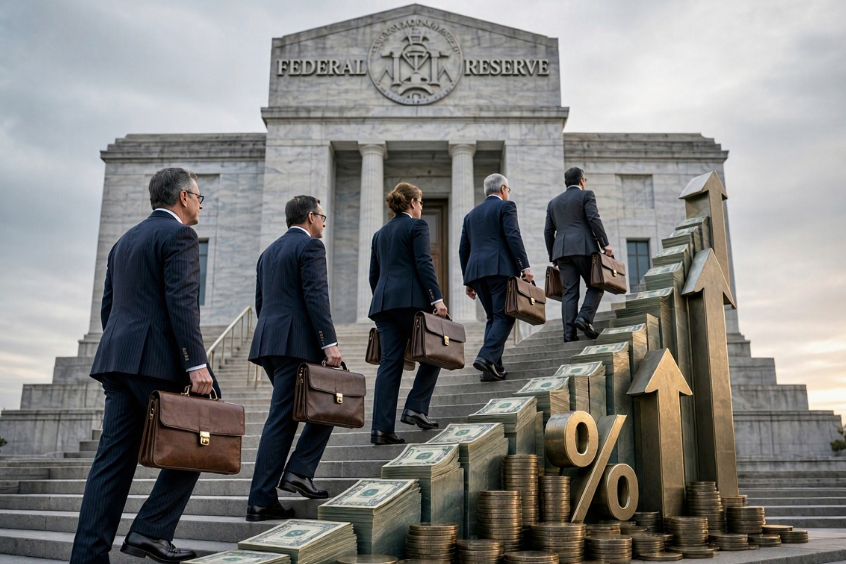
• An important question for the US Federal Reserve and investors is how restrictive is monetary policy? Often, it has been characterized as restrictive for housing by not the financial markets. And sure enough, pending home sales (signed contracts) have fallen by an eighth this year through September and are at their lowest level since 2001. September housing starts and permits will be reported today, and both are off about 1% this year. The FOMC minutes from last month’s meeting may be a somewhat more interesting than usual. Recall that in July, Fed presidents, Hammack, Kashkari, and Logan dissented in favor of a hike. The hike was delivered unanimously in September, but the stand pat decision in October saw two dissents Governor Cook and Hammack. Initially, some observers tried to dismiss Cook’s dissent as political, and the White House still is trying to force her out. Yet, it is not clear why Kashkari and Logan did not dissent. Perhaps, it is an issue of timing, and although both have indicated that more work is needed, back-to-back hikes might not be deemed warranted. The Fed’s Daly, Barr, Williams, and Kashkari speak today. Lastly, the September Treasury International Capital (TIC) report is due. Through August, foreign investors bought an average of about $112.5 bln a month of US stocks and bonds. In the first eight months of 2025, the average purchase was ~$119.80 bln a month. The average purchases in Jan-Aug 2024 were a little less than $50 bln and in the same period in 2023, the average was about $86.5 bln a month. The data simply does not support the “sell America” meme.
• On the heels of yesterday’s disappointing employment data, the UK reported October CPI. The headline pace rose to 3.6% from 3.5% in September. Service inflation was steady at 3.7%, as was the core rate at 2.8%. The swaps market has almost a 75% chance of a hike next month, net-net little changed over the past week.
• Australia reports October jobs data first thing tomorrow. It lost almost 40k jobs in September, but full-time posts grew by 34k. Still, the labor market has weakened. Unemployment has risen from 4.1% at the end of 2025 to 4.7%, even though the participation rate has been fairly steady (66.8% vs. 66.7% in December 2015). The market suspect that after five rate hikes this year, the Reserve Bank of Australia has moved to the sidelines. The futures market is pricing increasing chances of a cut starting around the middle of next year.


Comments
Log in or sign up to join the conversation.