

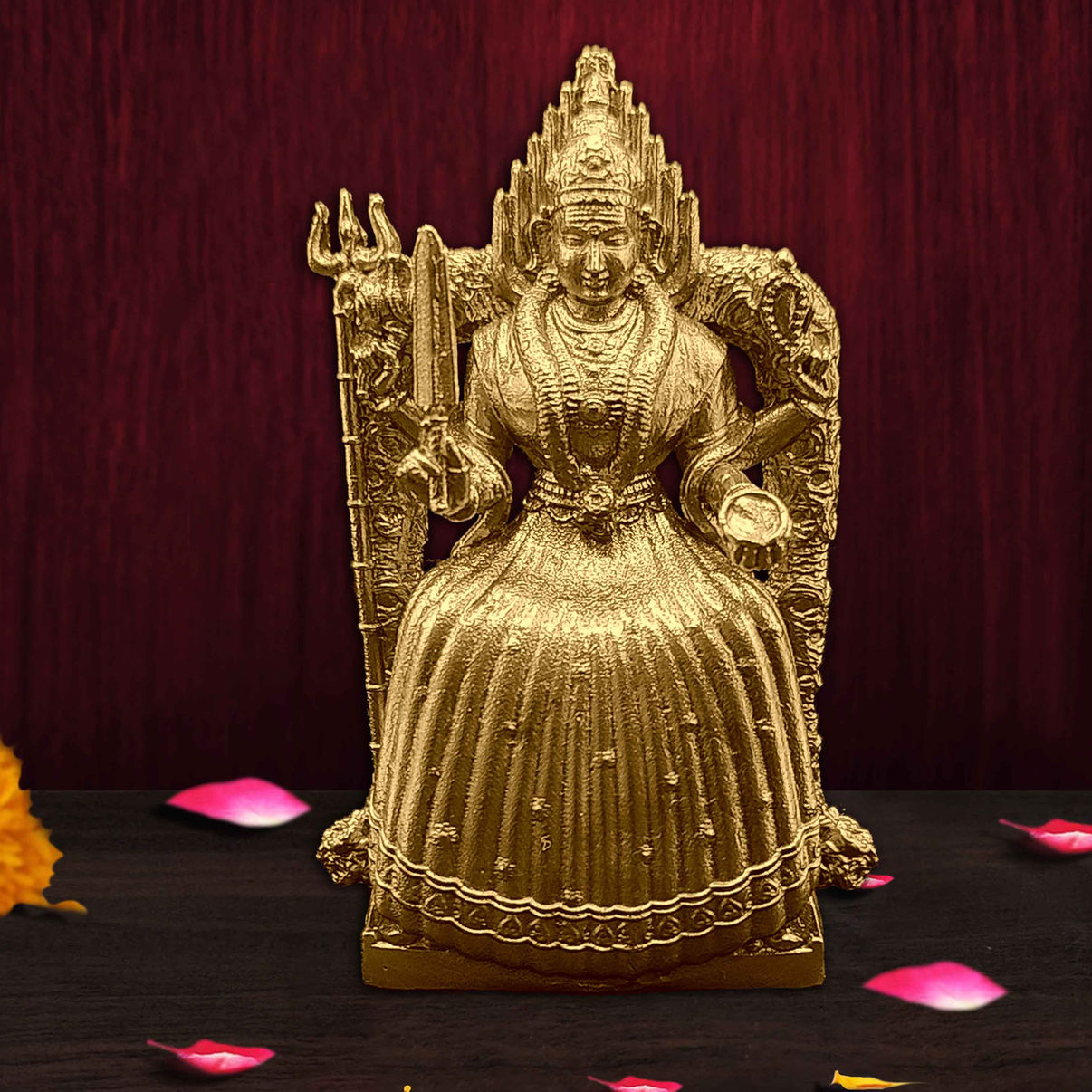
The Punnainallur Mariamman idol draws its power from one of Tamil Nadu's most revered village goddess traditions — a deity said to have manifested from the earth itself and worshipped for centuries as a protector against illness, misfortune and adversity. Enshrined near Thanjavur, Punnainallur Mariamman is regarded as a living form of Shakti, and her temple remains one of the most visited pilgrimage sites in the region.
Her story blends royal history, sacred geometry and village devotion in a way few other Amman forms do. This blog traces her origins, her symbolism and why devotees continue to bring her presence into their homes, brought to you by Idol Brass.
Who Is Punnainallur Mariamman?
Punnainallur Mariamman is a manifestation of Goddess Shakti, enshrined at the Punnainallur Mariamman Temple a few kilometres outside Thanjavur, Tamil Nadu. Unlike many temple deities carved from granite or metal from the outset, she is a self-manifested goddess — her original form rose from a white anthill, believed to be a natural dwelling place of divine feminine energy in Tamil village tradition.
Her Place Among the Ashta Shakti
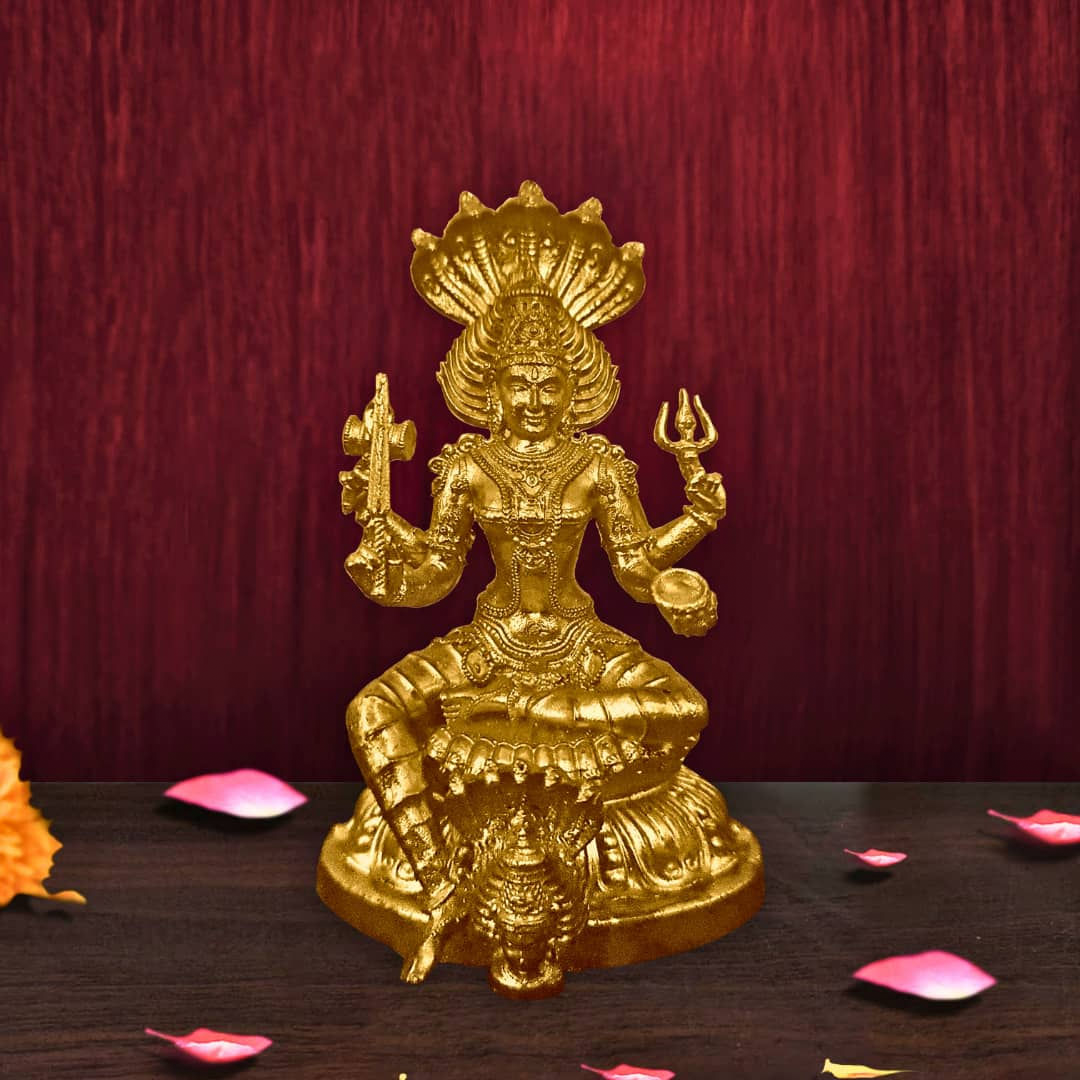
According to the temple's Sthala Purana, Punnainallur Mariamman is one of the Ashta Shakti — eight forms of the goddess that Lord Shiva stationed in the eight cardinal directions before going to battle. She is the form assigned to the east, and it is this position within a larger cosmic arrangement that gives her worship a scope beyond that of a purely local village deity.
Muthu Mariamman — The Pearl Goddess
During the summer months, devotees report seeing tiny droplets resembling pearls forming on the face and forehead of the goddess's image, a phenomenon that has earned her the affectionate name "Muthu Mariamman," or the Pearl Goddess. Small vessels of water are kept near her sanctum to ease the heat believed to build up around her at this time of year.
The Legend of Her Discovery and the King's Dream
King Venkoji's Pilgrimage and Divine Dream
Around 1680, the Maratha ruler Venkoji Maharaja Chatrapathi, a devoted follower of Mariamman, set out on a pilgrimage to the Samayapuram Mariamman temple near Tiruchirapalli. Resting under a tree along the way, he had a vivid dream in which the goddess told him she could be found not at his intended destination, but in a forest of Punnai trees a few miles from Thanjavur.
Discovery of the Sacred Anthill
Following the dream, the king travelled to the spot and found a striking white anthill standing in the forest — a sight traditionally understood as a sign of the goddess's presence. Recognising this as the very site of his vision, he resolved to build a temple around it rather than search any further.
Sadashiva Brahmendra Swamy and the Sri Chakra
The revered saint Sadashiva Brahmendra Swamy is credited with shaping the anthill into the recognisable form of Mariamman and installing a powerful Sri Chakra within the shrine. It is said that it was only after the installation of this Chakra that the goddess of Punnainallur came to be regarded as extraordinarily powerful, drawing devotees from across the region.
Punnainallur and the Sthala Purana of Tanjan Asuran
The temple's own legend connects Punnainallur Mariamman to a much older story: Lord Shiva's battle against the demon Tanjan Asuran, from whom the city of Thanjavur is believed to take its name. Before entering this conflict, Shiva is said to have stationed one of his eight Shakti forms in each cardinal direction to safeguard the region. The goddess placed in the east came to be worshipped, in later centuries, as Punnainallur Mariamman — linking a quiet forest shrine to one of the foundational myths of the Thanjavur region itself.
The Temple of Punnainallur — Architecture and Sacred Rituals
The temple King Venkoji built over the sacred anthill in 1680 has grown considerably over the centuries under the patronage of successive Maratha rulers of Thanjavur. King Serfoji II, who ruled from 1798 to 1832, added the Mahamandapa, the Narthanamandapa, a second prakaram and the temple's tall gopuram, later followed by further Kumbhabhishekhams in 1950 and 1987. Today the temple spans roughly an acre, with three prakarams, a 90-foot Rajagopuram, and several mandapams including the Arthamandapam, Dwajamandapam and Alankaramandapam.
Because the presiding image remains in its original sand-and-anthill form, no daily abhishekam is performed directly upon it — instead, the ritual bathing is offered to the Utsavar Murthy, Vishnu Durgai, enshrined nearby. Once every five years, however, a 48-day Thailabhishekam is conducted, during which devotees gather in large numbers even though the goddess herself remains behind a curtain for much of the ritual.
Spiritual Significance of Punnainallur Mariamman
Protector Against Illness and Adversity
Temple history recounts that the daughter of King Thulaja of Thanjavur, who had lost her eyesight to illness, regained her vision after offering worship here — a story that continues to shape the goddess's reputation as a healer and protector.
Manifestation of the Divine Feminine
As one of the Ashta Shakti, she represents Shakti's power made tangible and local, showing how the same supreme feminine energy can take root in a specific place and community.
The Power of the Sri Chakra
The Sri Chakra installed by Sadashiva Brahmendra Swamy is considered the true source of the temple's spiritual potency, connecting this village shrine to the broader Srividya tradition of goddess worship.
A Goddess Rooted in the Earth
Her origin as a self-manifested anthill form — rather than an idol carved and consecrated from the start — reflects a widespread Tamil belief that the earth itself can be a living seat of the divine feminine.
Compassionate Mother of the Village
Like many Amman deities across Tamil Nadu, she is approached above all as a protective mother figure, invoked for health, safety and relief from hardship rather than approached with fear.
Why Is Punnainallur Mariamman Different from Other Amman Forms
While many Amman idols are carved images installed and consecrated through formal temple rites, Punnainallur Mariamman's presiding form began as a natural anthill, only later shaped into a recognisable goddess figure by a saint rather than a sculptor. Her connection to the Ashta Shakti tradition also sets her apart, situating her within Shiva's own mythology rather than as an independent local legend. Add to this her rare "pearl-sweat" phenomenon and the unusual five-year ritual cycle in place of daily abhishekam, and Punnainallur Mariamman stands out as one of the more distinctive Amman traditions in South India.
Conclusion
Punnainallur Mariamman's story — from a dream on a pilgrim's path, to a white anthill in a forest, to a Sri Chakra that transformed a village shrine into a major pilgrimage site — reflects how deeply local devotion and larger Shakta tradition can intertwine. Her worship continues to offer comfort, protection and a tangible connection to the sacred earth of Thanjavur.
Comments
Log in or sign up to join the conversation.