

Fragility in nature is a dangerous characteristic.
Dinosaurs, for example, were large and powerful, but they still died off. Why? While there’s no shortage of theories about what led to their extinction, we do know the dinosaur’s inability to adapt and survive major shocks was a contributing factor that led to their extinction. One of the major lessons, among many, is that being large and powerful all by itself is not a guaranteed formula for survival or even thriving.
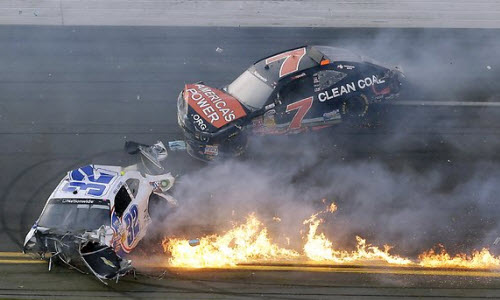
In Nassim Taleb’s framework, things that are fragile are negatively impacted by disturbances. These disturbances include chaotic events, unpredictable shocks (Black Swans, or what I like to refer to as black pianos falling from the sky), and volatility.
Fragile objects, by definition, are easily broken during periods of chaos. Think about how a delicate vase reacts during an earthquake. The vase is easily damaged with just one violent shake. It’s irrelevant how beautiful the vase looked before the earthquake or how long it took the artisan to design the vase. The vase falls victim to the destructive forces of being fragile
Getting back to dinosaurs, the extinction of certain creatures from nature provides ample evidence that fragility is a destructive force. Other fearsome species like the saber-toothed tiger and thylacine suffered a similar fate. For whatever reason, their fragility led to their permanent demise. In the context of a person’s investments, whether they be for retirement or another purpose, fragility is an acute threat to your financial well-being.
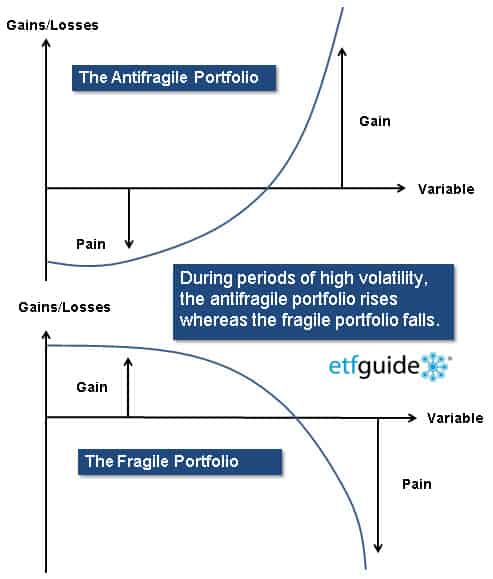
Fragile vs. Antifragile Investment Portfolios
At the opposite spectrum of “fragile” are things that resist the dangerous forces of fragility. We can describe these sort of objects or things as “antifragile.”
The benefits of designing an anti-fragile investment portfolio are only appreciated when everything seems to be going wrong. Instead of breaking during times of massive chaos, massive volatility, and a multiplicity of disorder, the antifragile portfolio actually benefits. While the fragile portfolio is vulnerable to losses, the antifragile portfolio is poised for gains. (See image above).
Rather than describing the overall framework of how to build an antifragile portfolio, which is something I do in my online classes Build, Grow, and Protect Your Money: A Step-by-Step Guide and Profit During Crashing Markets: A Step-by-Step Guide, let’s focus on the bits and pieces of the antifragile portfolio.
It’s the components of the antifragile portfolio that allow it to gain when market prices fall. For instance, inverse ETFs, which are designed to increase in value when market prices fall, are a prime example of a component within an antifragile portfolio. Beyond stocks, inverse ETFs cover an array of asset classes including bonds, commodities, real estate, and even currencies. Inverse ETFs come in three basic iterations: unleveraged, 2x leveraged, and 3x leveraged.
Put options are another type of antifragile object that can serve as a component within an antifragile portfolio. Instead of being damaged, put options and you can grow and improve during external shocks.
For the one-dimensional investor with a long only or buy-and-hold philosophical slant, both put options and inverse ETFs can serve as valuable risk management tools. Instead of liquidating an entire portfolio and incurring a large tax bill and brokerage costs when financial markets go haywire, the investor can simply insert antifragile components like inverse ETFs or put options to offset the inherent fragility of one-way long-only positions.



Comments
Log in or sign up to join the conversation.