

The 11-year US economic expansion slowed last year, and sluggish global growth along with uncertainties over trade issues made matters worse. The tight American job market also delivered slower, but still rather healthy, job gains at the end of 2019.
There are still no convincing signs of a new recession on the horizon, and despite the US economy slowing, there is no evidence to suggests that the American job creation engine has run out of steam.
Nonetheless, the seasonally adjusted payroll figures have been rather erratic on a month to month basis.
For example, in December only 145,000 new payroll jobs were created while in the previous month 254,000 job were reported.
The fourth quarter three-month average for employment gains was 184,000, still quite a respectable amount.
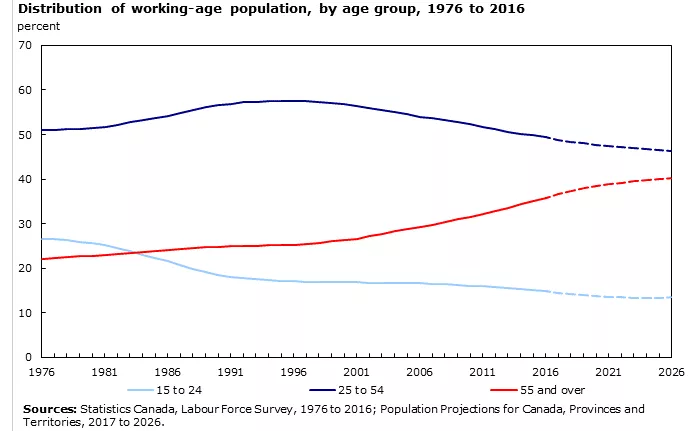
Bear in mind that roughly 150,000 new jobs are required every month simply to keep up with growth in the working-age population and to hold the unemployment rate steady. In other words, even in the recent slower-growing era, the US job market appears quite healthy.
In terms of employment, the goods-producing sector was largely flat in December, and virtually all of the jobs created last month were in the service sector of the economy.
The manufacturing industries reported a loss of 12,000 jobs in December even though in the previous month employers reported a 58,000-payroll increase. Obviously fourth-quarter manufacturing employment figures were quite distorted by the UAW strike in October.
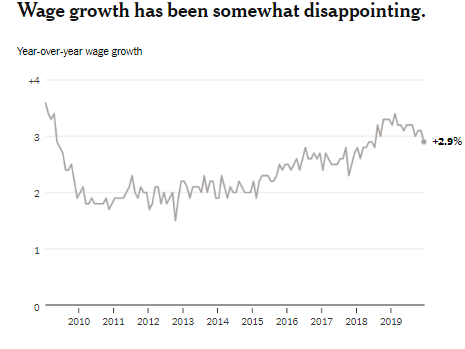
The tepid money wage picture which continued into December is both disappointing and somewhat puzzling since the overall jobs market is so tight. Average hourly earnings rose only 0.1% in December, and over the last 12 months were up 2.9%, versus 3.1% for the 12 months ending in November.
The household survey employment estimates are also quite erratic on a monthly basis. For example, US households reported a 209,000 increase in employment in December and a decline of 54,000 jobs in the previous month.
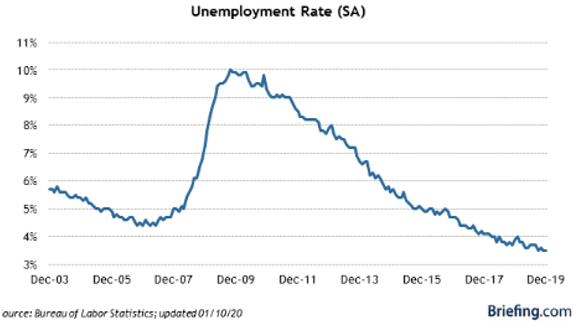
According to the household survey, the unemployment rate remained at its near all-time low of 3.5% in December unchanged from November. The broader U6 unemployment rate, which accounts for both unemployed and underemployed workers, was 6.7% in December compared to 6.9% in November.
The somewhat disappointing jobs report for December will likely not change the Fed’s current comfortable assessment about the economy and its monetary policy.
Worries that an economic downturn could be triggered by the Trump administration’s trade war with China spurred the Fed to cut interest rates three times in 2019. And in fact, economic growth did slow from the near 3% pace in 2018 to a 2.1% pace in the third quarter of 2019.
Nonetheless, assuming no major political shocks on the horizon, there is no reason to expect the Fed to change interest rates over the next six months.
(Click on image to enlarge)
(Click on image to enlarge)
(Click on image to enlarge)


Comments
Log in or sign up to join the conversation.