


Everyone is calling May an energy story. Iran spiked oil, gasoline ran, and the consensus is telling you to move along because once the geopolitical noise fades, so does the inflation print. That’s not what the data says.
CPI hit 4.2% year-over-year in May — fastest annual pace in three years, up from 3.8% in April. Bad enough on its own, but CPI is a lagging measure. It tells you what already happened. The pipeline tells you what’s coming.
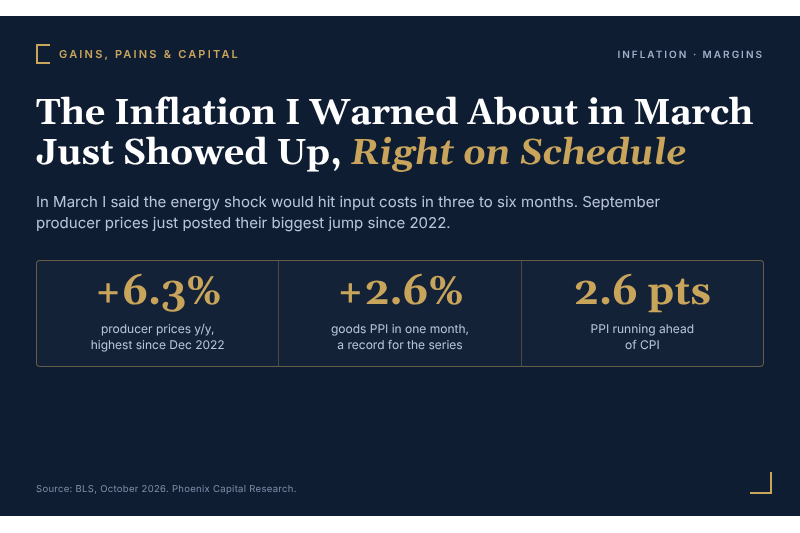
PPI — wholesale prices, what producers pay before any of it reaches the consumer — rose 1.1% in a single month. The 12-month rate is now 6.5%, highest since November 2022, and it beat Wall Street’s forecast by 57%. Economists penciled in 0.7%. They got 1.1%.
The energy excuse doesn’t hold either. Core PPI — strip out food, energy, and trade services entirely — rose 0.8% in May, the largest monthly jump since March 2022. That number has nothing to do with Iran or oil tankers in the Strait of Hormuz. That’s embedded inflation moving through the production system independent of whatever is happening in the Middle East.
Now look at the front of the pipeline. Stage 1 intermediate demand — the raw inputs that eventually become finished goods, the stuff that becomes the stuff that ends up in your cart — rose 3.2% in a single month, the largest increase since that data series began in 2009. Over the past twelve months it’s up 12.3%. That pressure hasn’t reached your grocery bill yet. It will.
This is 2021 running the same play. PPI ran hot for six straight months before CPI caught up, and every single month the Fed called it transitory, every single month the pipeline got fuller, and by the time CPI hit 9% the argument was long over. The people who positioned early walked away clean. The people who trusted the messaging got crushed.
The Fed now has no good options. Cut rates and you pour gasoline on a fire that’s already burning hotter than the headline number suggests. Hold rates and you keep bleeding a $36 trillion debt load at 5% while the economy slows underneath you. There is no clean exit from this position, and the market hasn’t priced that reality yet.
Inflation doesn’t announce itself — it builds quietly in the pipeline and then arrives at the consumer level all at once. The sequence we’re watching right now is identical to what we saw in 2021, with PPI running well ahead of CPI and the consensus still anchored to a soft landing narrative that the data stopped supporting three months ago.
Gold has been pricing this re-acceleration for months, and it wasn’t early — it was right. When CPI was still running at 2.3% in March, gold was already pushing $3,000. The market was reading the pipeline data, not the headline print. At 4.2% and climbing, with PPI at 6.5% behind it, the fundamental case for gold isn’t a trade thesis. It’s arithmetic. A dollar losing purchasing power at an accelerating rate is a dollar you want to hold less of.
The miners are where the real operating leverage sits. Mining costs are largely fixed — the drill turns, the mill runs, the overhead doesn’t change much whether gold is at $2,000 or $3,000. When the gold price moves, revenues move with it and margins explode. That’s the mechanism that re-rates junior and mid-tier miners from exploration discounts to producer multiples, sometimes in a matter of months. We’ve been in the early innings of that re-rating cycle and the BLS data out this week just confirmed the innings aren’t over.
Energy producers are in the same position. Gasoline is up 40% year-over-year at the consumer level, and wholesale gasoline rose 23% in May alone. The Iran disruption is not resolved on a 30-day timeline, and domestic producers with locked-in production are generating cash at a rate the market still hasn’t fully reflected in valuations. The lag between the commodity price and the equity re-rating is an opportunity.
What to avoid is long-duration bonds. Any fixed income with meaningful duration risk in a re-accelerating inflation environment is a slow bleed, and the Fed cannot cut aggressively with PPI printing 6.5%. Anyone still modeling three cuts this year is going to be wrong, and the portfolios positioned for that outcome are going to feel it.
The soft-landing narrative had one core requirement: inflation had to keep falling. It isn’t falling. It accelerated in March, April, and May — three consecutive months — and the upstream data suggests June won’t be the reversal the consensus is counting on. PPI running at more than double the CPI print means the pressure is building from the front of the pipeline, not fading from the back. The people telling you this is an energy blip are the same people who told you it was transitory in 2021. Position accordingly.
Comments
Log in or sign up to join the conversation.