

Greetings,
1. Let's begin with the Eurozone, where Italian bank shares were up nearly 8% on Tuesday.

What's driving this interest in Italian banks all of a sudden - other than the stimulus-driven global risk-on sentiment? One event that helped shares higher was UniCredit selling 10% of Poland’s Bank Pekao as a capital-raising exercise. The markets want to see these banks recapitalized.

Source: Google
2. Ireland's GDP growth is incredible.

Source: Bloomberg.com

Source: Bloomberg.com
Bloomberg says that this spike is "driven by companies relocating to Ireland". Some have also suggested that as a tax-haven, Ireland's GDP is not easy to determine (so many SPVs, so little time). Nonetheless, if this is real, the 12.5% corporate tax rate is working out well for Ireland. Will the UK follow?

Source: @wef
3. QE is good for indebted nations - at least in the near-term. For example, private sector debt ratio for Portugal stands out. Inflation eases some of that pressure on Portugal's households - just need more of it.

Source: Barclays, @joshdigga

Source: Barclays, @joshdigga
Similarly, QE continues to reduce Italy's borrowing costs. Of course, there is the matter of moral hazard - but that's a discussion for another day.

Source: HSBC, @joshdigga
4. Speaking of QE, here is the 3-month Euribor rate.

Source: quandl.com
1. Continuing with Europe, it turns out that 40% of the EU budget goes to landowners and farmers.

Source: @joshdigga
2. Sweden pulls out of deflation. It seems that inflation is picking up across Scandinavia.

3. According to the FT, "the UK's pension deficit has widened to a record £383.6bn". As gilt yields remain near record lows, this situation is only going to get worse.

Source: @fastFT
4. The British pound is grinding higher, with some investors viewing that currency as being oversold. Reduced uncertainty in the UK political scene certainly helps.

Source: Investing.com
The sterling-yen recovery over the past couple of days has been especially sharp.

Source: @barchart
Dollar-yen rallied further on the BoJ stimulus bets. Global markets will react violently if the central bank disappoints.

Source: Investing.com
The BoJ certainly has the justification for more QE acceleration, as Japan's wholesale price index (roughly PPI equivalent) shows worsening deflationary pressures.

Source: Goldman Sachs
1. Switching to China, growth momentum in the Chinese economy slowed in late 2Q. Will the PBoC implement additional easing, such as cutting the RRR (bank reserve requirement)?

Source: Citi, @joshdigga
2. Investors continue to be concerned about China's financial stability as the bloated corporate debt market faces some headwinds.

Source: Citi, @joshdigga
3. Wage growth in China moderates - which gives the PBoC some cover to ease.

Source: Goldman Sachs
4. Perhaps due to stimulus expectations (and helped by the global risk-on sentiment), China's stock market is attempting to rally again.

1. In other emerging market developments, easing financial conditions across EM economies should help stabilize growth.

Source: Goldman Sachs
2. Which EM nations will be most impacted by the situation with the UK/EU?

Source: Citi, @joshdigga
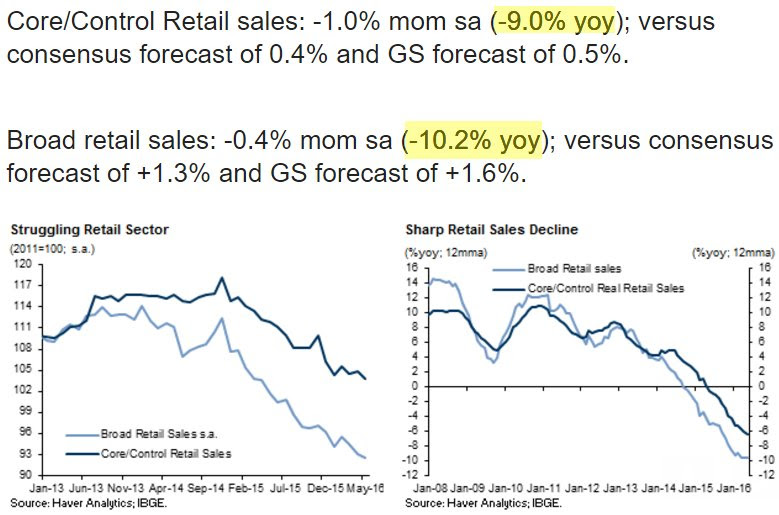
3. Brazil's retail sales report was a disaster, and no improvement is expected in Q3.
Source: Goldman Sachs
4. As funds flow into emerging markets debt, India's government bond yields hit the lowest level since 2013 (pre-taper-tantrum).

Now, a quick note on Canada's property markets. A great deal of the national housing index spectacular rise (chart in yesterday's Daily Shot) has been driven by Vancouver.

Source: @tpasturel
Of course, there is quite a bit of speculative activity in Toronto as well. Notice, for example, the bulk of the lights being out in the residential towers next to the Rogers Centre. Similar to New York City, condos are often just an investment by foreigners - a way to move some money into a "friendlier" jurisdiction.

Source: @ac_eco
1. Back in the United States, the Citi US economic surprise index continues to move higher.

Source: Yardeni Research
2. Labor quality remains a problem for US small business (skills gap).

Source: @NFIB

Source: @NFIB
3. US small business sentiment (NFIB) has diverged from the nation's consumer sentiment. Small business owners seem to be quite frustrated.

Source: @Callum_Thomas
4. US wholesale inventory growth eased, while inventory/sales ratio has stabilized, albeit at elevated levels.


5. US job openings in May were softer than expected - the year-over-year growth stalled. Will we see an improvement in the June figures corresponding to the payrolls report?

6. The current mini-refinancing wave seems to be quite sensitive to US mortgage rates. If rates rise just a bit, the refi activity will slow significantly.

Source: Goldman Sachs

1. Now on to commodities where crude oil was up over 4% on Tuesday.

Source: Investing.com
2. The decline in North American crude oil production has been partially offset by increases from Iran, Iraq, and Saudi Arabia. Supply disruptions are easing. It's hard to make a short-term bullish case for crude.

Source: Citi, @joshdigga

Source: Citi, @joshdigga
3. Copper was up 3% on stimulus hopes.

Source: @barchart
4. US cotton futures go vertical as funds move in.

Source: @barchart
5. Iron ore, Shanghai steel prices, coking coal - are all moving higher.

Source: @barchart

Source: @barchart

Source: @barchart
While Australia's business sentiment has been on the uptrend since 2014, the above market trends certainly helped to push it higher.

6. MarketWatch has a trading tip for you.

Source: MarketWatch

Source: MarketWatch
Indeed, US live cattle futures are at the lowest level since 2010.

Source: @barchart
1. In the fixed income markets, treasuries sold off sharply after a weak 10y note auction. Does this indicate a reversal in the rates trend? What does it mean for the equities markets?

Source: @barchart
2. US high yield default rate hit the highest level in 6 years on struggling energy names. The recovery rate dives.

Source: @FitchRatings

Source: @FitchRatings
3. At the same time, US HY bonds continue to beat the S&P500 (YTD), despite the equity markets hitting new records.

Source: Ycharts.com
Year-to-date, small caps are now ahead of the S&P500.

Source: Ycharts.com
In asset management, investors seem to be exiting hedge funds because of specific funds' underperformance rather than by shifting asset allocation away from hedge funds.

Source: @NickatFP, Credit Suisse
Turning to Food for Thought, we have 5 items this morning:
1. US government raises revenue in a way that is out of step with the rest of the OECD.

Source: @taxfoundation, @kpomerleau
2. Very different risk of poverty by age cohort between Spain and Germany.

Source: HSBC, @joshdigga

Source: HSBC, @joshdigga
3. According to Pew, smartphone ownership rates skyrocket in many emerging countries, but the digital divide remains.

Source: @pewinternet, @JmBadalamenti
4. According to the Economist, "activists dominated America's primaries, but it's the moderate voters who count in November".

Source: @ECONdailycharts
5. The WSJ asks "why are so many men dropping out of the labor force?"

Source: @WSJecon


Comments
Log in or sign up to join the conversation.