

We start with some observations on the latest developments in the global credit and rate markets (from Merrill Lynch, Citi, CS, Morgan Stanley and others).
Bank Credit
1. Bank CDS spreads are catching up with bank bond spreads which have been widening since last summer. This feels overdone - the US banking system is the healthiest it's been in years (even as returns on equity soften).

Source: BAML
2. Related to the above, here is the share price to book ratio over time for the major US banks. The current environment is NOT 2008 or even 2011.

Source: @ForbesInvestor, h/t Jake
3. Deutsche Bank's newest bondholders are unhappy with DB buying back its bonds at market. Apparently the latest issuance came out before the weak earnings results were made public. The bondholders are complaining that they have been misled - and now they would take a loss selling the paper back to DB.

Source: Bloomberg.com
4. European bank CDS trading volumes have surged.

Source: @acemaxx, @business
5. Will the pressure on European bank shares reverse the recent improvements in Eurozone's credit growth?

Source: @enlundm
Corporate Credit
1. US investment grade bonds have outperformed high yield on a relative basis.

2. Related to the above, here we have the year-to-date fund flows for select asset classes.

Source: BAML
3. The spread between energy and non-energy corporate credits continues to rise.

Source: Credit Suisse
4. US investment grade credit spreads have been highly correlated to the equity markets recently.

Source: BAML
Credit Dislocations
We've had a number of market dislocations recently. Spreads between corporate bonds and CDS, swaps and treasuries, CDX (index) and single-name CDS - are all sharply lower. A decade ago these dislocations would get arbitraged out, but not today.

Regulatory pressures make the arb difficult as banks conserve balance sheet usage by charging higher rates on repo financing. Moreover, single name CDS trading has become very expensive in terms of margin requirements.

Source: Citi Research
Citi also attributes the differences in swap spreads and bond-CDS spreads across currencies to the recent central bank activities.

Source: Citi
Rate Hike/Cut Expectations
1. As discussed on Friday, the last few weeks saw the most dramatic shift in market expectations of the Fed policy trajectory in years (possibly the fastest on record). This chart is just spectacular.

2. In the UK the situation has been similar.

Source: @acemaxx, @MorganStanley
3. In the Eurozone the markets now expect rates to be cut by 23bp this year - deep into negative territory.

Source: @acemaxx, @MorganStanley
4. In Australia the markets are betting on another RBA rate cut shortly.

Source: @markets
5. In fact here are the expectations for rate hikes/cuts priced into the market this year - now vs. a year ago. Hopefully the Fed is paying attention.

Source: @acemaxx, @MorganStanley
Negative Rates
Option-implied probability of negative rates in the US as well as the demand for those options has risen sharply.

Source: BAML
Flatter Yield Curves
1. The treasury curve continues to flatten as longer-term US growth expectations are reduced.

2. As discussed last time, the short end of the curve is also flattening - quite sharply.

Source: BAML
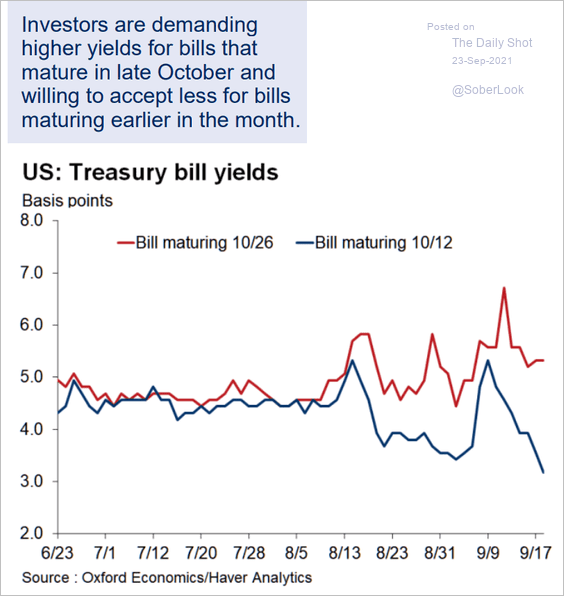
Here is the flattening in the treasury bill curve and the GC repo curve

Source: BAML
3. The US Treasury is expected to inject more bills into the market (based on higher demand), shortening the average US government liability. Note that this is also helping to flatten the yield curve.

Source: BAML
Let's continue with select economic indicators from the US.
Inflation Expectations
1. Longer-term market-based US inflation expectations are at the lowest levels since 2009.

Source: @SoberLook
2. Moreover, the UMichigan long-term consumer inflation expectations are now the lowest on record. The Fed can dismiss the TIPS indicators (above) as "transient". Are the consumer expectations also transient?

Source: Investing.com
Business Sales and Inventories
1. This chart shows US total business sales and the dollar.

Source: @SoberLook
2. Speaking of the stronger dollar, some may remember Friday's chart showing the dollar trading at 19 pesos to the dollar. Here is an example of what that does. Once again, this should be a message for the FOMC: US dollar strength is not just about weaker US exports. It's also about loss of domestic jobs. Some of the Fed's economists should be revising their "static" models.

Source: IndyStar
3. Also related to strong US dollar, here is the latest US inventories-to-sales ratio.

Financial Conditions
1. US Financial conditions have tightened considerably, which will clearly create headwinds for growth.

Source: @ReutersJamie, GS, h/t Ed Bozaan
2. Related to the above, the Credit Suisse Global Risk Appetite Index has been in panic mode this year. As discussed before, this can be a good contrarian indicator.

3. US narrow money supply (M1) growth slows - a sign of tighter credit conditions?

Source: @SoberLook
US Consumer
1. We can see the consumer becoming a bit jittery. The chart shows the divergence between UMichigan consumer current conditions and future expectations.

Source: UMichigan, @SoberLook
Similarly, we see some unease in the Gallup economic confidence index. Nevertheless, confidence remains robust on a relative basis.

Source: Gallup
2. US retail sales actually surprised to the upside as consumers continue to spend.

Source: @calculatedrisk
The two key trends helping the US consumer are low gasoline (and heating fuel) prices as well as lower mortgage rates (at least for those who can take advantage of that).

Source: @stlouisfed

Source: @stlouisfed
3. The Atlanta Fed GDP tracker model (GDPNow) is now predicting a 2.7% Q1 GDP growth. At this point it's hard to take this analysis seriously.

Source: @AtlantaFed
Now let's take a look at a few developments in other economies.
Canada
Here is some commentary from BAML on Canadian deficit projections and a response Norm Mogil (Daily Shot reader and SoberLook.com contributor).

Source: BAML

Source: Norm Mogil
The Eurozone
1. Greek recession is worse than consensus. That's what happens when the banking system freezes. Note that as discussed earlier, the pressure on European bank shares is a bad sign for credit growth across the euro area.

Source: Investing.com
2. Eurozone industrial production misses forecast, unexpectedly contracting. This is the same trend we are seeing in the US, UK, and Japan. China's industrial production growth is the lowest in decades.

Source: Investing.com
3. Here is a longer-dated GDP growth comparison - quite amazing.

Source: @jsblokland, h/t Ed Bozaan
Asia
1. China's trade surplus hits a new record.

Source: Investing.com
2. Here is Indonesia's export growth (YoY). A great deal of this is due to raw materials price collapse.

Source: Investing.com
3. Japan's Q4 GDP growth misses forecasts.

Now let's review some trends in the equity markets.
Valuations (from Callum Thomas)
1. Ex-energy, US shares look reasonable on a forward P/E ratio basis.

Source: @Callum_Thomas, Yardeni Research
2. Insider transactions are positive for shares.

Source: @hmeisler, @Callum_Thomas
3. Morningstar valuations also show stocks in a "reasonable" valuation territory.

Source: @Callum_Thomas
4. However, will we continue to see further deterioration in corporate margins as prices decline while wages grow (albeit gradually)?

Source: @jessefelder, Business Insider, JPMorgan
Performance
1. Mining firms are outperforming this year.

Source: @SoberLook
2. China's shares open lower after the holidays, but better than some had feared.

3. The Nikkei 225 index is up 6% today.

4. In spite of the equity bounce in the US on Friday, Saudi shares sold off again this weekend.

Finally, the long US dollar trade has been unwinding. Are we about to see a bounce in the dollar?

Source: @SaraEisen, @merrillmatter
Tomorrow we will have a discussion on the latest developments in the energy markets.
Turning to Food for Thought, we have 5 items this morning:
1. It's interesting to see Saturday night's GOP debate impacting South Carolina's odds in real time.

Source: @pivt
2. Americans with small kids should take a look at the projected college tuition in 18 years. Scary.

Source: savingforcollege.com, h/t Jake
3. Justice Scalia has been the most written about Supreme Court Justice in the 2000's.

Source: @FiveThirtyEight, h/t Jake
4. Total debt by age in 2015 and in 2003.

Source: @Schuldensuehner, WSJ
5. Child poverty rates in developed economies.

Source: @Ian56789


Comments
Log in or sign up to join the conversation.