

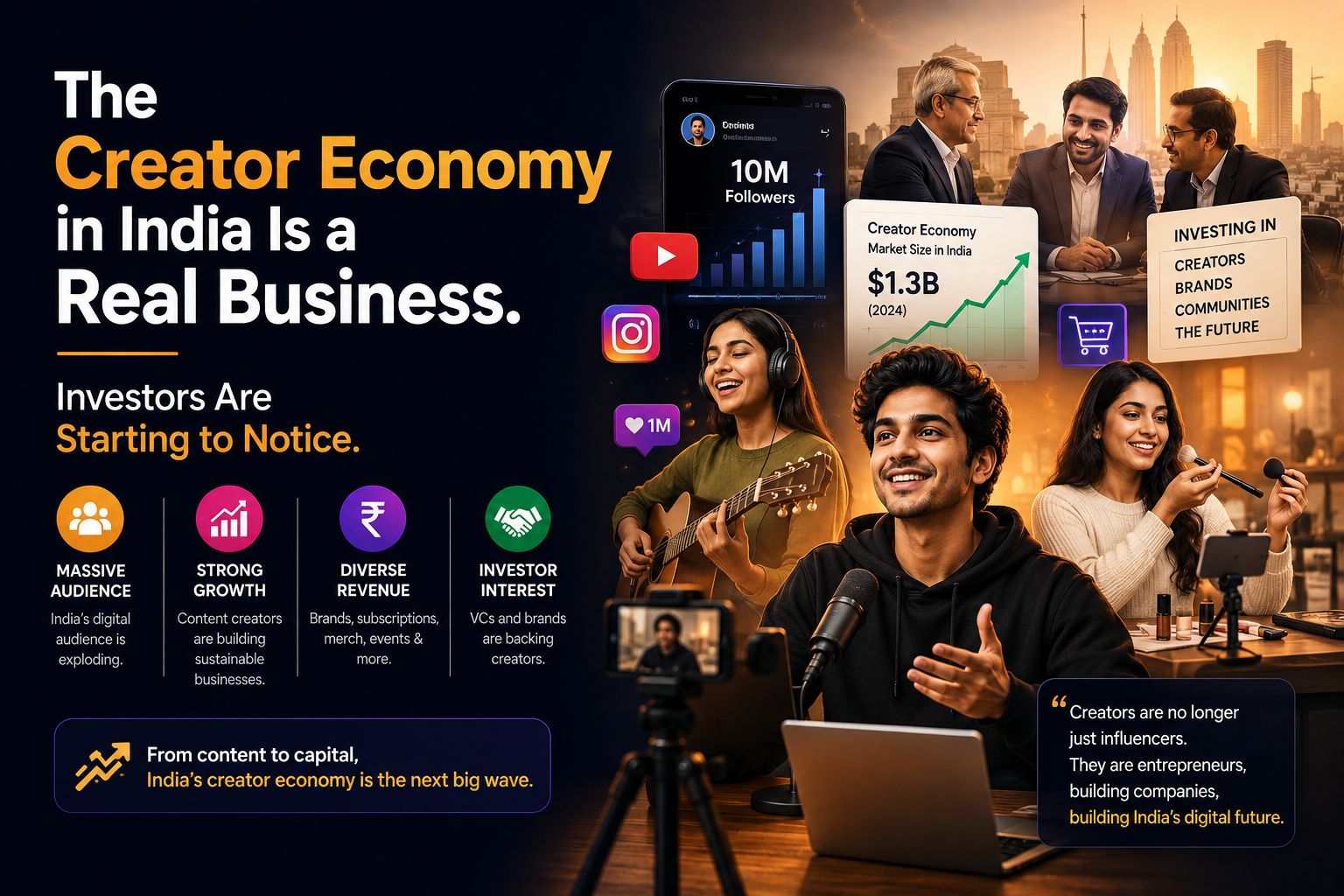
India added over 100 million internet users in the last three years. A large portion of them did not just come online to consume content. They came to create it.
The Indian creator economy is now estimated at over $1 billion and is growing at roughly 25% per year. That puts it among the fastest expanding segments of India's broader digital economy, which itself is projected to reach $1 trillion by 2030. For investors and business analysts tracking emerging market opportunities, this is no longer a niche trend. It is a measurable market.
What Creators Are Actually Spending On
Content creation in India has moved past a hobby stage for millions of people. Instagram and YouTube are the two dominant platforms, and both require consistent growth in measurable metrics to unlock income. For YouTube, that means hitting 1,000 subscribers and 4,000 watch hours to qualify for the Partner Program. For Instagram, it means building enough reach and engagement to attract brand deals, affiliate partnerships, or direct product sales.
To reach those thresholds faster, creators are spending real money on growth services. This includes views, subscribers, watch hours, and engagement packages. The market for these services in India has grown alongside the creator economy itself.
One factor driving this spending is platform-level friction. Instagram's algorithm makes early-stage organic growth difficult. A new Reel with no initial engagement gets suppressed within the first hour of posting, regardless of content quality. Creators who understand this dynamic treat early view counts as a distribution cost, not unlike how a small business treats paid advertising spend.
Why INR Pricing Matters in This Market
Most social media growth platforms were built for Western markets and price their services in dollars. For Indian creators paying through UPI or local debit cards, this creates friction. Currency conversion costs, international transaction fees, and card restrictions all add up.
Platforms that offer the ability to buy instagram views in inr remove that friction entirely. INR-based pricing with local payment options lowers the barrier for the large segment of Indian creators who do not hold international cards or foreign currency accounts. This is not a small segment. India's creator base is predominantly young, tier-2 and tier-3 city based, and largely unbanked in the traditional international sense.
The Business Case Behind Social Proof
From a pure business perspective, social proof on content platforms functions the same way foot traffic functions for a retail store. A video with 10,000 views signals credibility. A Reel with low engagement signals the opposite. Brands that allocate influencer marketing budgets in India use engagement metrics and view counts as primary filters when selecting creators.
This creates a straightforward business logic for early-stage creators. A modest spend on views at the start of a content strategy can affect brand deal eligibility, affiliate program access, and algorithmic reach in ways that compound over time. Treated as a customer acquisition cost rather than an expense, it fits cleanly into a creator's early growth budget.
What the Market Looks Like Going Forward
India's creator economy is still in its early innings. Penetration of monetized creator accounts remains low relative to the total number of active content creators. As more platforms localize their payment infrastructure and more brands shift ad budgets toward influencer marketing, the gap between supply and demand for creator growth services will likely widen.
For investors watching the digital economy in India, the creator services segment is worth tracking. It sits at the intersection of fintech, adtech, and the broader consumer internet. The businesses serving this market, particularly those built around local payment infrastructure and India-first pricing, are positioned well for the growth ahead.
Comments
Log in or sign up to join the conversation.