

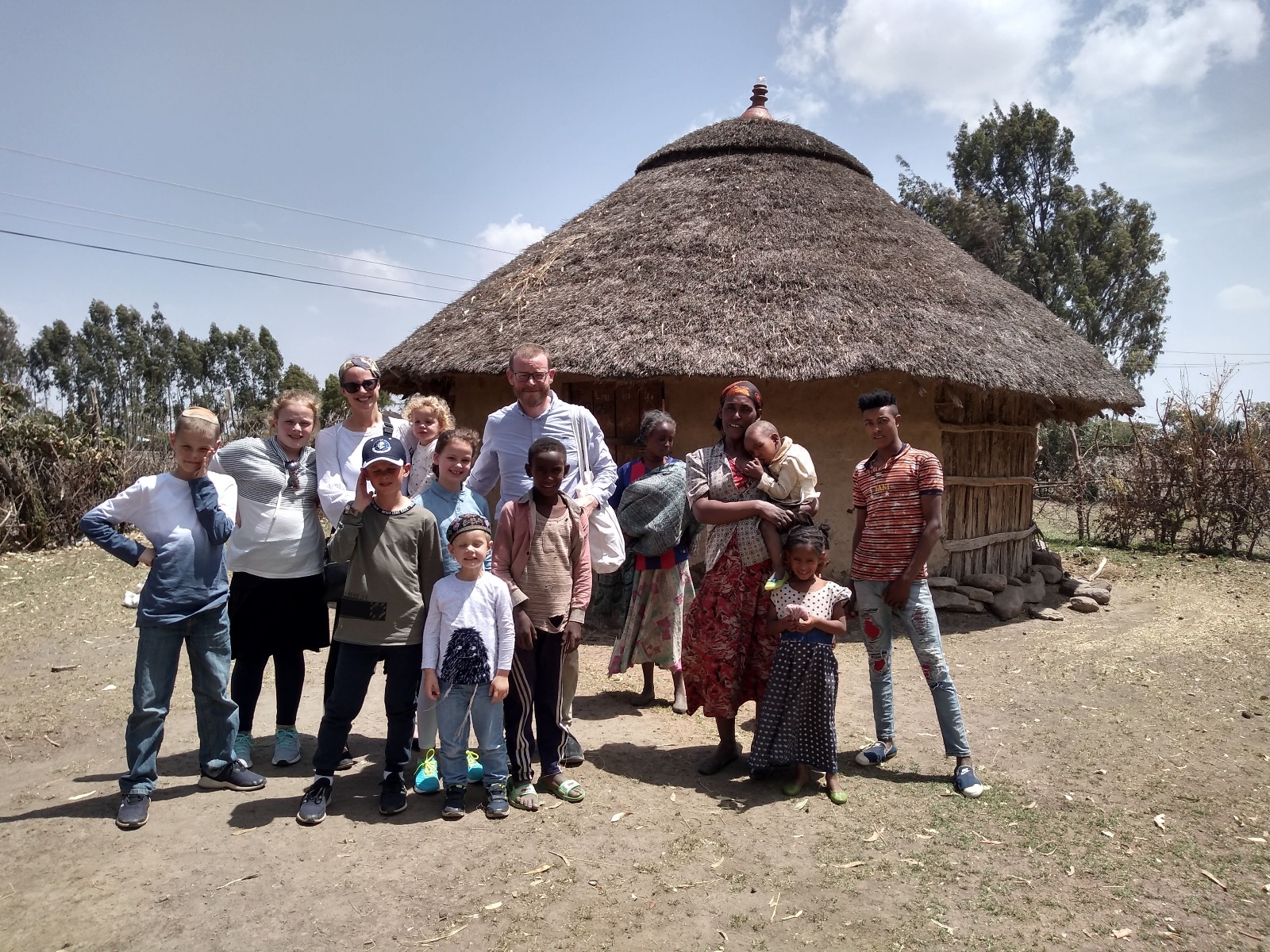
The author and his family in Ethiopia, 2019
My mother was a philosopher whose life work could be boiled down to one sentence: prioritizing only one good inevitably leads to great evil.
While my mother passed away before the arrival of the Wuhan Respiratory Syndrome, it is not hard to imagine how she’d react to today’s reality.
Earlier this year a locust swarm spread from Yemen to a massive part of East Africa. An area larger than Syria was stripped of its crops. This swarm was engendered by wet weather and wars that prevented the spraying of pesticides. The Wuhan Respiratory Syndrome had nothing to do with it. Now, the locusts have multiplied. The new wave is 20 times larger than the first. The UN is warning that it could consume 2 million square miles of pastureland – about half the size of Western Europe.
130 million East Africans face starvation.
Unlike the first swarm, these deaths were entirely preventable. East African nations were asking for $70 million in emergency assistance to stop this swarm. They needed helicopters and pesticide. In the end, they got neither. Because of the COVID-19 shutdowns, the supply chain needed to support their battle just wasn’t there.
130 million East Africans face starvation. Our laser focus on saving several hundred thousand Western lives has led directly to this.
There are other predictable side-effects. Much of the third world depends, directly or indirectly, on wealthy nations’ consumption of raw materials. In West Africa 4 million people and their families live on less than $3 a day. They are cocoa farmers. The trade in their product has vanished. They aren’t watching Netflix (NFLX) and hoping the crisis will pass. While we lack reporting, it is not difficult to imagine that they are facing mass starvation. Their children are dying as you read this.
Unlike the normal African catastrophe, these deaths aren’t caused by their some regional war, or systemic governance issues. These deaths are being caused by our lockdowns.
Globally, the World Food Organization is reporting that the economic effects of our shutdowns could leave over 130 million additional people facing starvation by the end of 2020.
Together with the locust infestations that is over a quarter of a billion people facing preventable starvation.
Prioritizing only one good inevitably leads to great evil.
The sad irony of this is that our efforts to sacrifice in the face of the Wuhan Respiratory Syndrome might not actually save many lives. While those in the developing world can’t survive a month without work, Western economies can’t survive a year. We won’t have a vaccine by next March. Nonetheless, we will be forced to reopen. And the virus, which will never leave the third world, will come back to every country that can’t completely seal its borders.
In the end the cost of our efforts won’t just be borne by faraway Africans. The bill will come to us as well. Our shutdowns will lead to healthcare systems that will be unable to deal with the regular cadence of illness. Over 12 million Europeans and Americans die annually – of causes other than the Wuhan Respiratory Syndrome. Many more become seriously ill. Our economic collapse will prevent us from affording the same level of care. And our supply chain issues will mean that even money won’t be able to buy the supplies and equipment needed to save lives. This year, we failed to deliver pesticides to save millions in East Africa. Next year, we may well fail to deliver the vast array of products necessary to sustain a modern hospital.
This is a marathon. Winning the first 100 meters might actually hurt your chances of coming out ahead in the long term.
What can we do now?
First, we should stop acting as if those calling for an end to the lockdowns are somehow immoral or callous. We should argue about the impacts of our options, but not brand those we disagree with as immoral people. These seems like a lesson today's US needs more than ever before.
Fundamentally, our choices have to be considered without the hysteria and moral opprobrium that has dominated this crisis. This is a complex and evolving situation with many unknowns - we all need to be a bit more humble.
Second, we should call on our leaders to help with problems other than the corona virus. I live in Israel. Israel has 14 Air Tractor firefighting aircraft. We should engineer whatever pesticide we can and fly it and these aircraft to Ethiopia. We should spray as many locusts as possible. We can’t stop the infestation at this point, but an intense effort by one little country could easily save as many lives as Italy has lost in the entire corona outbreak.
We cannot serve just one good. Even the preservation of life has its limits. It is time for us to open our eyes and focus on doing the best we can, across a wide range of priorities.
No matter how good the intentions, prioritizing only one good will inevitably lead to great evil.



Comments
Log in or sign up to join the conversation.