

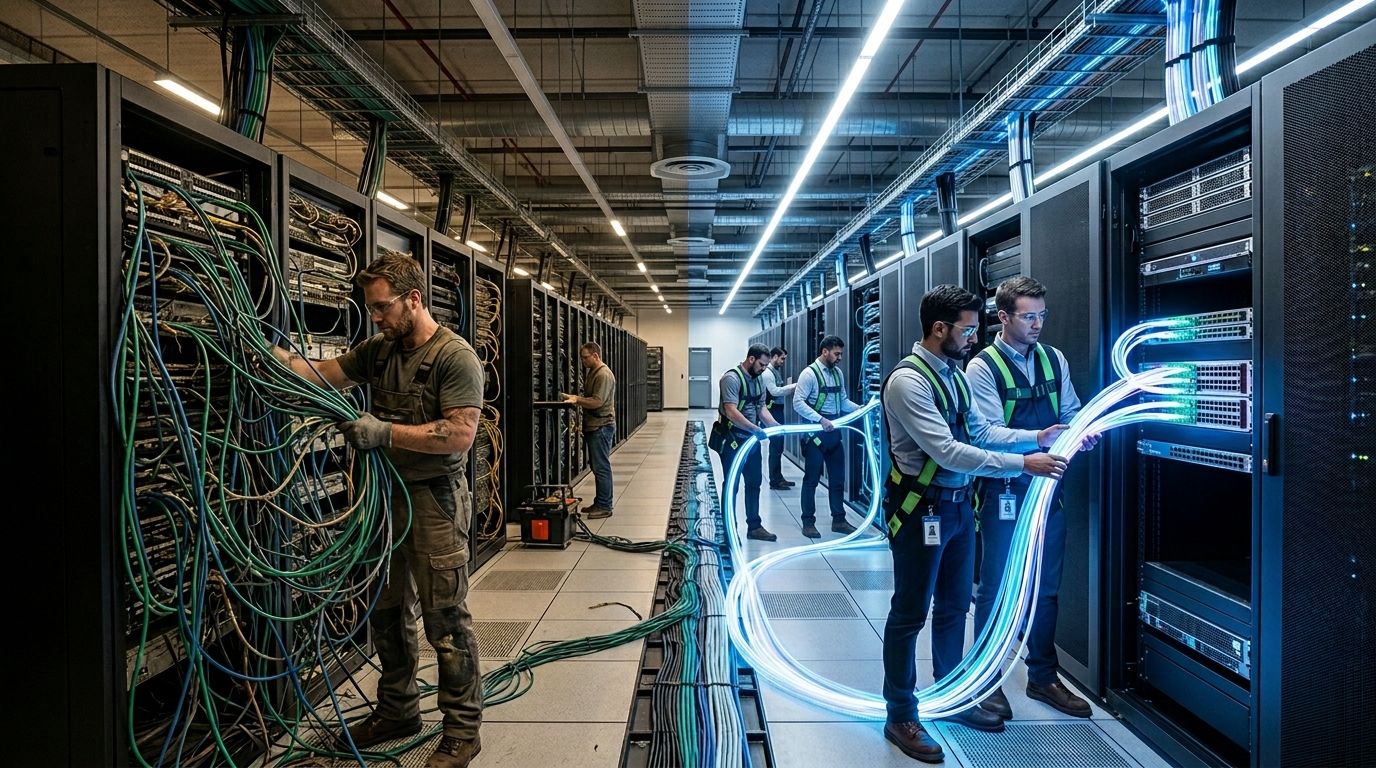
In corporate finance and operations analysis, management teams routinely spend hours optimizing software stacks, cloud migration plans, and database performance. However, a company's day-to-day operational ceiling is frequently dictated by something far simpler: the physical wires running through its walls.
For growing businesses expanding their footprints—whether moving into multi-floor corporate offices, scaling healthcare facilities, or deploying automated fulfillment hubs—relying on legacy copper local area network (LAN) infrastructure introduces a continuous, hidden cost.
As modern networks shift to support high-density concurrent workflows, understanding the physical limitations, systemic vulnerabilities, and capital asset implications of copper versus lightwave transmission becomes a operational necessity. Evaluating how Dallas businesses upgrade to fiber cabling highlights a notable market shift. Companies are increasingly moving capital expenditure toward high-performance optical backbones to protect themselves against operational bottlenecks and technical obsolescence.
The Economics of Attenuation and Hop Architecture
Traditional structured wiring frameworks depend on copper media, like standard Cat6 or legacy Cat5e cables, which use electrical impulses to transmit data. This design presents specific physical limitations that increase ongoing operating costs.
1. The 100-Meter Distance Limit
The laws of physics impose a strict maximum distance restriction of 100 meters (approximately 328 feet) on copper data runs. Beyond this point, attenuation occurs, which is the progressive degradation of signal strength that compromises data integrity.
When a commercial facility exceeds this 100-meter footprint, an IT department cannot simply run a longer cable. Instead, the business must invest in secondary, localized infrastructure. This requires setting up intermediate distribution frames (IDFs), dedicated telecom closets, active network switches, environmental cooling units, and backup power supplies.
This multi-closet layout converts a single physical network asset into a fragmented series of cascaded hardware dependencies. Each additional active hop introduces cumulative processing delays at the switch level and increases the overall probability of system failure. If one intermediate switch fails, entire wings of the building lose connectivity.
2. Packet Loss from Electrical Noise
Because copper lines operate as electrical conductors, they are highly susceptible to Electromagnetic Interference (EMI) and Radio Frequency Interference (RFI).
Routing copper communication lines adjacent to high-voltage conduits, industrial motors, elevator shafts, or heavy HVAC equipment distorts data packets. This physical interference results in chronic packet drop rates. At a macro level, the network must continuously retransmit corrupted frames, which degrades local bandwidth and causes unexplained applications lag that software analytics cannot trace back to a source.
Structural Consolidation Through Optical Architecture
Upgrading a commercial facility to a structured fiber optic backbone alters the underlying physics of the company's communication pipeline. Fiber optic cables utilize modulated light waves transmitted through glass or plastic cores, removing the traditional barriers associated with legacy copper wire networks.
Instead of building a fragmented infrastructure with multiple active tech closets, a fiber optic backbone allows for a centralized network design.
Because optical signals travel long distances with minimal signal loss, single-mode or multi-mode fiber can run continuously from a centralized main server room to remote endpoints miles away. This completely eliminates the need for intermediate switches, mid-span boosters, or extra telecom closets. As a result, businesses reduce ongoing equipment maintenance, replacement hardware costs, and utility expenses.
Furthermore, light waves do not interact with electromagnetic fields. This means fiber optic paths can be routed through dense industrial environments and directly alongside high-voltage electrical lines without experiencing signal degradation. This structural resistance ensures a stable data stream, removing localized network drops caused by industrial machinery or heavy office appliances.
Strategic Implementation and Long-Term Value
Migrating an active commercial property from legacy copper wiring to a structured fiber framework requires adherence to precise network engineering protocols. A compliant deployment follows a clear, four-stage lifecycle:
Optical Loss-Budget Analysis: Engineers assess the physical environment to map optimal pathways and calculate exact optical loss budgets, ensuring that light transmission remains stable across all terminals.
Pathway Engineering and Support: Installers deploy structured containment systems, including heavy-duty J-hooks, cable trays, and protective conduits, to protect the glass cores from physical stress, micro-bends, or compression.
Automated Fusion Splicing: Technicians utilize advanced automated fusion splicing machinery to align microscopic glass cores. An electric arc permanently melts the strands together, ensuring seamless light transmission with minimal insertion loss.
OTDR Certification Testing: Every fiber strand is validated using calibrated Optical Time-Domain Reflectometers (OTDR). This hardware generates trace reports certifying full compliance with international TIA/EIA industry standards, providing the company with full operational documentation.
Future-Proofing Corporate Real Estate
As enterprises continue to adopt data-intensive operational frameworks—such as real-time cloud database syncs, multi-channel video conferencing, and automated edge devices—the physical data layer will remain a critical variable in corporate efficiency. Investing in a certified fiber optic backbone offers a long-term hedge against technological obsolescence.
While network transmission protocols and endpoint hardware will inevitably advance over the coming decade, the underlying glass infrastructure can scale to accommodate higher speeds without needing to be extracted or replaced. For a practical, real-world analysis of this technological shift and its direct impact on commercial operations, review the strategic data available in the Dallas businesses upgrade to fiber cabling industrial report.
Comments
Log in or sign up to join the conversation.