


Oil prices have eased amid hopes of some de-escalation between the US and Iran. Yet risks to Saudi oil exports from the Red Sea are increasing
Energy - Hopes for de-escalation ease oil prices
Oil prices closed higher yesterday but retreated from session peaks, leaving Brent back below $90/bbl by the close. Prices are trending lower in early morning trading today. There’s some hope of de-escalation between the US and Iran. Reports are that mediators are proposing a 10-day ceasefire, which could put the Memorandum of Understanding (MoU) back on track. This won’t be an easy task. Large divisions remain between the US and Iran. And President Trump said the US would retaliate following the deaths of several American troops.
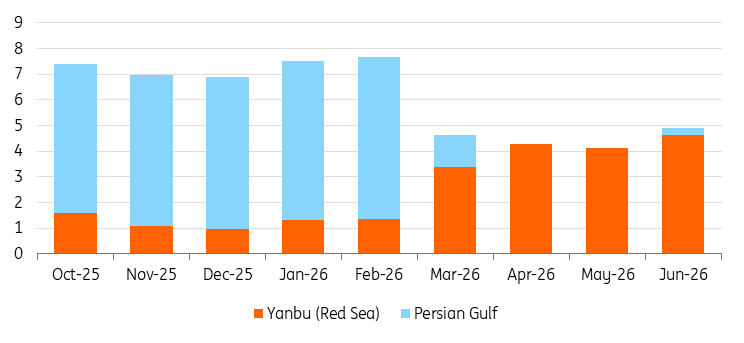
Additionally, the Houthis in Yemen announced a naval blockade on Saudi Arabia, putting oil supply at increased risk. Since disruptions hit the Persian Gulf, the Saudis have increased exports from Yanbu in the Red Sea, shipping around 4.6m b/d of crude in June, up from around 1.3m b/d at the start of the year. An effective blockade would prevent oil flows to Asia moving south via the Bab el-Mandeb Strait. Instead, vessels would have to take the much longer route through the Suez Canal and go around Africa. It’s yet to be seen how effective any blockade will be. But, clearly, this development will increase insurance costs. If shippers decide to avoid the Bab el-Mandeb Strait, voyage times will be longer and more expensive. Looking at oil price action this morning, the market is not convinced that this blockade will be successful.
The latest output data from China shows the pressure that refined products output is under as refineries reduce run rates amid the US-Iran war. Gasoline production in June fell 14.1% year-on-year to 10.75m tonnes. Middle distillates production saw steeper declines, with diesel and kerosene output falling 21.3% YoY and 21.1%, respectively. The fall in middle distillates production, as well as refined product export restrictions, will add to the tightness concerns we’re seeing in the diesel market. The ICE gasoil crack, for example, remains near record levels.
Saudi crude oil exports from Red Sea picked up since Iran war but Houthi threat puts this supply at risk
Saudi crude oil exports (m b/d)
Metals - Copper supported by tightening China market
Copper prices found support at the start of the week from tightening physical market conditions in China. Import premiums for copper - the Yangshan premium - surged to $100/t, their highest level in more than a year. This is up from just $20/t in late January, as scrap shortages boosted demand for refined metal and imports.
The tightness follows Beijing’s crackdown on invoice trading, which has disrupted scrap flows and constrained domestic supply. Maintenance outages at several Chinese smelters have also limited production. China’s copper inventories are now near the bottom of their seasonal range, while LME stocks are at their lowest since March as metal is drawn into the Chinese market.
Copper also continues to find support from expectations of potential US tariffs. LME copper was trading near $13,600/t during Monday’s trading session, up around 9% year-to-date.
Tight inventories, strong import demand and falling exchange stocks suggest copper fundamentals remain supportive in the near term. Still, concerns over global growth and the Fed outlook could limit further gains.
The latest data from the International Aluminium Institute (IAI) showed global primary aluminium production fell 2.9% month-on-month and 1.5% year-on-year to 5.98mt in June, although first-half output remained broadly stable at 36.4mt.
China’s aluminium production declined 3.2% month-on-month to 3.7mt in June, but year-to-date output was still 2.2% higher year-on-year at 22.3mt. Production, meanwhile, weakened across most other major regions. Output in Europe (including Russia) fell 1.7% month-on-month, while Asia ex-China saw a 2.9% decline. Gulf production dropped to 332kt, down 34.5% year-on-year, reflecting the impact of disruptions linked to the Iran conflict.



Comments
Log in or sign up to join the conversation.