

Introduction
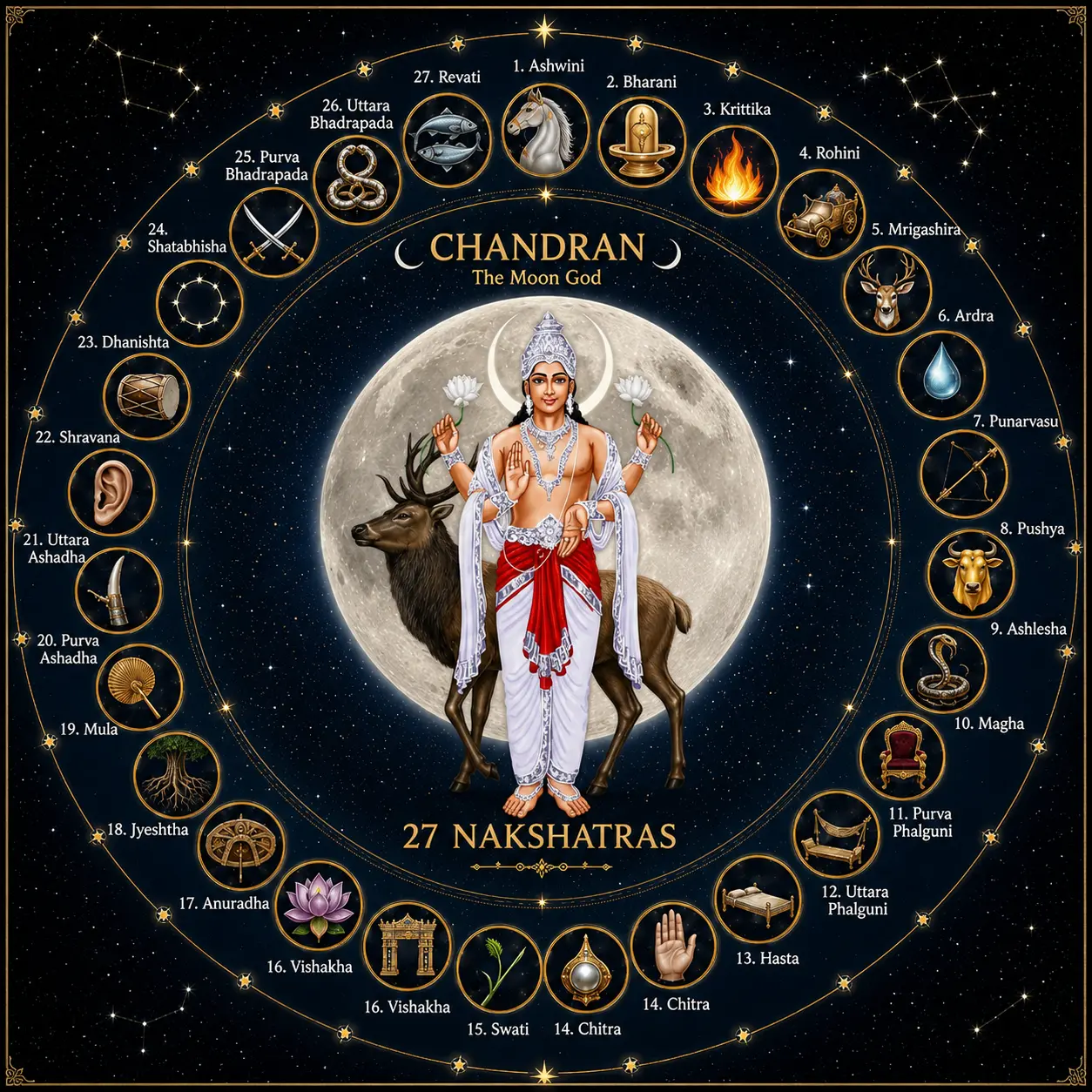
One of the most fascinating stories in Hindu mythology is about Chandra Deva (the Moon God) and his twenty-seven wives. This story beautifully connects astronomy the twenty-seven star constellations with a deep lesson about fairness and impartiality.
The Twenty-Seven Daughters of Daksha Prajapati
Daksha Prajapati, one of the mind-born sons of Brahma, had twenty-seven beautiful daughters. Each of them represented one of the twenty-seven lunar constellations (nakshatras):
Ashwini, Bharani, Krittika, Rohini, Mrigashira, Ardra, Punarvasu, Pushya, Ashlesha, Magha, Purva Phalguni, Uttara Phalguni, Hasta, Chitra, Swati, Vishakha, Anuradha, Jyeshtha, Mula, Purva Ashadha, Uttara Ashadha, Shravana, Dhanishta, Shatabhisha, Purva Bhadrapada, Uttara Bhadrapada, and Revati.
Daksha married all twenty-seven of these daughters to Chandra in a single grand ceremony.
Chandra's Promise
At the time of the wedding, Daksha made Chandra promise, "You must treat all my daughters equally and never be unfair to any one of them." Chandra happily agreed. A schedule was set up so that each wife would spend one day with Chandra in turn and it is said that this cycle became the basis of the twenty-seven-day rotation of the nakshatras that we still follow today.
Special Affection for Rohini
But as time passed, Chandra developed a deep, unequal fondness for one particular wife Rohini. Among all twenty-seven. Her beauty and grace captivated him completely. Because of this, he began neglecting his other wives, spending most of his time with Rohini alone while ignoring the remaining twenty-six.
The Sorrow of the Other Wives
The neglected wives were deeply hurt. Having lost their husband's love and attention, they went to their father Daksha in despair and sorrow. "Our husband ignores us and spends all his time with Rohini alone. We want justice," they said, in tears.
Daksha's Warning and Anger
When Daksha heard of his daughters' suffering, he called Chandra and warned him sternly. "Have you forgotten the promise you made? Didn't you say you would treat all your wives equally?" he asked. But Chandra paid no attention and did not let go of his special attachment to Rohini. Despite being warned again and again, Chandra refused to change his behavior, and Daksha grew furious.
Daksha's Curse
In his anger, Daksha cursed Chandra: "Since you have shown favoritism and been unjust to your wives, you shall lose your light and wane away, day by day!" As a result of this curse, Chandra's cool, radiant glow began to fade with each passing day. His beauty and brilliance slowly began to disappear.
Chandra's Repentance and Penance
Having lost his light and grown weak and pale, Chandra realized the mistake he had made. He understood how great an injustice of favoritism truly was, and he was filled with regret. He sought refuge in Lord Shiva and performed intense penance, praying for forgiveness.
The Resolution – Waxing and Waning
Moved by bronze idol Chandra's sincere repentance, Daksha did not remove the curse entirely but softened it instead. He granted a boon: "You shall wane for fifteen days,Lord Shiva's and then wax again for the next fifteen days. This cycle shall continue forever." This is said to be the origin of the waning phase (Krishna Paksha) and waxing phase (Shukla Paksha) of the moon that we observe even today.
It is also believed that Chandra's special fondness for Rohini never faded. Which is why the moon is said to shine especially bright on the day of the Rohini nakshatra.
Lessons from the Story
This story teaches us several important lessons:
Fairness matters: No matter how many people depend on us, we must treat them with equality and justice.
Keep your promises: Failing to honor a promise can lead to serious consequences.
Realizing mistakes and making amends: Even after making a mistake, sincere repentance can bring back what was lost.
Balance is the essence of life: Just like the waxing and waning of the moon, life too has its ups and downs. We must accept them and keep moving forward.
Conclusion
The story of Chandra and his twenty-seven wives is not just a myth. It beautifully weaves together the astronomical structure of the twenty-seven star constellations with a timeless message about fairness and justice in human relationships. Even today, when we look up at the night sky and watch the moon wax and wane, this ancient story quietly comes to mind.
Comments
Log in or sign up to join the conversation.