


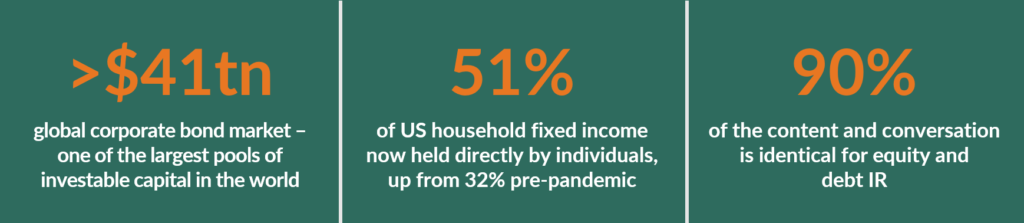
The global corporate bond market was valued at over $41tr in 2025 and is expected to grow to more than double that by 2034. It is one of the largest and fastest-growing pools of investable capital in the world. Yet for the majority of companies that have issued into it, the relationship with bondholders is largely episodic: a roadshow around new issuance; perhaps a call from the debt capital markets (DCM) bank; maybe a debt-focused results presentation for larger issuers. Between those moments, silence.
That sporadic, event-driven approach is becoming harder to justify, and the increasing number of retail investors entering the bond market is prompting group treasurers and board members to take notice.
Exhibit 1: Corporate bonds: The market, the momentum and the IR case
Sources: Fortune Business Insights, July 2026; Coalition Greenwich, cited in The DESK, November 2025; Edison Group
Debt IR is an extension of what IR teams already do
One of the most persistent obstacles to better debt investor relations (IR) is the perception that it requires new expertise, new teams or a fundamentally different approach. In practice, c 90% of the content and conversation is identical for equity investors and debt investors. The same corporate story – strategy, performance, management quality and capital discipline – is relevant to both. The additional focus required for debt investors – funding plans, credit metrics, rating agency positioning and refinancing timelines – is simply a lens applied to familiar material, not a reinvention of the discipline.
For companies with existing equity IR teams, expanding their remit to include debt is straightforward: lean on the infrastructure, investor relationships and communication expertise already in place. For those lacking an equity IR function, and a considerable number of bond issuers do not have publicly listed equity, the same principles apply. Think clearly about the corporate narrative. Be available to the market. Build investor relationships before they are needed, not when the deal window has already opened. Where in-house resource is limited, a fractional or outsourced IR function can provide the expertise and continuity of engagement that debt investors expect, without the overhead of a dedicated hire.
The retail bond opportunity is global and growing
At the end of Q225, 51% of US household fixed income was held directly by individuals, up from 32% before the global pandemic, driven by higher yields, improved electronic trading access and lower minimum investment sizes. The UK and Europe are at an earlier stage of this journey, but the direction of travel is clear.
In January 2026, the UK took a significant step with the launch of the Public Offers and Admissions to Trading Regulations 2024 (POATRs). This introduced Access Bonds, a new category of corporate bond specifically designed to make UK corporate debt accessible to retail investors under a simpler, standardised framework. The proof of concept arrived quickly: in March 2026, Secured Fixed Income issued the first corporate Access Bond tradeable on the LSE: a £20m, 7.5% fixed-rate three-year bond that attracted more than 1,500 individual investors.
The POATRs framework also enables bond issuers to convert outstanding bonds – those already issued and trading in the markets – into the Access Bond format, opening up their securities to a broader retail audience without requiring a round of new issuance. And in June 2026, the UK launched the bond consolidated tape, a single, real-time source of prices and trading activity across the entire UK bond market. This added a much-needed layer of transparency to bring the UK closer to the conditions that have made the US retail bond market so much more developed.
The pieces are being put into place and conditions are ripe. Companies that begin building retail bondholder engagement programmes now will be ahead of the curve as this market develops.
The fixed income research gap is structural, but issuers can help close it
Third-party research has traditionally been a tool IR teams use to validate their corporate story and keep investors informed. However, in fixed income, sell-side research is significantly thinner than in equities, and it is effectively out of reach for retail bondholders because of the 2018 Markets in Financial Instruments Directive II (MiFID II). When an individual investor wants to understand a bond issuer’s financial position, credit trajectory or refinancing outlook, independent open-access research may be the only verified information source available.
Therefore, addressing that imbalance with open-access, independent research – freely available to institutional and retail investors alike on platforms including the LSE – is in any bond issuer’s direct interest. Just as the best equity IR programmes draw on independent research to reach and inform shareholders, the same logic applies in fixed income. Open-access content also carries an additional advantage equity research does not: discoverability by the AI tools investors increasingly use to research investments, building visibility that a company website alone cannot replicate.
An always-on model, not an episodic one
The most important shift debt IR requires is cultural rather than structural. Bondholder engagement should not begin when a deal is in the window and end when the order book closes. By contrast, the best debt IR programmes are continuous, not transactional. They include regular investor updates between issuances; a clearly maintained debt investor section on the corporate website; participation at investor conferences and fixed income forums; and an open, well-publicised channel through which institutional and retail bondholders can ask questions and receive responses. The same logic applies to rating agencies: companies that maintain proactive, ongoing dialogue with their analysts, rather than engaging only at review time, consistently find that agencies have a more complete and nuanced picture of the business, which tends to be reflected in how credit events and covenant headroom are assessed. The goal is to be known to a wide pool of potential fixed income investors before any deal comes to market and to be known to rating agencies before you need to be rated.
The companies that manage their cost of debt most effectively over time maintain those ongoing relationships with their bondholders. They also test AI discoverability, ensure third-party content reaches the channels bondholders actually use and treat the bondholder base as the strategic audience it is.
None of this requires a dedicated team or a significant increase in budget. It does require applying the same rigour to bondholder engagement that the best equity IR programmes bring to shareholder communications. The infrastructure to deliver it – DCM bank relationships, IR platforms, fractional IR support and independent research – should already exist for teams of any size.
The bond market is too large, and the Access Bond opportunity too significant, for debt IR to remain an afterthought.


Comments
Log in or sign up to join the conversation.