

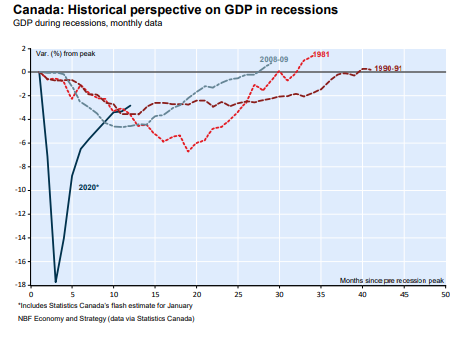
“The Canadian economy soldiered through the second wave restrictions much better than anticipated, supported by a big rebound in resource sector activity and a raging housing market. Look for new growth drivers to kick into gear as the economy re-opens in stages through this year, leading to roughly 6% growth—a nice mirror image to last year's deep dive. It's not precisely a V-shaped recovery, but it's Very close.” (Douglas Porter, BMO, March 3, 2021)
The financial markets, which are quite optimistic, are betting on a sharp reduction in Canada’s high personal savings rate driving a robust economic recovery. In other words, the markets are assuming the existence of massive pent-up demand created by the pandemic.
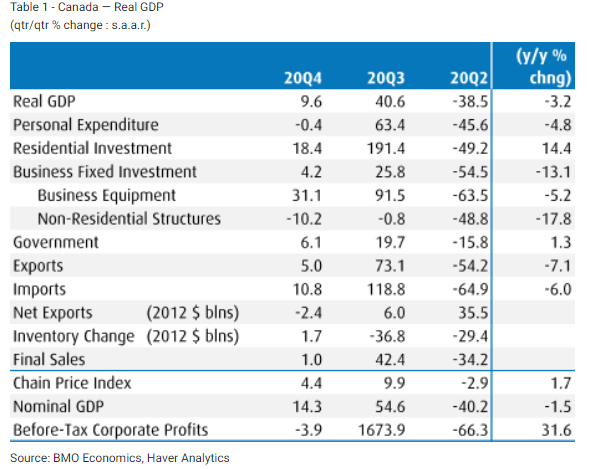
Because of the covid recession, Canada experienced the sharpest decline in real GDP on record in 2020. The 5.4% drop in real GDP was not caused by a collapse in aggregate demand. The economic decline originated as a supply side shock as the pandemic and the lockdowns shuttered major parts of the economy.
Canada’s fourth-quarter strong recovery last year was also unusual since it compared favorably against US Q4 growth of 4.1% and a Euro Area decline of 2.4% decline.
Most of Canada’s GDP growth in Q4 was due to a surge in inventory accumulation following large inventory reductions in the previous quarters due to the pandemic.
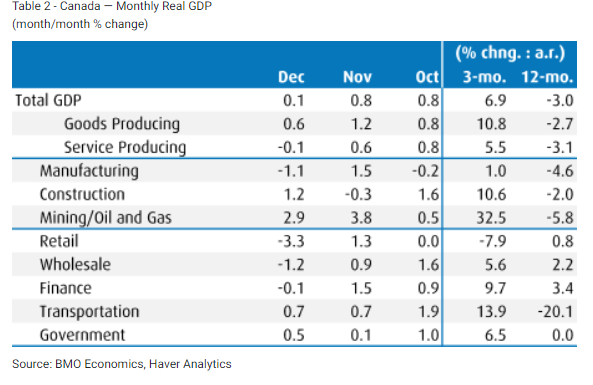
As well, Statistics Canada’s flash estimate for January’s GDP performance suggested a strong 0.5% advance compared to December’s lackluster growth of only 0.1%.
Moreover, Canada’s export expansion in January was also quite encouraging.
Finally, it is very favorable that Canada can almost immediately expect some of the US fiscal stimulus to spill over into the Canadian economy.
In other words, it appears that the Canadian economy started 2021 on a stronger footing than its major competitors.
It should be remembered that the consensus estimate for Canada’s first quarter of 2021 was typically negative growth, and indeed even the Bank of Canada was earlier on projecting a 2.5% Q1 annual rate of decline.
Finally, what really affects the corporate sector and Canadian government finance is the growth in nominal GDP, which incorporates price increases in its calculation.
Canada’s nominal GDP accelerated at a 14.3% annual rate n Q4 following a 54.6% surge in Q3.
Despite all of the alarm over Canada’s huge government deficit and indebtedness, the recent improving recovery prospects are encouraging for both for public finance and corporate profits.
(Click on image to enlarge)
(Click on image to enlarge)
(Click on image to enlarge)


Comments
Log in or sign up to join the conversation.