


Markets may be underestimating the economic costs of trade uncertainty for Canada. We expect CAD, which has remained relatively resilient so far, to underperform most other G10 currencies in the coming months. USD/CAD still has scope to move higher in the very near term, although gains may later be capped as we see dovish Fed repricing weighing on USD
What’s happened and where we stand – in a nutshell
Following the collapse of negotiations on 22 August, 50% US tariffs on roughly USD 20bn of Canadian goods have come into effect. President Trump has also announced 50% tariffs on Canadian autos, auto parts and steel from 1 January 2027. In response, Canada has unveiled dollar-for-dollar retaliatory tariffs worth USD 20bn, set to take effect on 8 September, including 50% levies on steel and aluminium (discussed by our commodities team here).
Latest media reports suggest the US administration is considering further trade penalties, with Canada prepared to retaliate again if needed. While US Vice President JD Vance said talks with Canada are “still ongoing”, Canadian PM Mark Carney had previously indicated there was little prospect of negotiations resuming before the 5 November US midterms.
Growth headwinds re-intensify
This comes at an unfortunate time for the Canadian economy. After contracting in three out of the past four quarters, a period of trade stability was prompting optimism to return. That will be evident in Friday’s second-quarter GDP release, which is expected to show annualised growth exceeding 3%. Similarly, Canada’s labour market was displaying renewed signs of life, having added 181,100 jobs over the past three months after losing 112,300 in the first four months of the year. An escalation of trade tensions, creating business uncertainty and consumer anxiety about the implications for jobs and inflation, risks stopping these improvements in their tracks.
While tariffs will put up costs, which will add to price pressures, it may also mean some squeeze to corporate profits as the burden is shared. The one bit of positive news is that inflation is currently within the Bank of Canada’s target band, which offers some time for the central bank to assess the growth and inflation implications.
Markets have reduced the pricing around potential Bank of Canada rate hikes – at the start of the week, 63bp of cumulative hikes was priced for April 2027, but today that is only 44bp. The headwinds to growth and the lack of corporate pricing power in the economy amidst labour market slack mean economists are more cautious on rate hikes. The BoC is almost certain to keep policy unchanged next week and through to year-end. We currently have one rate rise pencilled in for 2Q 2027 and a further hike in 4Q 2027, while the consensus is split between one and two hikes for 2027 in total.
CAD reaction contained, why?
Under similar circumstances in the past, the Canadian dollar would likely have fallen sharply. That is not only because of the direct economic impact – which remains more sector-specific than broad-based, affecting roughly 5% of exports for now – but also because the tariffs represent a direct breach of the USMCA, a cornerstone of Canada’s export model.
USD/CAD is up around 1.0% since trade negotiations collapsed on 21 August, but when we strip out the idiosyncratic USD rally, CAD has underperformed its closest peers by only 0.5% (chart below).
CAD weakness has been limited
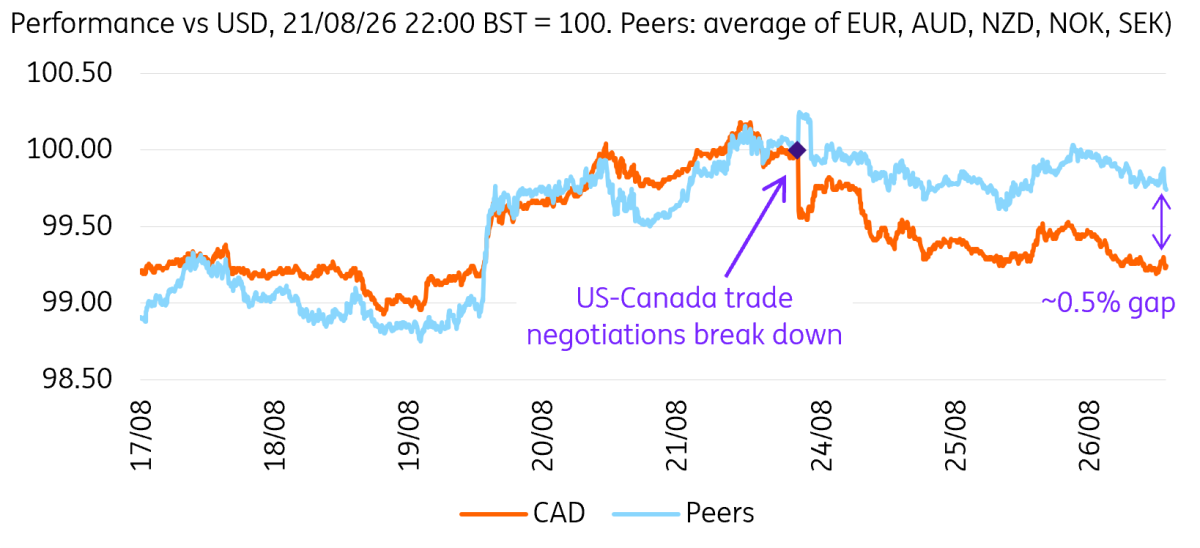
In our view, the main reason is that markets are still following the 2025 playbook on US protectionism. The assumption is that an initial escalation will eventually give way to negotiations and some form of agreement. Under that framework, fading the initial FX reaction remains the preferred trade. Trump’s decision to delay auto tariffs until 1 January also leaves the door open to further talks and may reflect concerns about the inflationary impact of higher tariffs ahead of the midterms.
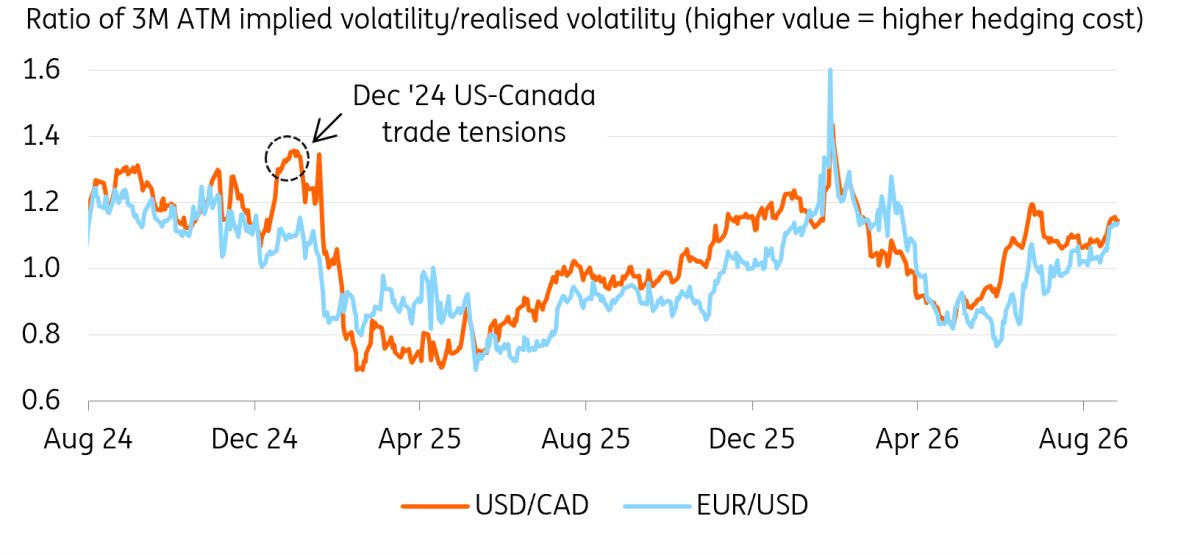
The options market offers another indication of how investors are now responding to trade tensions. The premium of implied short-term USD/CAD volatility over realised volatility is smaller than when US-Canada tariff risk first emerged in December 2024. At that time, the gap relative to EUR/USD's volatility premium was considerable. Today, it is null.
Cost of hedging CAD remains contained
CAD can drop further against G10 peers
We aren’t in the position to claim this time is different than 2025. The economic arguments to avoid a complete spiralling of trade tensions and de-facto collapse of the USMCA are obvious, both for Canada and the US. A return to the negotiating table in the coming months still looks like the most likely scenario.
That said, Bank of Canada surveys have consistently shown that the costs of the US-Canada trade dispute reach far beyond the industries directly affected by tariffs. The Bank has repeatedly pointed to trade policy uncertainty as a drag on business investment, hiring intentions and demand, with negative spillovers spreading across the broader economy.
For now, we believe CAD has further downside. A combination of dovish repricing in BoC rate expectations and a rising tariff risk premium should leave CAD underperforming most of its G10 peers. In particular, we continue to expect AUD and NOK, supported by higher carry and stronger fundamentals, to outperform CAD by a meaningful margin.
USD/CAD still looking mildly cheap
USD/CAD may be capped by USD weakness
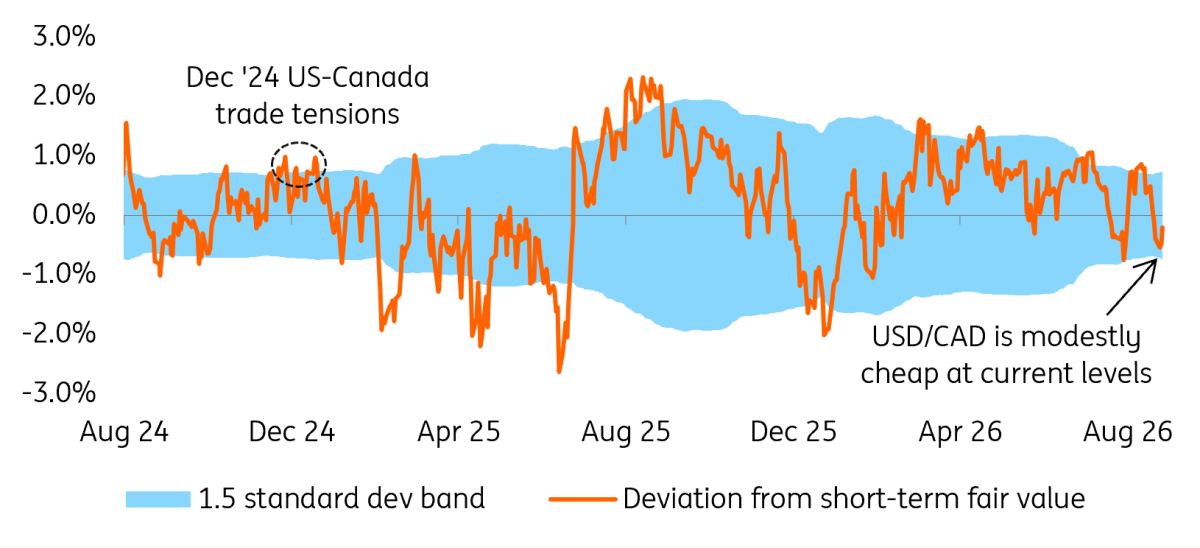
When it comes to the USD/CAD outlook, we must weigh it against the USD view. In the very near term, we see upside room for the pair. USD/CAD is showing no tariff risk premium (chart above), and is instead trading modestly below its short-term fair value, which sits just above 1.390. With the gradual unwinding of the UST-intervention premium on USD and the ongoing trade tensions, the argument for a move at least to the 1.3920-1.3950 area is compelling.
However, we are also quite bearish on USD, as we see market expectations on the Fed as too hawkish and expect no hikes by year-end also in the US. As we expect the unwinding of 10bp for the September FOMC and 26bp by December, we see the upside in USD/CAD constrained by the USD side of the equation. Our forecast is 1.39 for end-3Q and 1.38 for end-4Q.



Comments
Log in or sign up to join the conversation.