


On paper, the list of risks hanging over the U.S. economy and financial markets is daunting. Presented with today’s concerns a few years ago, a rational investor might have concluded that trouble was brewing and that shifting portfolios toward a more defensive stance was prudent. Yet the past several years have shown that caution has not been a winning strategy. The risks have evolved, but the bulls have prevailed. That resilience may seem surprising given the steady stream of troubling headlines. But investors who focused on trend analysis often found evidence that markets could withstand the apparent threats and continue advancing.
A review of several ETF-based market ratios continues to support the view that investors remain broadly constructive on the near-term outlook. Some areas are flashing warning signs, but the overall message is still positive. Conditions can always change, but from a top-down perspective, a significant move toward de-risking still appears premature, particularly for investors with relatively long time horizons.
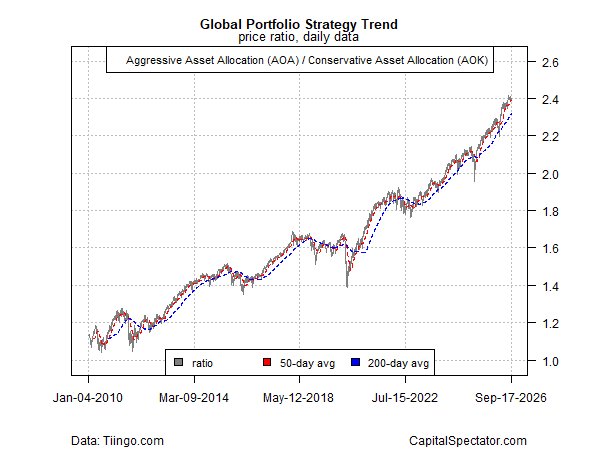
A broad gauge of global asset allocation sentiment continues to favor a risk-on stance, based on the ratio of an aggressive allocation strategy (AOA) to its conservative counterpart (AOK). The metric has recently been trading sideways, which could be an early indication that the uptrend is losing momentum. Until a clearer downshift emerges, however, marked by a series of lower lows, the evidence remains inconclusive. For now, long-term investors can afford to be patient before embracing a more defensive posture.
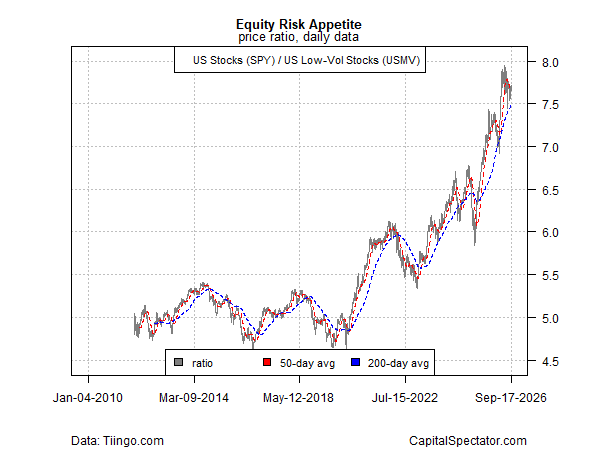
The case for a peaking in risk appetite is somewhat stronger in U.S. equities. The ratio of the broad U.S. stock market (SPY) to a low-volatility counterpart (USMV), a proxy for a more defensive equity allocation, has been drifting lower for several months following a sharp surge in April and early May. Even so, the decline has been gradual, leaving room for debate over whether this is simply a healthy consolidation or the beginning of a more consequential downturn. The next several weeks could be decisive in resolving the debate.
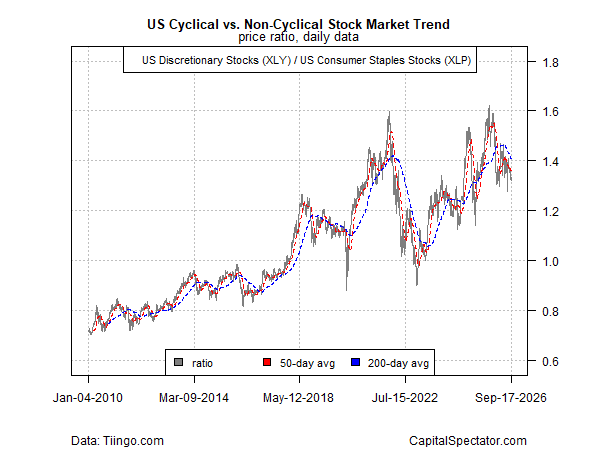
One reason to think broader risk-off signaling may be strengthening: the ratio of U.S. cyclical stocks (XLY) to defensive shares (XLP) continues to deteriorate. If the slide persists, the signal will become increasingly difficult to dismiss and could reflect a broader shift in market sentiment.
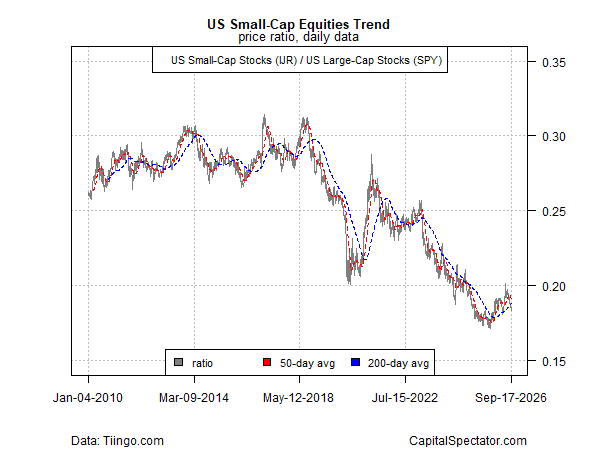
The recent weakness in small-cap stocks (IJR) relative to large caps (SPY) also warrants attention. After rebounding in the first half of 2026 following years of relative underperformance, small-cap advocates argued that conditions were finally turning favorable for these firms. That optimism has faded in recent months as the rally has begun to reverse. If the trend continues, it would add another warning signal for overall risk appetite by highlighting renewed doubts about holding higher-risk small caps.
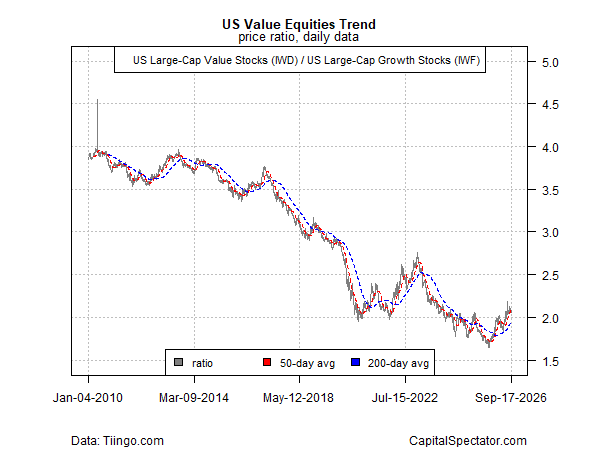
Another possible warning flag: the ratio of large-cap value stocks (IWD) to large-cap growth stocks (IWF) continues to trend higher. This may indicate that investors are gradually migrating toward more defensive segments of the equity market. If value continues to outperform, especially amid renewed concerns about inflation or other macro risks, the trend will increasingly be viewed as an argument for de-risking.
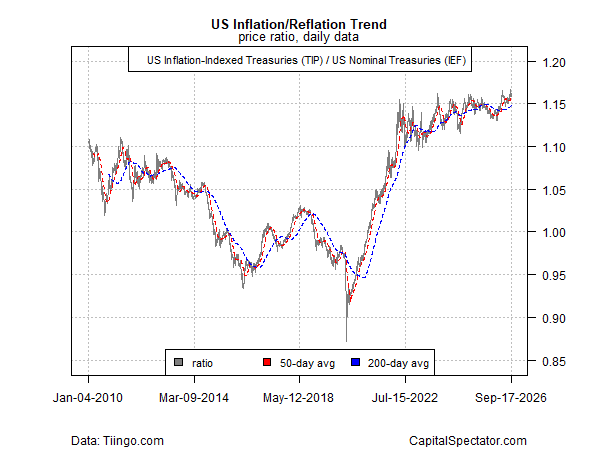
Speaking of inflation, the ratio of inflation-protected Treasuries (TIP) to nominal Treasuries (IEF) has for some time suggested that bond investors remain concerned about inflation pressures.
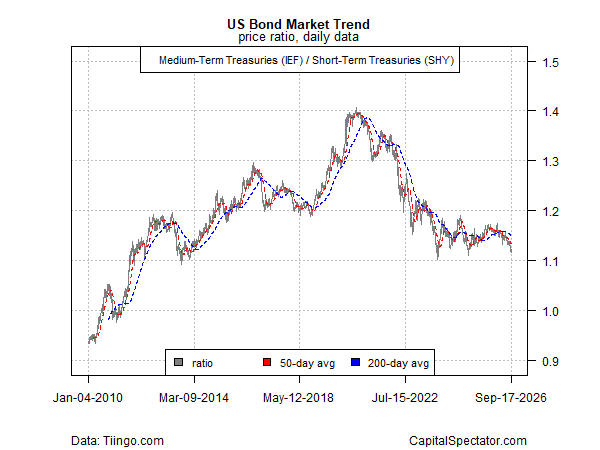
Meanwhile, fixed-income investors are showing a renewed push to favor shorter maturities in the government-bond space, based on the ratio of intermediate-term Treasuries (IEF) to short-term Treasuries (SHY).
If the risk appetite continues to deteriorate in the bond market, the effects are likely to spill over into equities and broader asset-allocation strategies. For now, however, the evidence points to moderation rather than a decisive shift to risk aversion. The trend signals are becoming more mixed, but the case for a wholesale move into defense remains unconfirmed. The main focus in the days and weeks ahead is monitoring trends in search of more clarity on market signals.

Comments
Log in or sign up to join the conversation.