

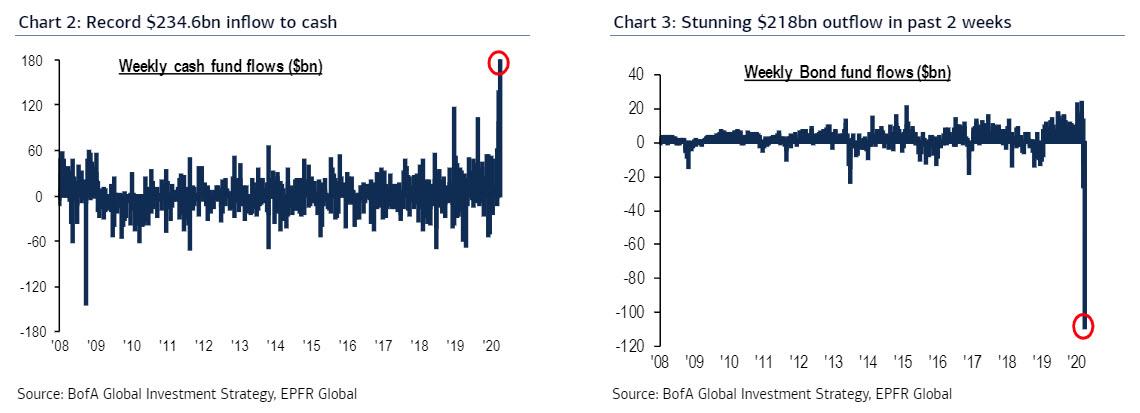
There is a reason why the Fed took the unprecedented step to announce it would begin buying corporate bonds this week: according to Bank of America, which is looking at the latest EPFR fund flow data, March 20 was the "bond capitulation day" when a record $34.6BN in redemption from bond funds took place.
This, together with the record outflows observed in the past two weeks which now amount to a "stunning" $218BN in bond outflows led BofA CIO Michael Hartnett to declare that the "bond bubble has popped" leading to an almost identical inflow, or $234.6BN, not into stocks but into the one asset that most certainly is not "trash": cash.
(Click on image to enlarge)
And speaking of stocks, they too got thrown out with the bondwater, as $26.2bn was redeemed from equity funds, and even $0.7bn was pulled out of gold funds.
Here are some of the data points to support his conclusion which forced the Fed to step into the bond market:
- Record $61.2bn redemption from IG bonds for the week, which is why the Fed announced it would bail out the IG bond market.
- Record $6.4bn redemption from MBS.
- Second consecutive week of monster outflows from EM debt ($17.1bn), municipal bonds ($10.8bn).
- First week of outflows from government bonds in 9 weeks ($3.7bn)...like gold, Treasuries were dragged into liquidation vortex (only US dollar was faithful safe haven).
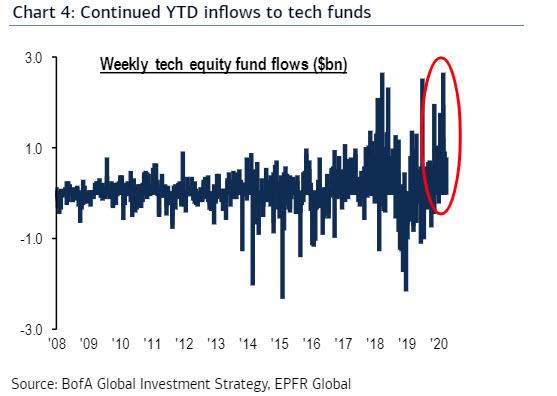
Yet with everything being liquidated, there is one bubble that just refuses to burst, and as Hartnett points out, it is "fascinating to note inflows to tech funds every week thus far in 2020" as it now appears that the growth bubble will be the very, very last to burst (also for anyone who listened to JPM's "once in a decade" opportunity to rotate out of growth and into value last summer, may you rest in piece).
(Click on image to enlarge)
So going back to the bold assessment that the bond bubble, if only in corporates, has burst, Hartnett calculates that the redemptions of $257bn from bond funds in the past 4 weeks has unwound 44% of bubble inflows of $583bn of inflows in prior 52 weeks.
Of course, the Fed can't possibly have that - after all without the corporate bond bubble companies won't be able to issue debt and purchase any of their stock - which is why it had to explicitly backstop both the primary and secondary bond market, while also announcing it would purchase the LQD ETF.
And speaking of LQD here is why the Fed had no choice but to start buying: according to Hartnett, credit is a key leading indicator for stocks...
(Click on image to enlarge)
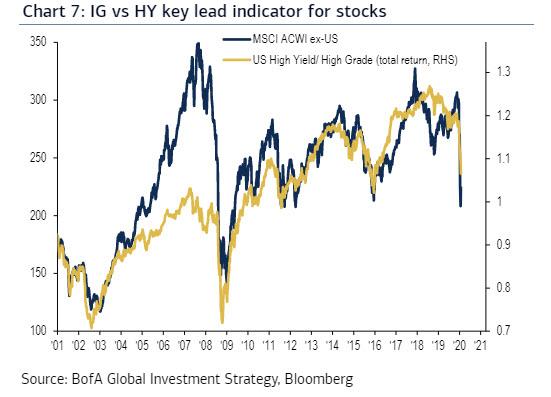
... and the most important ETF is LQD (IG bond): "if LQD >$120 (200-week moving average) there will be no retest of SPX 2250 low; if LQD >$126 SPX can break 2850."
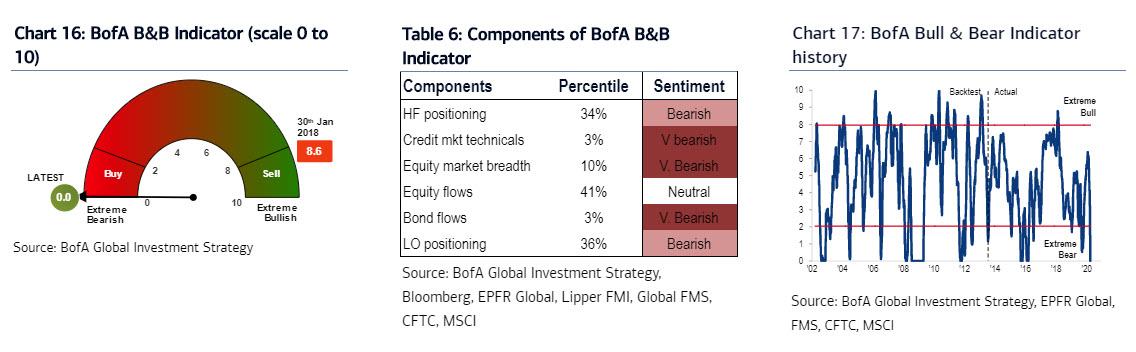
Hartnett then goes on to show how BofA's clients are positioned, and what the bank's risk indicators currently show, with the highlight that the "Bull & Bear Indicator drops to max bearish 0":
(Click on image to enlarge)
Which brings us to the final part of Hartnett's latest report namely his thoughts on whether this is the bottom or if this is just a bear market rally:
On recession & retests: everyone says it's a "bear market rally" because we are now trading recession; 3 million surge in unemployment claims = US unemployment rate spikes to 6-7%; everyone expects a "retest of lows", but perversely this only likely once virus numbers improve and recession numbers don't improve ; then SPX retraces from 2850 to 2450.
(Click on image to enlarge)
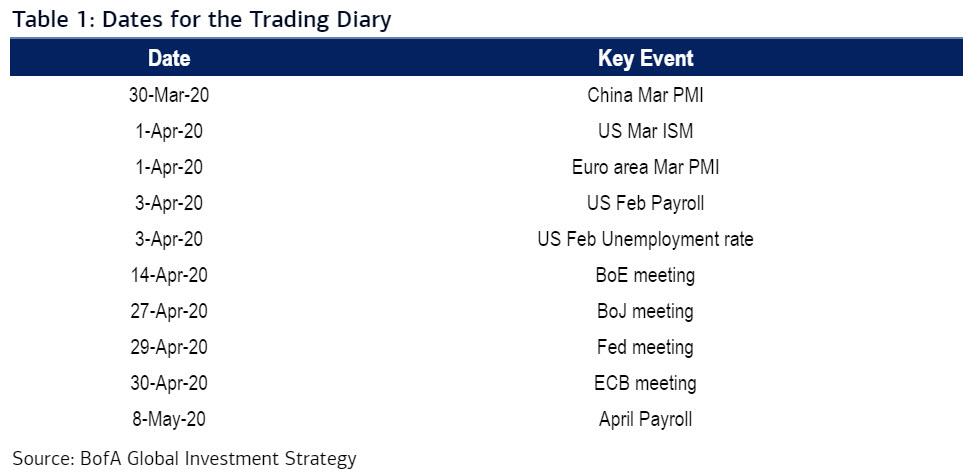
On whether credit or equity leads:
... we adhere to deflation playbook of "growth", "yield", "quality" due to macro but also because credit saying same (high quality IG bonds outperforming low quality HY); IG vs HY v key barometer going forward; once oil trough, dollar peaks, HY beating IG...low quality>high quality, EM>DM, global stocks>US, small cap>large cap, value>growth.
Finally, on policy and panicking policymakers:
The scale of policy panic is astonishing...62 rate cuts (Table 2), $7tn of QE, $4-5tn of fiscal stimulus, acceleration toward YCC (Yield Curve Control), UBI (Universal Basic Income), MMT (Modern Monetary Theory); tells us not that inflation guaranteed to rise but that 2020 sees a multi-year low in inflation expectations; gold, small cap, EM are the inflation hedges for secular contrarians.
(Click on image to enlarge)




Comments
Log in or sign up to join the conversation.