

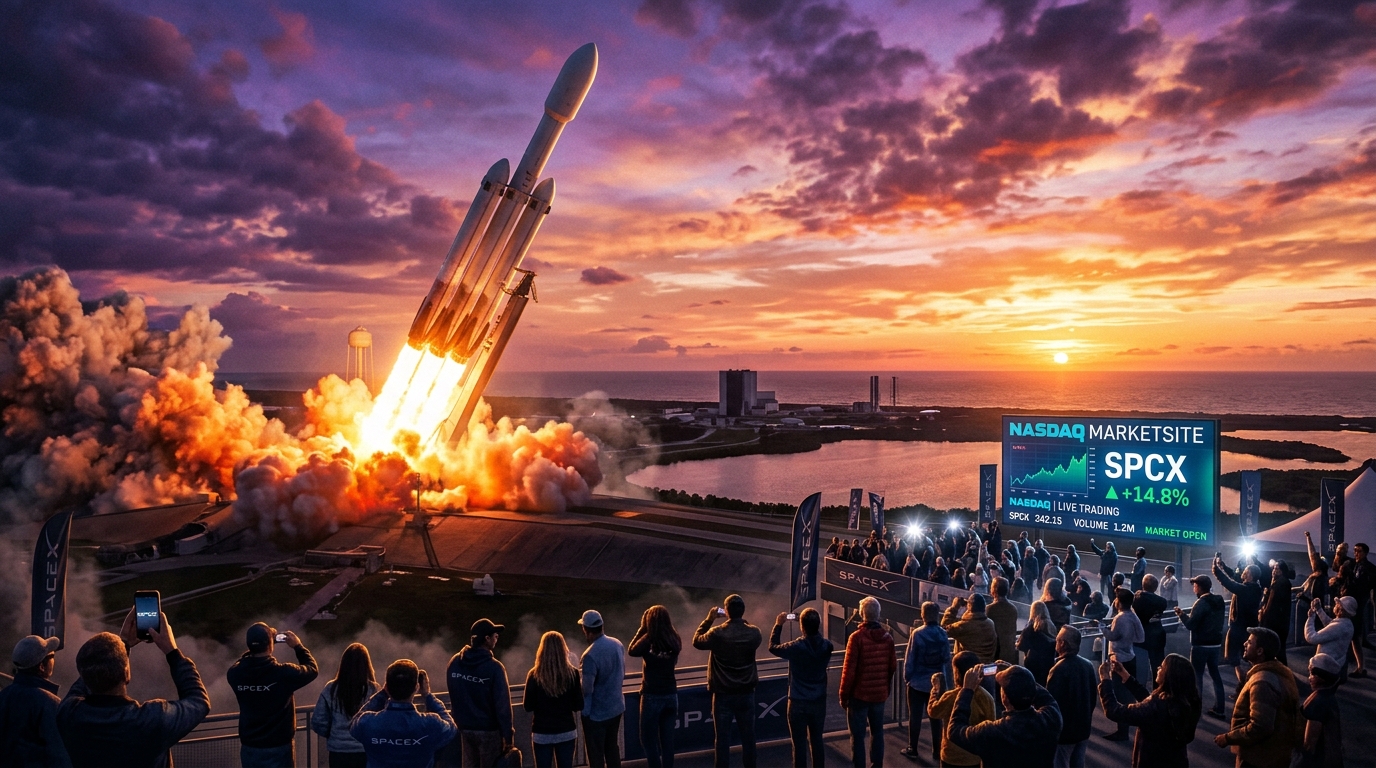
By The Numbers
$75 billion — amount raised in today's IPO, the largest in history, surpassing Saudi Aramco's 2019 record
$1.75 to $1.8 trillion — SpaceX (SPCX)'s opening valuation on Nasdaq under ticker SPCX
$135 per share — IPO price on 555.6 million Class A shares offered to the public
$250 billion — total demand from investors, meaning the offering was oversubscribed more than 3x
30% — share of IPO allocated to retail investors, an unusually high proportion accessible through Robinhood (HOOD), Fidelity, Schwab, and E*TRADE
Today is the day. SpaceX, Elon Musk's rocket and satellite company, started trading on the Nasdaq Global Select Market under the ticker SPCX. The company raised $75 billion in the largest IPO in history. BlackRock placed an order for at least $5 billion before a single retail share changed hands. Demand topped $250 billion. The offering was oversubscribed three times over.
The question isn't whether this is a historic moment. It clearly is. The question is what you actually own if you buy SPCX today, and whether the price makes sense.
What You're Actually Buying
This isn't just a rocket company. Earlier this year, SpaceX merged with xAI, Musk's artificial intelligence lab that operates the Grok chatbot. The IPO package includes four businesses: SpaceX's rocket design and launch services, Starlink's satellite internet network, xAI, and X (formerly Twitter).
That's a lot of different revenue streams bundled under one ticker. Starlink is the most commercially understood of the group. It has paying subscribers in dozens of countries, contracts with governments and militaries, and growing revenue. Rockets are the backbone, but the margin story lives at Starlink.
xAI is newer, harder to value, and burning cash. X is a social media platform that has gone through a turbulent few years. Musk has said X is profitable now. Independent verification of those numbers is limited.
The Index Tailwind Nobody Is Talking About
Here's something that matters more than most investors realize. Nasdaq changed its rules to allow SpaceX to join the Nasdaq 100 index after just 15 trading days. The normal requirement is three months. This is not a minor procedural detail.
The Nasdaq 100 has roughly $600 billion in passive money tracking it through ETFs like QQQ alone. When SPCX gets added to the index, every fund that tracks Nasdaq 100 has to buy it. That buying happens at scale, regardless of price. It's mechanical, not discretionary. Every pension fund, every 401(k) index fund, every robo-advisor that holds QQQ becomes a SpaceX shareholder within two weeks.
That forced buying creates real upward pressure. It's part of why IPOs with fast index inclusion often trade higher in the first month.
"Demand topped $250 billion for a $75 billion offering. That's not retail enthusiasm. That's sovereign wealth funds, pension managers, and the world's largest asset managers trying to get a piece of something they couldn't own before."
The Risk Side of the Trade
At $1.75 trillion, SPCX trades at a premium to most comparable companies. Starlink's revenue is strong but still growing into its valuation. xAI is in a competitive AI market where every dollar of compute time competes against OpenAI, Anthropic, and Google (GOOGL)'s Gemini. X (Twitter) has had advertiser issues that are still resolving.
The $135 IPO price also comes after years of private market appreciation. Early investors and employees already captured enormous gains. What you're buying today is the public market's first chance at ownership, but it's not ground floor. The ground floor was 2004.
You don't have to trust me. Trust the math: at $1.8 trillion, SPCX is priced like it will dominate multiple industries simultaneously. That might happen. Musk has a track record of making improbable things look obvious in retrospect. But the valuation already prices in a lot of success.
The index tailwind is real and provides a near-term mechanical bid. The 30% retail allocation means regular investors can buy in without competing for scraps. But buying at the IPO price on the most hyped offering in history requires knowing your time horizon. This isn't a trade. For most people, it's a position.
P.S. Nasdaq 100 inclusion in 15 trading days is not a coincidence. The passive buying pressure that creates is real money, and it arrives on a schedule. Watch the date.


Comments
Log in or sign up to join the conversation.