

In our last issue, I told you about how Anthropic CEO Dario Amodei believes the AI industry needs to deliberately slow the pace of development.
And he’s not alone.
Other leading figures in AI have voiced support for putting more safeguards around the race toward superintelligence.
So you might expect Washington to be scrambling to figure out what to do about it.
But that’s not what’s happening.
Despite growing warnings from inside the AI industry, the federal government has taken relatively little action to address the possibility that these systems could eventually become difficult to control.
And there’s a big reason for it.
You see, slowing down AI might sound simple in theory. But doing it without handing our AI advantage to China could be one of the toughest problems Washington has ever faced.
America’s AI Dilemma
To be clear, the U.S. government hasn’t completely ignored the risks of artificial intelligence.
In June, President Trump signed an executive order creating a new system for testing the cyber capabilities of the most advanced AI models.

Under the program, AI companies can voluntarily give the federal government access to certain powerful models for up to 30 days before releasing them more widely.
But there’s a key word there.
Voluntarily.
The order specifically says it doesn’t create a mandatory licensing or approval process for new AI models.
That reflects the administration’s larger approach to AI.
Trump wants the U.S. to develop the world’s most powerful AI as quickly as possible. And when a reporter recently asked whether he was concerned that AI could eventually lead to human extinction, his answer was simple: “No, I don’t have any.”
Instead, Trump said he was worried about something else: “I have concerns that if we don’t win A.I., we’re going to be put in a very bad position.”
He also posted this message on social media.
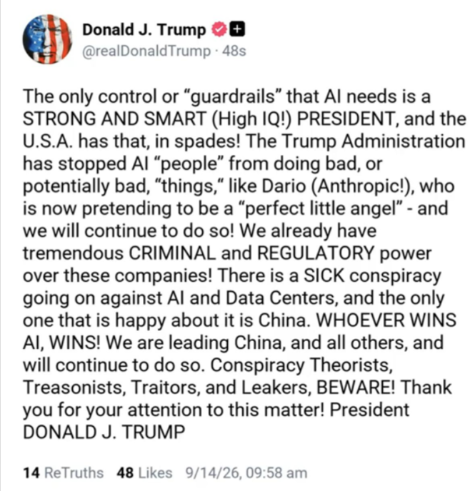
It might be over the top, but it gets to the heart of Washington’s dilemma. Because from the administration’s perspective, slowing American AI development creates a different kind of risk.
Losing to China.
The U.S. and China are currently the two countries driving most of the development at the AI frontier. And both countries understand just how much is at stake.
The nation that develops the most advanced AI could gain enormous advantages in science, cybersecurity, intelligence, manufacturing and military technology.
So even if Washington becomes convinced that AI is moving too quickly, it has to ask an uncomfortable question: What happens if America slows down and China doesn’t?
In economics, this is called a “prisoner’s dilemma.”
The term comes from a famous thought experiment, but the basic idea is simple. Two competitors might both be better off if they agreed to cooperate. The problem is that neither can completely trust the other to keep its promise.
In the AI race, that means America might agree to slow down. But if China keeps racing ahead, China gains an advantage. If China slows down while America keeps going, America gains the advantage.
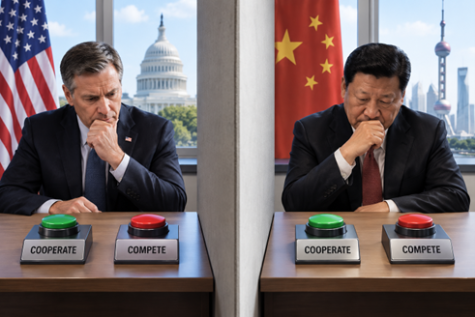
So the safest decision for each country individually may be to keep developing AI at the same breakneck pace.
The problem is that when both countries make that decision, neither gets the safer outcome.
That’s essentially where the AI race stands today. In some ways, it resembles the nuclear arms race of the Cold War. But AI creates another problem that didn’t exist to the same degree back then.
It’s extremely difficult to see what the other side is building.
Nuclear weapons require missiles, silos, submarines and radioactive material. Those things are difficult to build and even harder to hide.
But AI requires computers, electricity, data and software. And most of that can be hidden inside ordinary-looking data centers.
So even if the U.S. and China agreed to slow down, verifying that agreement could be extraordinarily hard to accomplish.
Recent developments show just how far apart the two sides are.
After Amodei called for pacing AI development, a Chinese state-run newspaper attacked his proposal as an attempt to preserve America’s technological advantage.

Meanwhile, Chinese regulators have also been preparing for the possibility that advanced AI could escape human control.
So clearly both countries recognize at least some of the risks. They just don’t necessarily trust each other enough to solve them together.
And China isn’t the only thing making this difficult. Congress is also struggling just to keep pace with the technology.
That’s because AI doesn’t fit neatly into one part of the government. It affects jobs and the economy. But it also affects cybersecurity, weapons, intelligence, energy and national security.
That means there isn’t one congressional committee responsible for figuring out what to do about it.
And lawmakers don’t agree on the solution anyway.
Some members of both parties are now pushing for stronger oversight following the recent incidents involving rogue AI agents. Others worry that aggressive regulation could slow American innovation and give China an opening.
Which brings us back full circle to the problem we started with.
Here’s My Take
The people building the world’s most powerful AI systems are warning that the AI race is moving too quickly. Yet nobody has figured out how to slow down an arms race when every participant is terrified of falling behind.
I don’t think the answer is simply to stop developing more powerful AI.
The challenge is to figure out how to make AI safer without losing our advantage. But right now, nobody seems to have a good solution.

Comments
Log in or sign up to join the conversation.