

Let's be honest about something most CRM vendors won't say out loud: most CRM software was not built for your industry.
It was built for SaaS sales teams. For B2B tech companies with long deal cycles and quarterly forecasts. And when a food distributor or a restaurant group tries to squeeze their operations into that mold, things break, missed reorder windows, lost account history, sales reps working from spreadsheets because the CRM "doesn't quite work the way we do."
If that sounds familiar, you're not alone. And you're not using the wrong process. You're using the wrong tool.
Why the Food and Beverage Industry Needs a Dedicated CRM
Whereas off-the-shelf enterprise software solutions are often oblivious to the intricacies of food and beverage industry operations, the most useful CRM software solutions geared toward food and beverage companies are well-versed in the nuances of the field, including its seasonality, perishability, regulatory environment, and high B2B order frequency.
For example, a company that distributes beverages in 500 different locations across various territories does not only require a contact management solution; it also needs tools capable of monitoring order frequency, contract renewal, and different price levels for different customers. Similarly, an operator of a network of restaurants across several cities will require a solution that is able to monitor vendor relations, loyalty schemes, and advertising campaigns from one platform.
What is Bridge CRM for food and beverage?
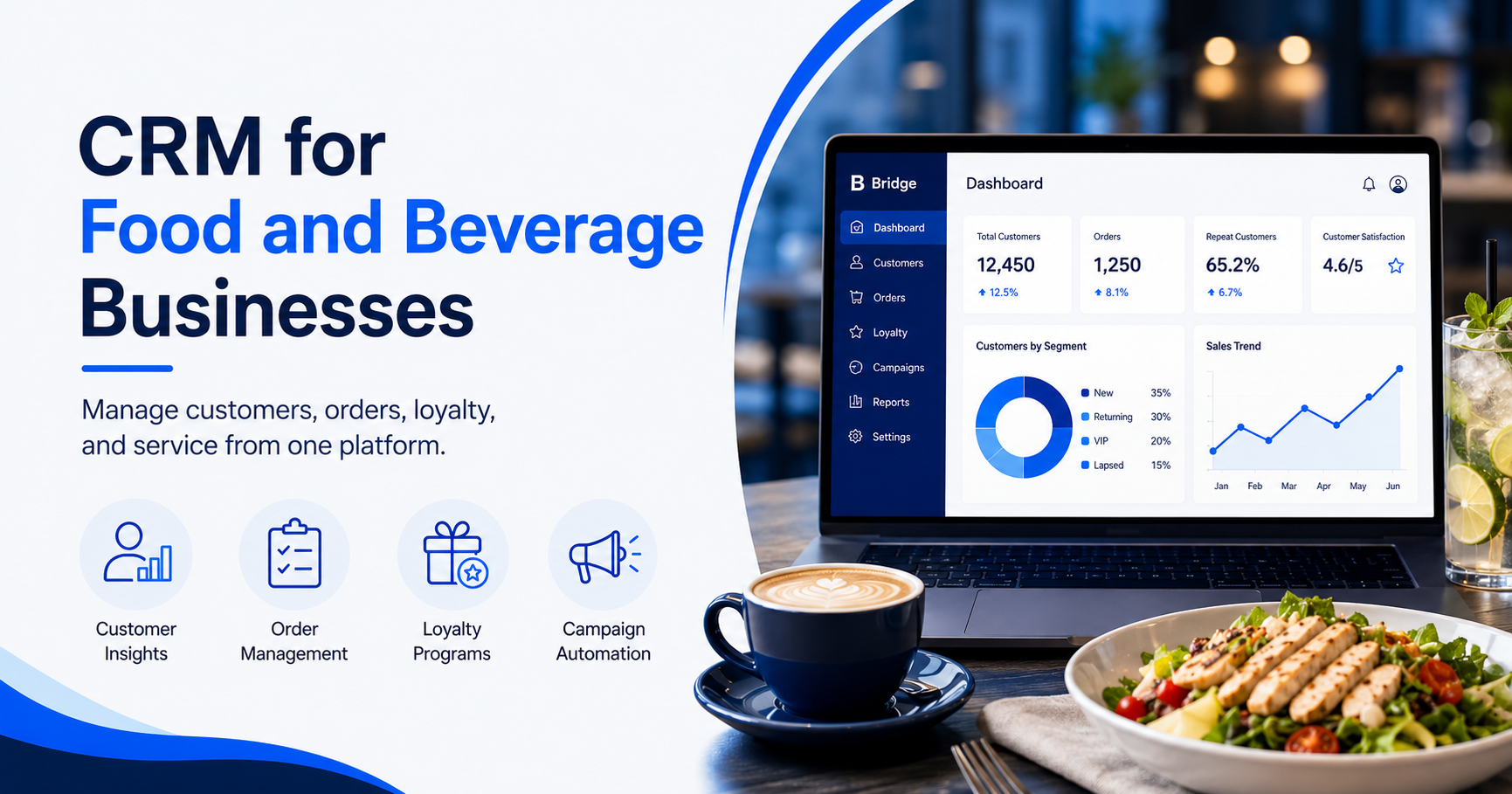
Bridge CRM is a relationship and pipeline management platform built specifically for businesses in the food and beverage sector, distributors, restaurant chains, catering companies, and beverage brands operating across multiple territories and markets.
Unlike general-purpose CRM tools, Bridge is designed around the rhythms of this industry: seasonal demand fluctuations, perishable inventory cycles, high-frequency B2B reordering, compliance documentation, and the complexity of managing hundreds of accounts across different pricing tiers, routes, and regions.
In short, it's the CRM that actually maps to how your business works - not the other way around.
What is the best CRM solution for restaurant chains?
Groups of restaurants, particularly those having presence in more than one city or region, face a whole new set of challenges. Vendor relationships are complicated. Procurement processes take place at the corporate level while individual locations handle their needs separately. Franchise models complicate things even further.
What Bridge CRM does for restaurant chains:
1. Integration of Customer Information
All interactions are gathered in a single customer database - telephone calls, email correspondence, orders, complaints, and meetings. It is necessary when comparing restaurant chain CRMs.
2. Beverage Distributor-Specific Features
Here are some must-have features for a beverage distributor CRM: territory management, route optimization, contracts tracking, pricing rules per volume, and compliance documentation.
3. Pipeline Management for Restaurant Chains
In case of enterprise restaurants and their search for the best CRM software for restaurant chains, we offer a multi-site view of sales pipelines that monitor procurement negotiations, vendor onboarding, and franchise performance.
Selecting CRM Software for Restaurants and Beverage Companies
If you're in the process of selecting among all of the choices and figuring out which one works best for your business, here's what you need to do:
Industry knowledge: Does the software have experience in helping companies in your industry meet compliance standards, workflow practices, and even distributor hierarchies? Off-the-shelf CRM software may require significant customizations in order to accomplish that.
Integration: Does the software integrate seamlessly with your other software packages, including ERP, POS, inventory, and marketing automation systems?
Scalability: Regardless of whether you own a regional craft beverage company or a multinational food processor, your CRM system should be scalable to grow alongside your business.
Mobility: Your sales team requires mobile CRM to be successful in the field. It's not a nicety; it's an absolute necessity.
Analytics: Effective CRM systems provide analytics that allow you to make informed decisions.
Bridge CRM V/S Generic CRMs
Feature | Bridge CRM | Generic CRM |
Territory & route management | Yes | Requires customization |
Food-grade compliance workflows | Yes | No |
Multi-currency, multi-region | Yes | Varies |
POS/ERP integration | Native | Varies |
Perishable inventory visibility | Yes | No |
How to choose the right CRM system for a food or beverage company
If you're in the process of evaluating options, here's a practical framework for making the decision:
Start with industry fit, not feature lists. The first question to ask any CRM vendor is: "How many food and beverage companies use this, and what do they use it for?" If the answer is vague, that tells you something.
Map your workflows before you demo anything. Know your actual processes — how an order moves from inquiry to delivery, how a complaint gets logged and resolved, how a contract renewal gets triggered. Then ask the vendor to show you how those specific workflows live in their system.
Think about your field team, not just your managers. The most powerful CRM in the world is useless if your field reps don't use it. Mobile access, ease of updating records on the go, and speed of data entry matter more than dashboard aesthetics.
Check integration depth. Your CRM needs to talk to your ERP, your POS systems, your inventory platform, and ideally your marketing automation tools. Ask specifically about the integrations you rely on, and request references from companies running the same stack.
Plan for where you want to be in three years, not where you are today. A regional distributor expanding into new territories, a restaurant chain opening international locations, a beverage brand moving into e-commerce, your CRM needs to scale with your ambitions, not cap them.
Serving Global Markets with Local Precision
Managing the different regulations, consumer behavior, and distribution methods in such diverse locations requires an understanding that only Bridge CRM can provide through its globally integrated infrastructure while allowing localized deployment. It would make Bridge CRM an excellent choice to be a partner for any food and beverage company with global aspirations.
The Bottom Line
The food and beverage industry is running on tighter margins than ever, with higher consumer expectations and more competition than most sectors have seen in decades. The businesses pulling ahead aren't necessarily bigger or better resourced; they're better organized. They know their accounts, they act on signals early, and they don't let relationship history live in someone's head or a personal spreadsheet.
A CRM built for your industry is part of that infrastructure. Not because technology solves everything, but because your team's expertise deserves better tools to work with.
Bridge CRM for food and beverages was built for exactly that to take what your best people already know and make it visible, actionable, and scalable across your whole organization.
Whether you're a beverage distributor in Lagos, a restaurant group in London, a catering enterprise in New York, or a craft brewer in Toronto, the starting point is the same: better relationships, better data, better decisions.
Comments
Log in or sign up to join the conversation.