

Whenever I add a new ETF to my recommended portfolio, I get questions about the fund’s expense percentage. It’s a good question, but often matters less than what investors have been taught. However, the management expenses of business development companies (BDCs) are rarely discussed, and actually have a greater impact on investor returns.
Quickly about fund expenses. The lowest expense ratios apply only to index-tracking ETFs. A fund that tracks an index, such as the S&P 500, will own stocks to match the index. The index tracking ETF with the lowest expenses will post the best returns.

Actively managed funds, in which fund managers pick investments to meet the fund’s strategy, will have higher expenses. For many types of investments, active management will provide significant returns above a comparable index fund.
However, in the BDC world, expense ratios are an important consideration.
There are two BDC expense structures. The majority of BDCs are externally managed by large financial institutions. (For example, you can probably guess who manages the Goldman Sachs BDC (GSBD).) In a recent update including expenses, BDC Buzz listed 25 companies, of which 23 are externally managed.
The other structure is called internal management. With internally managed companies, the management teams are employees of the BDCs.
Externally managed expenses will be higher. The external management company also needs to pay people to manage the BDC, and then they want to earn some profits on top of the expenses needed to run the BDC.
The recent BDC update from BDC Buzz (the newsletter is a premium service) includes a table showing operating costs as a percentage of available income for the last four quarters:
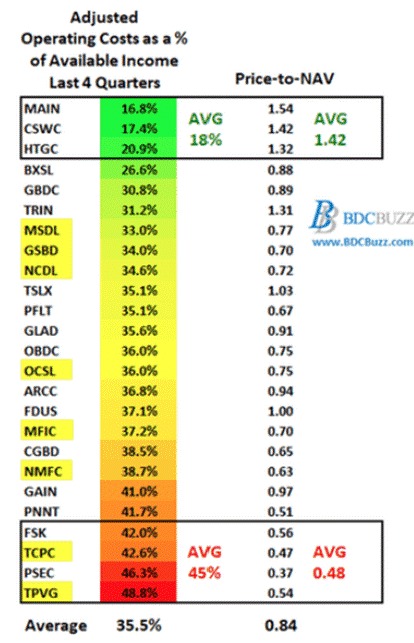
The three BDCs with the lowest expenses, Main Street Capital (MAIN), Capital Southwest Corp (CSWC), and Hercules Capital (HTGC), are all internally managed. You can see that internal management expenses are less than half of the average of the externally managed companies.
The data from BDC Buzz makes me pleased to report that MAIN, CSWC, and HTGC are three of the four BDCs in my Dividend Hunter newsletter portfolio. And, the Main Street Capital management team manages the fourth one, the MSC Income Fund (MSIF).
I regularly review BDC yields and returns, and the lower expenses from the internally managed companies give a huge advantage that shows up as better returns for investors.


Comments
Log in or sign up to join the conversation.