

The battlegrounds are fluid as multiple dynamics are going on in this world; with the outcomes hard to ascertain. Not to mention GAAP vs Non-GAAP earnings show an incredible divergence. Some believe an Election trend toward Trump is a potential negative; others see Trump or Clinton as neutral for markets, while Sanders would be bearish. Trump's economics sound childish on the surface; at the same time the irony is the outcome might be different. However, either way a pricey (based on valuation) U.S. stock market is again the focus; and can take a bit hit in the near future, irrespective of the domestic politic prospects, or lots of propaganda (from our own politicians and foreign leaders worried about loosing the market and currency advantages they gained from us).
What's at stake is nothing less than global stability, against despite politics here in the U.S.; as it has been known politically and even sociologically. Sovereigns across the globe are concerned. Is this an overstatement? No. The U.S. is just the most visible anti-establishment campaign 'we' see. Look at the UK, France, or Germany, and you see domestic versions (that's why Merkle's CDU Party lost 2 of the most loyal states in the past week's elections; although that resulted of course from a highly different mass-migration political calculation she'd made).
While it's probably not an overstatement to say how much is 'in play'; I hope so in a way. Whether it's Chinese miners rioting today (not being reported widely); or political chaos in the United States (again a revolt against the establishment, whether viewed from either partisan side, or just a conclusion that our politicians become too comfortable in DC; as even if they arrived with good intentions, they become influenced by a slew of lobbyists and so on, more than the citizens who sent them there); or the threat of the migrant invasion of Europe (even with all compassion to refugees) shifting political allegiances, and provoking a return to sovereign nationalism.
Then you have the 'outliers', or wild-cards, which include North Korean threats it seems we've become accustomed to); China's effort to refocus local worries by creating enemies in the form of claims upon international waters; or even by the flooding of foreign markets with even-cheaper goods that destabilize what's left after their cannibalizing industry (mostly due to our own mediocre trade policies) for decades now from not just the U.S., but the now-less-industrialized West.

Follow the money
One of the most curious remains the Middle East. Today's announced Russian decision to start 'initial phases of their main military "groups" from Syria, while it maintains its footholds; the cobbled-out naval and air base (can't protect absent troops, so suspect not too many coming out), may be for reasons other than the few possibilities trotted-out. Putin himself said the job is accomplished; but that's oversimplification. To a degree yes; or to a degree he's avoiding war with Turkey who just moved a few hundred yards into Syria to set-up the safe-zones many in the West called for; to relieve the pressure on Europe and their own cities (from bombing, which whether 'ISIS' or Kurdish-related groups, will find access harder with a safe zone buffer established). Or maybe the U.S. takes over from here.
Perhaps a bit of all of the above. But there may be another reason. Earlier today Russia announced that, after talks, Iran would NOT agree to freezing or cutting oil production. As I often remark: usually follow the money. Moscow may have presumed Iran would be malleable to cooperating with the other oil producers in appreciation for Russia's intervention, which enables the Shia crescent to have a chance to be established (something most everyone else fears or opposes).
Russia has financial concerns itself; based on low oil prices; so without military efforts having an impact on oil prices; well, Russia's achievements are reduced,if they had (as I suspected) oil at the heart of their motivation to get so-involved. They never really assaulted ISIS as they claimed; but they did basically destroy the so-called rebels (many of whom didn't stray far from extreme Islam) and left the 'field of battle' perhaps for Iraq and the U.S. (and Kurds) to 'liberate Mosul'; a Spring offensive we constantly hear preparations being made for (thinking April).

Market sustenance
Then there was the other focus I mentioned during the day; that being 'buybacks again' as a sustaining enabler of the past month's rebound; while investors were in a 'sell on balance' mode again. Interesting; as that makes the rally suspicious too; and again based on financial engineering such as some of last year's lifts.
Buybacks are financial engineering and further evidence that companies either are trying to again set-up executive compensation (lower float, higher earnings as a charade, allowing insider selling if the shares again move up); or simply do not see a visible reason to invest in the actual business operations. Part of what is implied by the divergences between earnings perspectives.

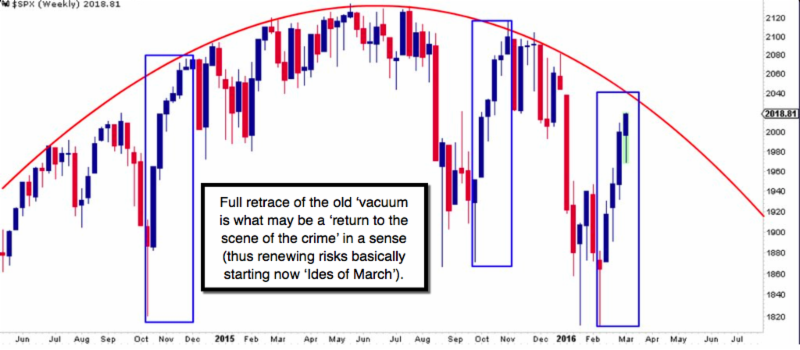
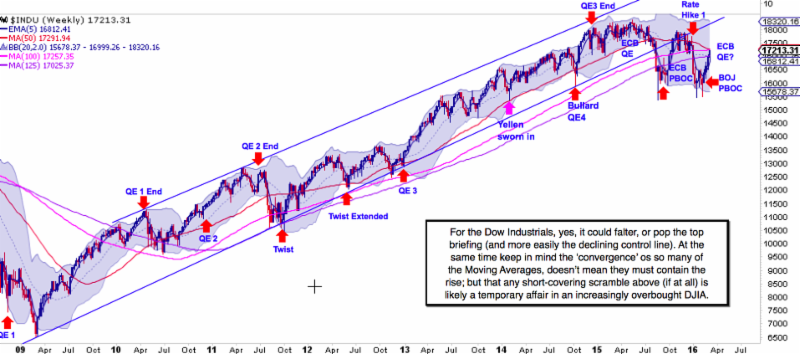
Bottom-line: this remains a market on-hold ahead of the Fed (and roiling after it); preceding the tail-end of a Quarterly Expiration. Either during this activity or after we think the market has significant downside vulnerability. Hints of that are now present; and not just because Oil stocks were a bit defensive.
Comments
Log in or sign up to join the conversation.