


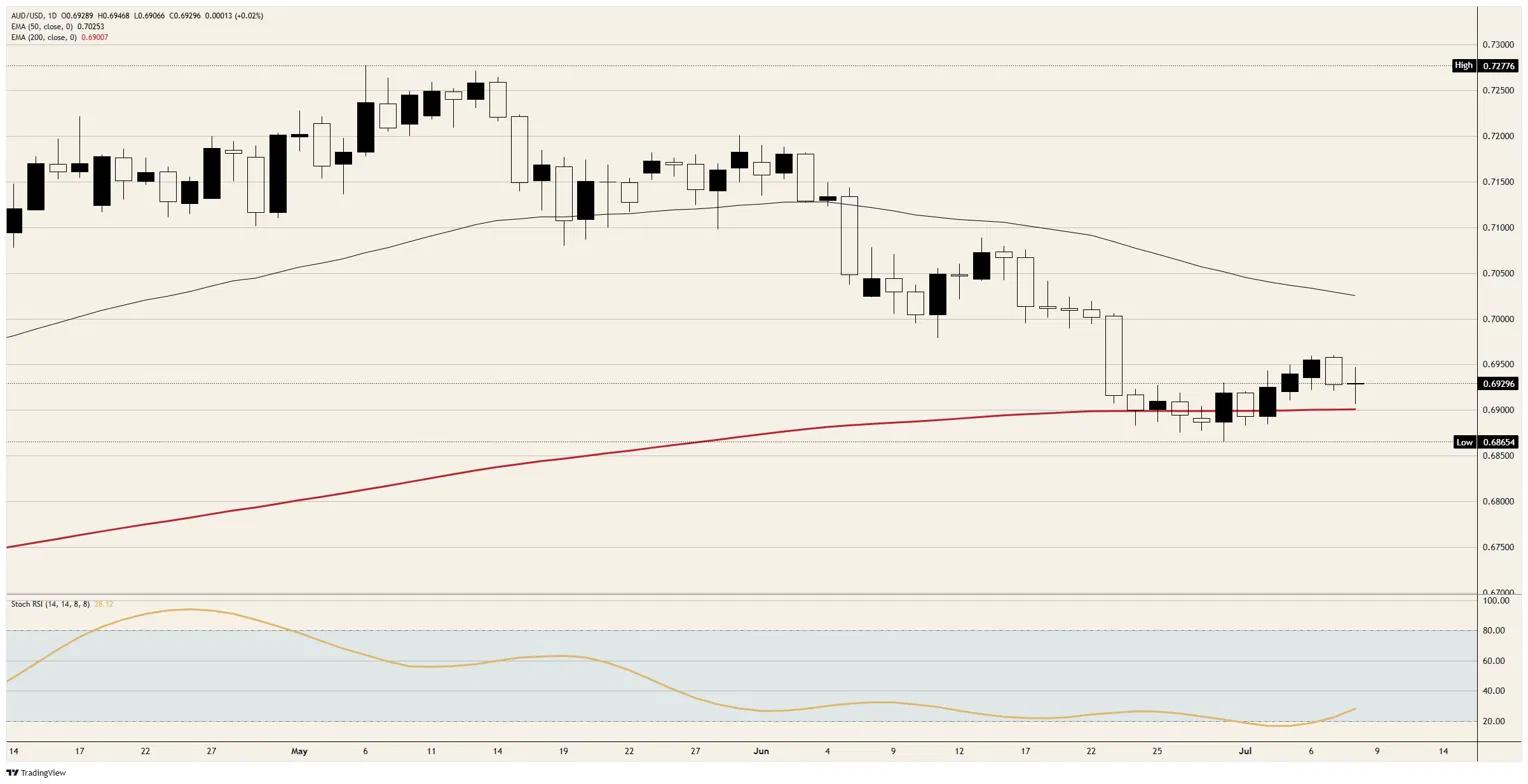
AUD/USD trades pinned between 0.6900 and 0.6950 on Wednesday, essentially unchanged and printing the kind of indecision candle that tells traders the week's rebound has run out of sponsorship. The Aussie has spent five sessions climbing away from the 200-day Exponential Moving Average (EMA) at 0.6900, and the reward is a market that no longer knows what to do with it: No follow-through, no rejection, just a doji parked in the middle of last week's range. For a currency that spent June shedding almost three big figures, standing still this close to the 200-day EMA reads less like stability and more like suspense.
Two hawkish central banks walk into a stand-off
Wednesday's Federal Open Market Committee (FOMC) minutes, released at 18:00 GMT, showed a committee split nearly down the middle on the next move, with the June dot grid printing nine hikes against eight holds and one lonely cut. That quiet split keeps the US Dollar bid on every dip and puts a lid on risk currencies generally, the Aussie included.
The Reserve Bank of Australia (RBA) is running its own hawkish experiment from the other side, holding the cash rate at 4.35% in June after three hikes this year, which is precisely why the pair refuses to break down. Monday's TD-MI Inflation Gauge cooled to 3.9% YoY from 4.4%, lending the hold some vindication without retiring the tightening debate. Two central banks leaning the same direction leave AUD/USD without a rate differential to trade, and a currency without a story consolidates.
The tightening debate is dormant rather than dead: The Governor has framed any inflation print with a three in front of it as unacceptable, and rate markets that flirted with a cash rate near 4.70% by year-end during the worst of the energy shock have only partially walked that back. A hawkish central bank that refuses to act is still a floor under its currency, just not a bid.
A war that helps and hurts in the same breath
Fresh US strikes on Iran and a Crude Oil surge of more than 6% would normally sink a risk proxy like the Aussie, but Australia exports the very energy the war keeps repricing, so the terms-of-trade channel offsets a meaningful slice of the risk-off channel. The chart's verdict is paralysis rather than direction: The pair neither joins the Dollar bid nor collects a commodity premium, and Wednesday's candle is the flattest of the month.
The catch is that the commodity premium runs through Beijing before it reaches Sydney. Iron Ore, not energy, remains the export that sets the Aussie's pulse, and Chinese construction demand has spent the year absorbing an energy shock of its own, which blunts the terms-of-trade windfall. That leaves the currency long a war dividend it cannot fully collect and short a risk appetite it cannot fully escape.
Momentum agrees with the stalemate, with the Stochastic Relative Strength Index flat in the high 20s, going nowhere from nowhere. The slide from the May peak just shy of 0.7300 remains the chart's dominant feature, and a sideways coil forming beneath a falling 50-day EMA above 0.7000 is more often distribution wearing a disguise than a base in construction.
Beijing gets the deciding vote
Thursday's Chinese Consumer Price Index (CPI) lands at 01:30 GMT, expected at 1.1% YoY, easing from 1.2%, with the monthly print seen at -0.2%; the Producer Price Index (PPI) is forecast to accelerate to 4.1% from 3.9% as war-driven input costs pass through factory gates. A consumer deflating while factory costs inflate describes a margin squeeze, not a recovery, and Australia's export machine is priced off exactly this demand. A downside CPI surprise hands the bears the 0.6900 test they have been waiting for; an upside one buys the coil another week.
US Initial Jobless Claims follow at 12:30 GMT with 218K expected, and the heavier set pieces wait at month-end, when the RBA, the Federal Reserve (Fed) and the Bank of England all decide policy within roughly the same 48-hour window. Until Beijing or Washington breaks the tie, the 0.6900-0.6950 box is the market's honest opinion of the Australian Dollar.
AUD/USD technical levels to watch
Resistance: 0.6950 caps this week's candles, ahead of the 0.7000 handle and the falling 50-day EMA just above it; bulls own nothing until that zone breaks.
Support: The 200-day EMA at 0.6900 is the floor that matters, backed by 0.6850 sitting beneath last week's washout low.
Bias: Bearish while capped below 0.6950; a daily close under 0.6900 puts the June downtrend back in charge toward 0.6850, and only a daily close above 0.6950 earns the rebound another leg higher.
AUD/USD daily chart



Comments
Log in or sign up to join the conversation.