

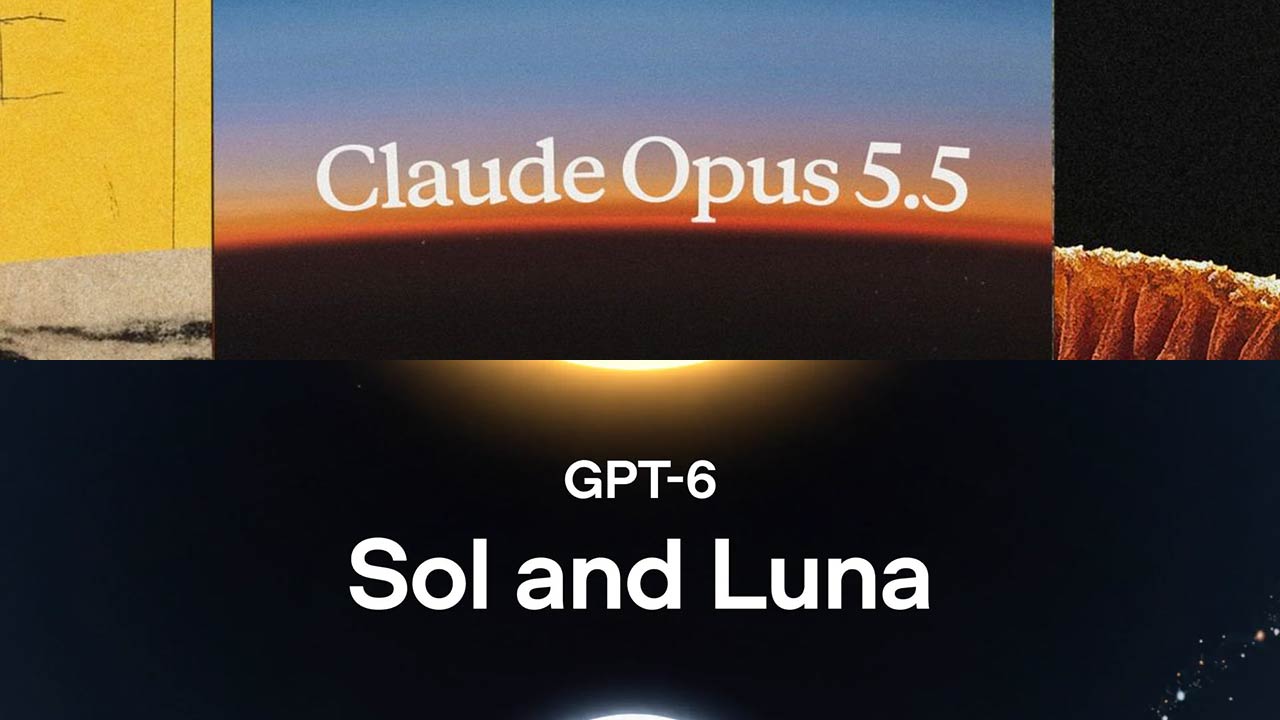
Anthropic launched Claude Opus 5.5 on Tuesday, and OpenAI released GPT-6 Sol and GPT-6 Luna roughly an hour later. Anthropic says Opus 5.5 performs at the level of its pricier Fable 5.1 on most work and costs 40% less to run than Opus 5 on typical workloads at default settings. OpenAI cut API prices for Sol and Luna by at least half versus its GPT-5.6 promotional rates. Both companies were as focused on the bill as they were on the brains.
At standard rates for prompts up to 272,000 input tokens, Opus 5.5 lists at $4 per million input tokens and $20 per million output tokens, down from $5 and $25 for Opus 5. GPT-6 Sol lists at $2 and $10 (down from $4 and $20), exactly half of Opus 5.5. GPT-6 Luna drops to $0.10 and $0.50 (from $0.20 and $1.20). Opus 5.5 and Sol tie on cache-read pricing. Anthropic says cache reads make up the majority of agentic and coding costs, and it priced them at $0.20 per million, 60% below Opus 5. OpenAI’s 90% cache discount puts Sol’s cache reads at $0.20 as well.
Neither lab’s launch chart includes the other lab’s same-day release. OpenAI says Sol at xhigh effort beat Claude Opus 5 at max effort on Zapier’s AutomationBench (33.2% to 26.9%) at 9% of the cost per task. Anthropic’s chart puts Opus 5.5 at 40.0% on the same test, just behind GPT-6 Astra at 41.4%, both at max effort. OpenAI notes that Fable 5.1 fell back to Opus 5 on about 40% of tasks, and Anthropic says its own safeguard interventions were scored as failures. Anthropic also concedes that benchmark margins have become “a less reliable guide to real-world differences.”
Tokens are easy to meter and hard to value. Anthropic is selling fewer tokens per task. OpenAI is selling cheaper tokens. A better metric is cost per completed task (inside your actual workflows).


Comments
Log in or sign up to join the conversation.