

Public safety networks, community broadcasters, and base-station operators all need the same thing from an antenna: coverage that holds steady, day after day, regardless of weather or network load. A High Gain TETRA Antenna, fiberglass collinear antennas, and FM broadcast antennas are different antenna types used for reliable coverage across communication and broadcasting systems. These antennas make better communication and provide reliable coverage.
A professional network is only as dependable as the antenna radiating its signal. Whether it is a police dispatch system, a hospital communication network, or an FM station, reliable coverage begins with the right antenna setup. Coverage depends heavily on antenna design, along with transmitter power, installation height, and surrounding terrain. With the help of this article, you will get a better understanding of TETRA, FM broadcast, and Collinear antennas.
High Gain TETRA Antenna for Critical Communications
TETRA stands for Terrestrial Trunked Radio, the ETSI-standardized digital radio technology built specifically for public safety, transport, and utility networks. It has now been deployed in over 100 countries worldwide as the backbone for police, fire, ambulance, and emergency-service dispatch. More than 250 TETRA networks are currently in service for governments alone, covering public safety, military, and defense communications, where a dropped call isn't an inconvenience; it's an operational risk.
TETRA base station antenna range is built around that reliability requirement, spanning the full set of bands — 380–400 MHz, 410–430 MHz, 450–470 MHz, and 806–870 MHz. The range includes configurations such as fiberglass collinear and stacked dipole antennas for base stations, along with directional designs like Yagi antennas for specific coverage needs. It gains from 3 dBi up to 12.8 dBi depending on whether the site needs a wide beam or a tightly focused directional link. V-polarized, H-polarized, and X-polarized designs are all part of the line. Getting that polarization choice right matters. A mismatch between base station and mobile terminal is one of the more common, and most avoidable, causes of weak TETRA coverage in the field.
Fiberglass Collinear Antenna for omnidirectional coverage
Where TETRA and other land-mobile networks need even 360-degree coverage from a single mast rather than a directional beam. The fiberglass collinear antenna is the standard choice. A collinear array stacks multiple radiating elements vertically and feeds them in phase, which produces a high-gain, omnidirectional pattern that a single dipole can't match. And doing this inside a fiberglass radome means the radiating elements stay fully protected from wind, rain, and salt air without blocking the RF signal passing through.
Collinear antennas spanning VHF and UHF bands from 66 MHz through 2.6 GHz, with 316 marine-grade stainless steel mounting hardware built for coastal and marine-duty applications. This is the same antenna type mainly used in fixed base stations, while emergency vehicles typically use compact whip antennas for mobility. They are used by police and firefighters for consistency. Precisely because it holds an obstruction-tolerant signal in every direction the vehicle happens to be facing.
FM Broadcast Antenna for reliable transmission
Selecting an FM broadcast antenna starts with matching the antenna's power handling and directivity to the coverage area, not just picking the highest gain on the datasheet. A single circular-polarized panel like the FM-1 suits small community stations. While stacked dipole arrays and log-periodic designs deliver the higher gain and power handling that regional broadcasters need across the full 88–108 MHz FM band.
FM range includes Fiberglass Collinear options such as the FMC-98 and FMC6-98. They are suitable for low-power or localized FM broadcasting where omnidirectional coverage is required. Directional yagi antennas for point-to-point links, and heavy-duty stacked dipole arrays built from corrosion-resistant 6063T6 aluminum alloy for base station-grade vertical-polarized coverage. The right choice comes down to one practical question– Does the station need even coverage in all directions or a stronger signal pushed toward one specific service area?
Why choose Antenna Experts?
Antenna Experts is an established antenna manufacturer and supplier in India. We are a NATO NCAGE code holder and ISO certified manufacturer. We manufacture TETRA, collinear, and FM broadcast ranges. They are built with durability standards, suitable for demanding environments, including defense and industrial applications.
Same durability standard applied across its defense and aerospace antenna lines. Every collinear and TETRA fiberglass model uses corrosion-resistant materials rated for continuous outdoor operation. The team offers custom antenna design for networks that fall outside a standard catalog configuration along with the supporting aluminum tubular masts needed to get an antenna properly elevated and in service. One practical advantage of sourcing from a single manufacturer is easier integration in mixed installations. Beyond the standard catalog, the team also builds custom antennas to specification for networks with non-standard frequency plans or mounting constraints.
Conclusion
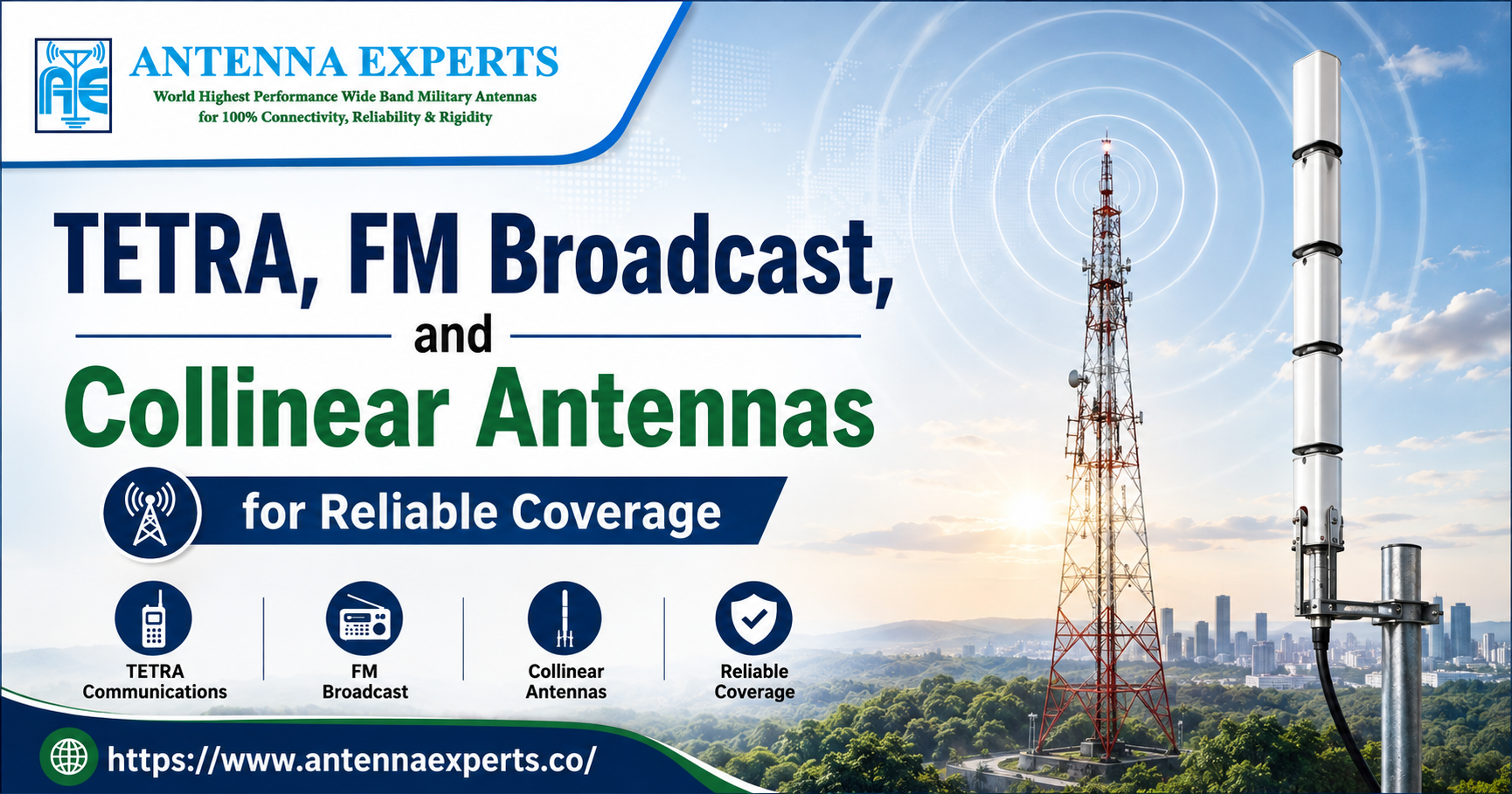
Good coverage starts with the right antenna. That's true for a TETRA base station, an emergency vehicle's collinear array, or an FM transmitter serving a whole region. The fix isn't the highest gain on a spec sheet. It's the right band, gain, and polarization for the work at hand. Get that right, and the network holds up when it matters most.
Need help specifying the right coverage antenna for a network or broadcast project? Browse the High Gain TETRA Antenna, Fiberglass Collinear Antenna, and FM Broadcast Antenna ranges, or contact Antenna Experts at [email protected] or +91 98102 05738 for a coverage antenna recommendation.
Comments
Log in or sign up to join the conversation.