

2020 has seen Tesla's (TSLA) stock price jump by 127%, opening the year at $425.77 a share, and spiking to $968.52 on February 4. What's even more astounding is that $300 of this price difference took place this week, with a 20% rise on Monday and a further 14% rise on Tuesday.
2020's strong performance follows an increase of nearly 195% in the past 12 months, and a 400% rise from the 52-week low of $178 (June 3, 2019).
(Click on image to enlarge)
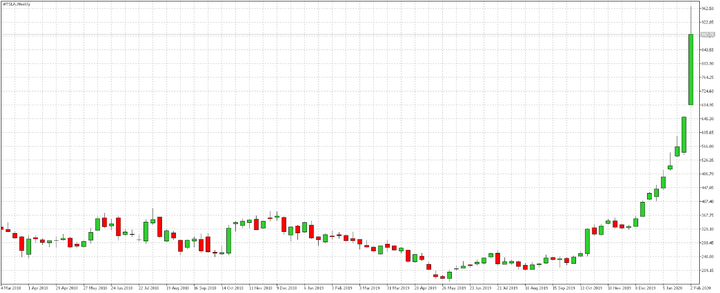
Source: Admiral Markets MetaTrader 5, #TSLA, Weekly - Data range: from 4 March 2018 to 5 February 2020, accessed on 5 February 2020 at 9:30am EET. Please note: Past performance is not a reliable indicator of future results.
Why is Tesla's stock price so high?
So why has Tesla's price climbed so high, seemingly out of nowhere? While the stock's 2020 gains are unprecedented, the overall upward trajectory over the past 6 months does have fundamental support.
First, Tesla released a strong Q4 earnings report on January 30. Profits were up, Tesla had made a record number of sales (more in 2019 than the previous two years combined), and Elon Musk shared expectations that the company would increase their sales by a third in 2020 - all good news for the bulls.
Second, Tesla announced it would be releasing its crossover electric SUV, the Model Y, three months early.
Then there is the element of popularity. One of the reasons companies like Google, Apple, Facebook and Amazon are such attractive investment opportunities is because their products are popular with the wider population. When inexperienced investors are looking for somewhere to invest, many start with brands they know and love, and inexperienced investors turning to Tesla helps increase the price for everyone.
What triggered Monday's 20% Tesla price rise?
Beyond the previous months' fundamentals, the stock also benefited from the February 3 earnings report from Panasonic Corporation, which is Tesla's battery partner.
Panasonic posted better-than-expected earnings for Q3, 2019, reporting an operating profit of about $924 million - 33% higher than the average analyst estimate of $620 million, and up 2.9% from the previous year.
Panasonic's price also spiked following the announcement, as seen the the yellow box in the chart below - jumping from a close of $1,083 a share on Monday to open at $1,165 a share on Tuesday.
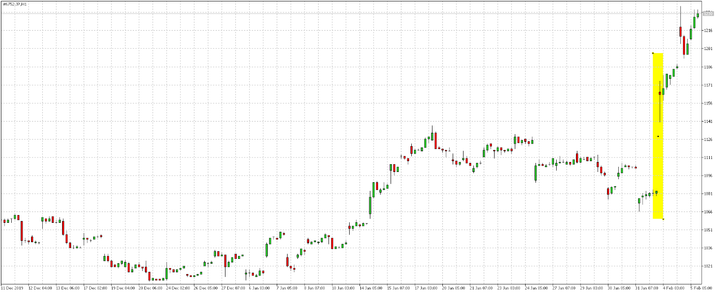
Source: Admiral Markets MetaTrader 5, #6752.JP, Hourly - Data range: from 11 December 2019 to 5 February 2020, accessed on 5 February 2020 at 10:00am EET. Please note: Past performance is not a reliable indicator of future results.
This was Panasonic's first quarterly profit in its US battery business with Tesla, following years of production issues and delays. This increase in profits is a sign that the costs of battery production are falling, which will benefit all players in the field of electric vehicles - including Tesla.
The Tesla short-squeeze pushing stocks higher
According to Business Insider, #TLSA is the most-shorted US stock, with $16 billion in short interest, which accounts for nearly one fifth (18.22%) of available shares.
The financial positions of these short traders have taken heavy hits over the past few months, with the short market losing $2.5 billion on Monday alone.
With the rise in Tesla's stock price over the past few months paired with Monday's positive news, it led to a short squeeze in the stock, or the rapid increase in a company's share price due to low supply and high demand.
Essentially, traders and investors who were short in Tesla shares close their positions to cut their losses, or are closed out due to margin calls. Because a short trade is a sell trade, closing that trade essentially means the trader is buying back the stock (if you start with 0 shares and open a short trade on one share, your position is -1 shares. Buying to close the trade brings you from -1 back to 0), this means there is an influx of demand to buy Tesla shares, and when demand outstrips supply, prices increase - often dramatically, when there are a large number of short positions on that stock.
Where will Tesla's stock price go next?
Many traders and analysts are worried that there will now be a sudden correction in Tesla's share price. In fact, at the time of writing, Tesla's stock has already dropped to $887.75 a share - a drop of $80.77 since yesterday.
On top of that, some analysts are saying that now it is time for investors to take their profits.
In the long term, though, there are many investors who believe that Tesla still has room to grow, with former Wall Street analyst Gary Black saying on Twitter that Tesla should be worth more than GM, Fort and Fiat Chrysler combined due to having the first-mover advantage.
Billionaire Tesla investor Ron Baron also believes Tesla has room to grow, telling CNBC that Tesla has the potential to hit "at least" $1 trillon in revenue in 10 years, and to continue to grow from there.
In any case, it will be an interesting journey ahead.


Comments
Log in or sign up to join the conversation.