

Updated July 5, 2018
Tesla’s (TSLA) executive turnover is widely believed to be unusually high, although this belief seems to be based on anecdotal evidence, rather than quantitative evidence. Famed short seller Jim Chanos, for instance, calls Tesla’s rate of executive turnover “stunning”. He says it’s among the highest turnover he’s seen at any company he’s looked at. Chanos never mentions, however, whether he actually benchmarks Tesla’s rate of turnover against any kind of average, or even compares it on a quantitative basis to another company.
It is possible that Chanos’ firm Kynikos Associates has data or analysis that it hasn’t shared publicly. However, Chanos makes other bizarre claims about Tesla that cause me to seriously question his research methodology. For instance, in an interview with CNBC he claimed that Tesla was behind on autonomy because Enhanced Autopilot is a Level 2 system, whereas Waymo’s (GOOG, GOOGL) test vehicles use a Level 4 system. This is a basic misunderstanding that shows a surprising lack of due diligence. Tesla’s internal test vehicles, just like Waymo’s, are intended Level 4 systems in development. Tesla’s driver assistance system, Enhanced Autopilot, is a Level 2 system, like other driver assistance systems. Waymo has no driver assistance product. To not understand this distinction is to not understand autonomy. This is a mistake as big and glaring as not understanding the difference between all-electric cars and hybrids.
In another interview, Chanos expressed his view that Elon Musk will step down as Tesla’s CEO. As evidence, he cited the fact that in the photographs of Musk in a profile by Rolling Stone, Musk was pictured next to SpaceX rockets, not next to Tesla cars. This is a bizarre, bewildering thing to say. First, in the online version of the article at least, there is a stock image of Musk standing on stage next to a Tesla Model 3. Second, this is just such an odd logical leap to make. Presumably, Musk did not make these kinds of creative decisions for Rolling Stone. Maybe Rolling Stone thought photos of rockets looked cooler and more novel than photos of cars.
These kinds of bizarre statements lead me to doubt whether Chanos has actually benchmarked Tesla’s executive turnover rate against an average, even privately. There are some clear gaps in his due diligence and his weighing of evidence. I also haven’t seen anyone publicly attempt to benchmark Tesla’s turnover against an average. So, I pulled together the data I could find to attempt it myself.
I found two sources of data on average executive turnover:
- A 2014 academic study by Peter Cappelli and Monika Hamori that exclusively covered executives at financial companies in the New York area. (Non-paywalled manuscript.) It found an average executive tenure of 5 years.
- A 2015 survey by job site ExecuNet that covered U.S. executives across industries. It found an average tenure of 4.1 years.
The academic study’s methodology is probably more rigorous than the survey’s methodology, but the survey data is more generalizable than the study data. So I’ll use both averages.
I also found two sources of data pertaining to Tesla’s average executive tenure:
- A May 2018 analysis by Christian Prenzler at Teslarati, who looked at the LinkedIn profiles of Tesla executives at the VP level and higher. Prenzler found that the average tenure of these executives was 4.5 years.
- A March 2017 statement from Tesla to Bloomberg pertaining to Tesla’s “senior leadership team”. Doing some simple math, Tesla’s statement implies that the average tenure of its senior leadership team is at least 4.8 years, and likely higher. To complement this statement, Reuters’ tally shows no increase in the rate of executive departures between 2017 and 2018 year-to-date, so this statement should still be relevant today.
Using Prenzler’s finding of 4.5 years, Tesla’s average executive tenure is 10% or 6 months shorter than the Cappelli and Hamori study average of 5 years, and 10% or 5 months longer than the ExecuNet survey average of 4.1 years. So, between 10% shorter and 10% longer than average. Let’s call that about average.
Using Tesla’s statement, which implies a minimum average tenure of 4.8 years, the average tenure of Tesla’s senior leadership team is no more than 4% or 10 weeks shorter than the study average of 5 years. It’s at least 17% or 8 months longer than the ExecuNet survey average of 4.1 years.
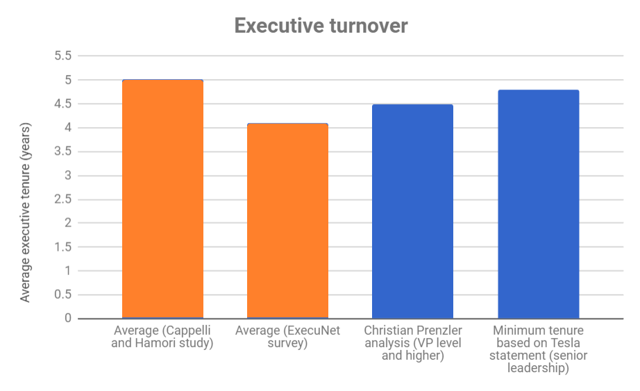
So, is Tesla’s rate of executive turnover “stunning”? It doesn’t look like it. It looks about average. Maybe a little higher, maybe a little lower.
If you’re aware of any data or analysis that contradicts this finding, please let me know. I would love to hear about it.
For now, we should treat this as a cautionary tale. Sometimes a lot people believe things without quantitative evidence, and even when the quantitative evidence available contradicts it. I think this happens a lot with Tesla. Human cognitive bias and systemic media bias toward negative, rare events has created a set of predictably irrational beliefs about Tesla that are widespread.
Skepticism about Tesla’s ability to grow enough to justify a higher valuation is fair and reasonable. If the case for a market-beating return on Tesla stock were obvious and free of serious risk, then the valuation would already be higher and there would be no opportunity. This is something reasonable people can disagree about, and it isn't obvious who is right.
There is inadequate skepticism, however, of sensational claims about why the company is doomed to fail. I would encourage short sellers to discount anecdotal evidence and base their beliefs only on quantitative evidence and other hard evidence. To believe things without checking the data to see if they are true is to risk falling into a financially painful trap.
Update (July 5, 2018): Galileo Russell at HyperChange found Jim Chanos’ spreadsheet tallying Tesla’s executive departures and calculated an average tenure of 4.6 years among departed executives. That’s right in line with the 4.5 years that Christian Prenzler at Teslarati found.
As of April 30, 2018, Chanos’ spreadsheet showed 7 executive departures from January to April 2017 and 8 departures from January to April 2018. This pretty much matches up with Reuters’ tally (credit to Tom Randall at Bloomberg for pointing this out). So, there is no discernible major increase in the rate of departures from 2017 to 2018.
Chanos’ spreadsheet shows a marked increase from 2016 to 2017, but there are two variables that need to be controlled for: 1) change in the overall number of executives as the company has grown and 2) any increase in the level of media scrutiny, since with more scrutiny more departures are reported.


Comments
Log in or sign up to join the conversation.