

The highly anticipated "Battery Day" didn't play out for the Tesla (TSLA) stock as expected. While Tesla and its CEO Elon Musk certainly stood out with its impressive technology plans, capacity and cost targets, some of Musk's promises lacked substance. In fact, Musk himself acknowledged that the ambitious technology is proving "Insanely difficult" to manufacture at high volume.
But with Musk failing to deliver anything really new on "battery day", and instead promising a $25,000 car which he has been discussing for the past three years and which comes with a risk, Tesla's market capitalization of still more than 400 billion USD seems a bit elevated compared to its competition.
Tesla loses its advantage over competition like VW
The disappointment among market participants can already be seen in the sharp drop in Tesla's stock in the days following battery day, with the stock dropping below 400 USD per share again.
And we expect further losses in Tesla's stock ahead as the signs of a bubble in Tesla's stock price are still clearly visible:
- According to Bloomberg data, global car companies currently see sales of around 2.3 trillion USD – ex-Tesla
- These companies have a $100 Billion EBIT and a market capitalization of around 805 – 810 billion USD - combined
- While Tesla has a market capitalization of more than 430 billion USD (half of what all other car companies have in market cap combined), it saw sales in 2019 of only 25 billion USD and no EBIT since Tesla does not make any money (at least not yet).
Some might argue now that Tesla made money in the last four quarters, but only because of profits made from regulatory credits which Tesla receives for selling electric cars, some of which they sell to other carmakers.
While Tesla certainly had an advantage, compared to its competitors like VW, when starting from scratch without having to make an internal combustion engine car into an electric car, over the next years, Tesla, and all other electric carmakers, can expect only incremental gains in battery efficiency.
And as VW has introduced their ID.4 sport utility, which is said to sell thousands less than the Tesla Model Y SUV and as Tesla is still struggling to at least deliver a previously promised $35,000 Model 3 sedan, we see rough times for Tesla stock ahead.
How can you trade TSLA in this environment?
Technically, the mode for TSLA remains bullish above the SMA(200), but a break below 330.00 USD can be considered a clear bearish sign, making a test of the February lows and at least a short-term push to below the SMA(200) towards 195.00 USD very likely.
Such a bearish scenario will be negated with TSLA if bulls regain control and push the stock back to above 460.00 USD – a scenario which would come as a surprise given the bearish seasonal window which the broader US equity market just entered on the 21st of September that likely will last until the US presidential election at the beginning of November:
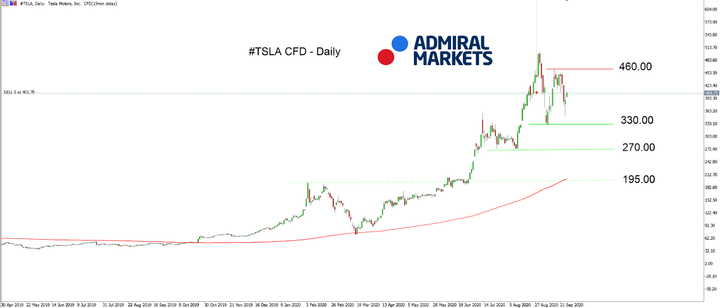
Source: Admiral Markets MT5 with MT5SE Add-on TSLA chart (between April 30, 2019, and September 28, 2020). Accessed: September 28, 2020, at 10:45 AM GMT - Please note: Past performance is not a reliable indicator of future results or future performance.
In 2015, the value of TSLA increased by 7.7%, in 2016, it decreased by 7.4%, in 2017, it increased by 44.9%, in 2018, it increased by 6.7%, and in 2019, it increased by 36.7%, meaning that in five years, it was up by 87.7%.



Comments
Log in or sign up to join the conversation.