

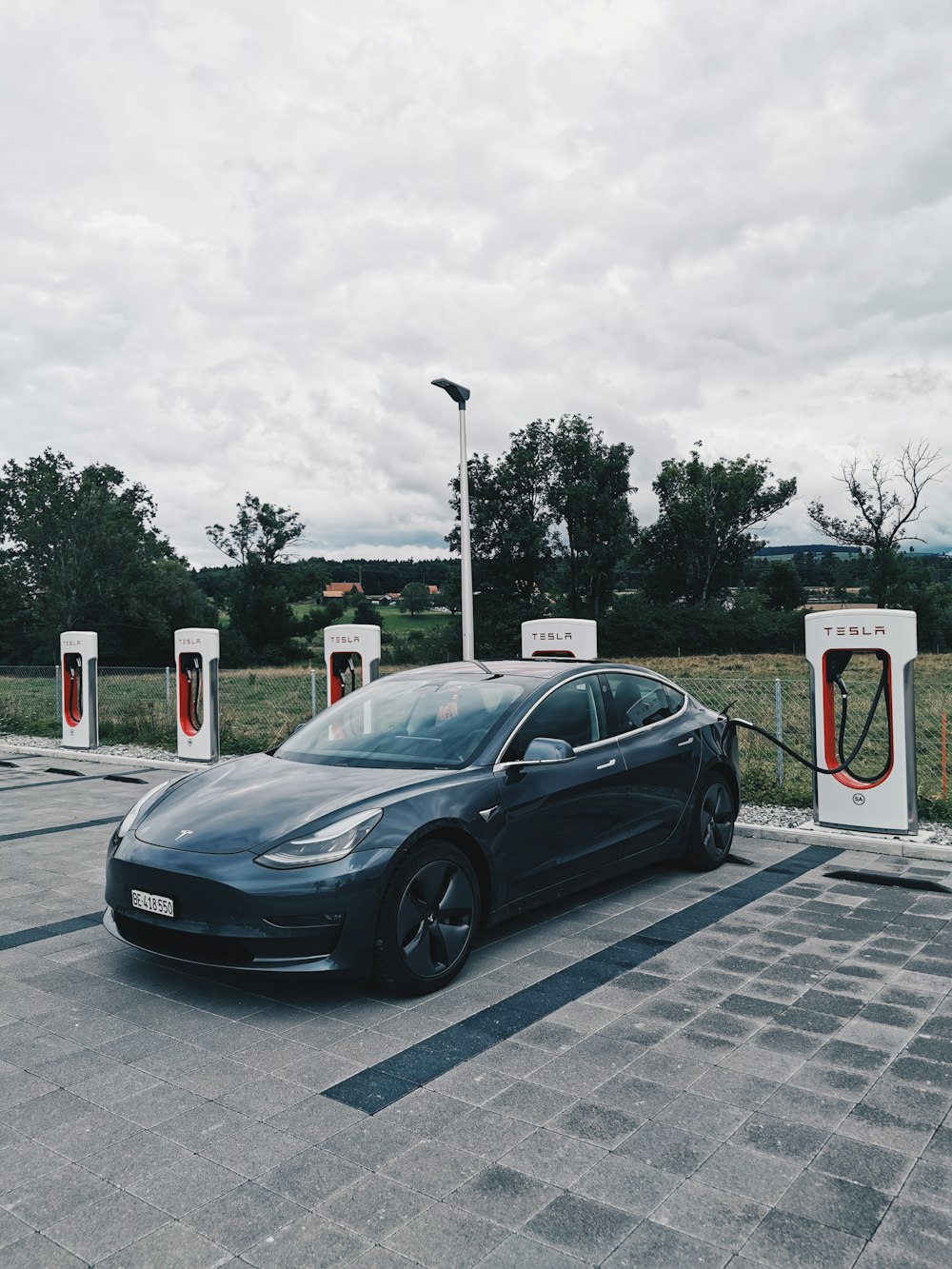
Tesla (NASDAQ: TSLA) shareholders have endured a fairly turbulent year to date. The Electric Vehicle (EV) maker was a victim of January's tech sell-off but recovered slightly following some positive results. More recently, there's been a mixed of positive and negative news for investors. The firm enhanced its long-term prospects with the opening of its fourth manufacturing plant in Texas last week. However, this was tempered by news of new Covid-19 lockdowns in China which have had a short-term impact on production at the company's Shanghai plant.
Musk's world-leading EV firm is now trading at a near 20% discount against the beginning of the year. Despite the fall, I still don't think Tesla stock is cheap, particularly in the context of an increasingly competitive EV marketplace.
What's behind Thursday's drop?
Tesla shares dropped nearly 4% on Thursday after CEO Elon Musk offered to buy the social media firm, Twitter. One concern is that Musk may sell Tesla shares to finance his takeover of Twitter. Shares of Tesla are down about 14% since Musk first revealed his stake in the social media giant on April 4. The South Africans most liquid assets would be his Tesla shares - valued at $170bn. Selling some of his Tesla shares could put downward pressure on the stock. Some Tesla investors may think the Twitter purchase will divert Musk's attention away from his EV maker.
Is Tesla starting to look cheap?
Tesla's valuation has always been problematic for me. While I appreciate a large proportion of its $1tn valuation is based on future earnings and the growth of the EV market, that concerns me as an investor. The first reason for this is that in a record-breaking 2021, the company reported revenues of just $53.8bn, leading to adjusted EBITDA of $11.6bn and net income of $5.5bn. For me, this means Tesla is a long way off being a company that is genuine worth more than $1tn.
I appreciate that Tesla's revenue growth is impressive. In the last 5 years, Tesla has increased its revenue by 668.9%, going from US$7b in December 2016 to US$53.8b in December 2021. Maintaining this growth rate in the current climate – partially defined by semiconductor shortages – will be difficult in near and medium term. BMW CEO Oliver Zipse said this week that he foresaw the semiconductor shortage continuing through until 2023. This feature may make it hard for Tesla to build their chip-heavy EVs in line with demand.
Moreover, and I think this may be the biggest factor, other companies are catching up and even surpassing Tesla's offering in the EV space. There are new companies focusing only on the EV sector, like Lucid, and there is a host of established car manufacturers with new offerings in the sector.
For example, Lucid announced that it would begin deliveries of a new performance model of its luxury Air Grand Touring sedan in June 2022. The model competes with Tesla's Model S Plaid which can accelerate from zero to 60mph in about two seconds and can deliver a peak of 1,020hp. Lucid's Grand Touring Performance model reaches the benchmark speed in 2.6 seconds and can deliver 1,050hp.
But, if I were a Tesla investor, I'd be more concerned about growing competition from established car brands. Not only do these companies have well-developed reputations, but some manufacturers are already rivalling and surpassing Tesla's offering in the sector. Mercedes – a brand which is synonymous with luxury and reliability – is the current manufacturer with the longest-range vehicle on sale. The German auto-powerhouse also flexed its EV-muscles this week. Its electric concept car, the Vision EQXX, successfully completed a long-range test of over 1,000km on a single battery charge. On arrival at its destination in southern France, it still had 15% charge left.
Tesla are also being undercut by a number of other brands. The cheapest Tesla starts around $45,000; and in the UK that becomes, for one reason or another, £45,000. That's considerably more than a lot of other EVs on the market. One competitor worth noting for the cost conscious buyer is the MG ZS EV. The SUV, which has many of the modern features a driver has come to expect, is available for a little over £25,000 in the UK. Yes, MG is a now a Chinese company, but American manufacturers haven’t traditionally had the best reputation in the UK either.
It's also worth noting that thousands of Tesla cars have been recalled due to a variety of issues. In February, Tesla recalled 579,000 US cars and SUVs over 'Boombox' safety violations. In December, it was announced that Tesla would be recalling 475,000 vehicles due to the "unavailability" of a rearview camera on the Model 3 and front hood issues on the Model S. Tesla said its Model S cars, available from $94,990, were being recalled due to issues with the front hood that could lead to it opening “without warning, obstruct[ing] the driver's visibility [and] increasing the risk of a crash.”
Am I buying?
Unsurprisingly, I don't think Tesla stock is looking cheap. Yes, there certainly is growth potential. But potential is risky. Other brands – notably some with better reputations – are now producing EVs which are comparable and even superior to Tesla's offerings. This is why I won't be buying.
Naturally, I'm not the only person to pose that Tesla is overvalued. In fact, in late 2021, David Trainer, CEO of investment-research firm New Constructs, said he believed the EV maker was overvalued by roughly $1tn – a vast proportion of its valuation at the time.


Comments
Log in or sign up to join the conversation.