

Safety requirements on construction sites, industrial facilities, warehouses, infrastructure projects, and public areas can change quickly. Work zones may move, maintenance activities may create temporary hazards, and access routes may need to be redirected without installing permanent protection.
This is where Temporary Barriers provide a practical solution. A properly planned Temporary Barriers system helps organizations control access, separate people from hazards, manage traffic movement, and improve workplace safety while maintaining operational flexibility.
Across Saudi Arabia, temporary barrier solutions are increasingly relevant for construction, industrial, commercial, logistics, and infrastructure environments where safety requirements can change during different phases of a project.
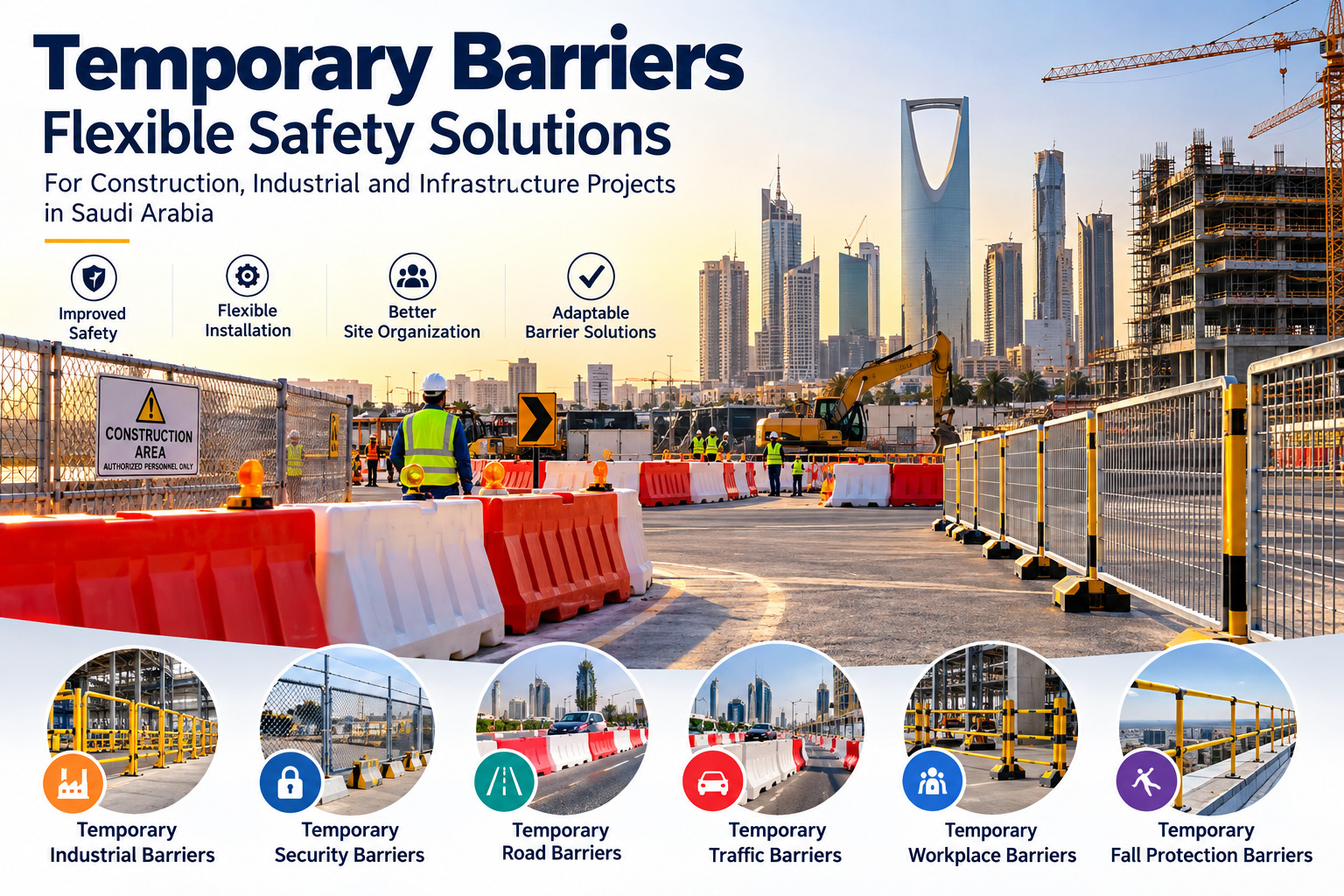
What Are Temporary Barriers?
Temporary Barriers are protective systems installed for a limited period to separate hazardous areas, restrict access, guide movement, or protect workers and visitors.
Unlike permanent barriers, they can often be positioned according to changing site conditions and project requirements.
Depending on the application, a Temporary Safety Barriers system can be used around:
Construction work zones
Maintenance areas
Vehicle routes
Machinery zones
Restricted industrial areas
Loading and unloading locations
Excavations or hazardous areas
Temporary pedestrian routes
Rooftop or elevated work areas
Their flexibility makes them suitable for projects where permanent installation may not yet be required or where site layouts frequently change.
Improving Safety in Changing Work Environments
Industrial and construction environments rarely remain unchanged throughout a project.
Equipment moves, temporary storage areas are established, access routes are modified, and new hazards may appear as work progresses. Temporary Workplace Barriers allow safety teams to respond to these changing conditions without redesigning the entire site.
By clearly separating workers, vehicles, equipment, and hazardous areas, Temporary Barrier Systems can contribute to better site organization and safer movement.
Organizations searching for Temporary Safety Barriers in Saudi Arabia should consider the actual hazard, location, traffic conditions, required protection level, and duration of use before selecting a barrier solution.
Temporary Industrial Barriers
Factories, warehouses, workshops, logistics facilities, and production plants frequently have areas that require temporary separation.
Temporary Industrial Barriers can help isolate:
Maintenance operations
Equipment repair zones
Machinery movement areas
Material handling locations
Restricted production zones
Loading bays
Temporary storage areas
Industrial facilities can also use Temporary Barrier Solutions while modifying layouts or installing new equipment.
Because these barriers can support changing operational requirements, they are particularly useful where fixed barriers would limit future flexibility.
Temporary Security Barriers
Temporary protection is not limited to workplace hazards.
Temporary Security Barriers can also be used to control movement and prevent unauthorized entry into restricted locations.
Potential applications include project boundaries, temporary access areas, restricted construction zones, maintenance sites, industrial compounds, and controlled operational areas.
A visible Temporary Barriers system can make restricted boundaries easier for workers, visitors, contractors, and vehicle operators to recognize.
Temporary Road and Traffic Barriers
Roadworks and infrastructure projects frequently create changing traffic conditions.
Temporary Road Barriers and Temporary Traffic Barriers can help separate vehicles from work areas and guide traffic through temporary routes.
They may be used around:
Road maintenance projects
Construction entrances
Infrastructure development areas
Temporary lane changes
Utility maintenance works
Vehicle and pedestrian separation zones
Good traffic management requires barriers to be positioned according to actual vehicle movement, road conditions, visibility, and project requirements.
Temporary Hazard Barriers
Temporary hazards can appear in almost every workplace.
Maintenance work, damaged flooring, equipment servicing, construction activities, open work areas, or restricted zones can create short-term risks.
Temporary Hazard Barriers help visually define these areas and reduce unnecessary access.
However, barrier selection should always reflect the severity of the hazard. A lightweight visual barrier may be appropriate for simple access control, while higher-risk areas may require stronger engineered protection.
Temporary Fall Protection Barriers
Working near exposed edges, rooftops, access openings, or elevated platforms can create serious fall hazards.
Depending on the project conditions, Temporary Fall Protection Barriers may be installed to create physical separation between workers and exposed edges.
Typical applications may include:
Rooftop maintenance
Construction floors
Elevated work platforms
Temporary access areas
Open edges
Service and maintenance zones
Fall protection systems should always be selected according to applicable project requirements, risk assessments, and safety regulations.
Why Temporary Barrier Systems Are Useful
Temporary Barrier Systems can provide several practical advantages during project execution.
Flexible Installation
Barrier arrangements can be modified when site conditions change.
Clear Area Separation
Temporary barriers help distinguish work areas, pedestrian routes, traffic lanes, and restricted zones.
Support for Short-Term Operations
Maintenance, construction, renovation, and temporary industrial activities may not require permanent barriers.
Improved Site Organization
Clearly defined safety zones can improve movement and make operational areas easier to manage.
Adaptability
Different Temporary Barrier Solutions can be selected according to traffic, environment, hazard level, and project duration.
Selecting the Right Temporary Barrier Solution
Not every temporary barrier provides the same level of protection.
Before selecting a system, project teams should assess several important factors.
Hazard Type: Identify whether protection is required from vehicles, falls, machinery, unauthorized access, or another hazard.
Site Environment: Outdoor exposure, industrial operations, temperature, dust, moisture, and traffic conditions may affect system selection.
Barrier Location: Consider whether the system will be used on roads, rooftops, factory floors, construction sites, warehouses, or pedestrian areas.
Duration: Determine whether the barrier will remain in place for a few hours, several weeks, or throughout a project phase.
Movement Requirements: Where workers, forklifts, vehicles, or equipment regularly pass through an area, barrier positioning should support safe movement.
Required Protection Level: The strength and configuration of the barrier should be appropriate for the identified risk.
Temporary Safety Barrier Solutions in Saudi Arabia
Saudi Arabia continues to develop major industrial, logistics, commercial, infrastructure, and construction projects. Many of these environments require safety systems that can adapt as project conditions change.
Temporary safety barrier solutions in Saudi Arabia can therefore support contractors, industrial operators, facility managers, and project teams by providing adaptable protection for temporary hazards and restricted areas.
The most effective solution begins with identifying the actual risk rather than selecting a barrier based only on appearance or convenience.
Temporary vs. Permanent Barriers
Temporary barriers and permanent barriers serve different purposes.
Temporary systems are generally more suitable where site layouts or hazards may change, while permanent barriers are commonly used where long-term protection is required in a fixed location.
In some projects, both systems may be used together. Temporary barriers can protect changing work zones during construction or maintenance, while permanent safety barriers provide long-term protection after project completion.
Final Thoughts
Temporary Barriers are an important part of flexible safety planning for modern industrial, construction, infrastructure, and workplace environments.
From Temporary Security Barriers and Temporary Road Barriers to Temporary Workplace Barriers, Temporary Hazard Barriers, and Temporary Fall Protection Barriers, the correct solution depends on the specific risk and operating environment.
#TemporaryBarriers #TemporarySafetyBarriers #SafetyBarriersSaudiArabia #TemporaryBarrierSystem
#IndustrialSafety #TemporaryIndustrialBarriers
Comments
Log in or sign up to join the conversation.