

In my 45 years in the investment business, we’ve observed numerous peaks of excitement. In 1987, a bull market that started at a 1982 bottom below 800 on the Dow Jones Industrial Average (DJIA) peaked at 2,722. It then crashed 43% in 78 days. In 1990, following a nationwide Savings and Loan Crisis, the S&P 500 Index bottomed at 322 and peaked at 1,517 in June of 2000. The proceeding bear market took the index down to 916 on June 1, 2002. The index never officially bottomed until September 1, 2008 at 896. It has now hit a recent peak of 7,580.
What did these situations have in common? First, they started with cheap stocks after a bear market decline loaded with fear and investor pessimism. The longer the market moved forward, the more confident investors became. Ultimately, euphoria took over and investors gained what we would call damaging confidence.
In a piece this week, Thomas R. Carroll, Director at Stifel, and his associate, Miles Matyiko, point out what Warren Buffett said about bull-market runs.1 I believe I heard Buffett say one time that a bull market is like an orgy; it always gets the most exciting towards the end. Carroll explains, “Bull markets have explosive starts, unexciting middles and FOMO-driven finales.” The great investor Sir John Templeton always said, “Bull markets are born on pessimism, grow on skepticism, mature on optimism, and die on euphoria.”
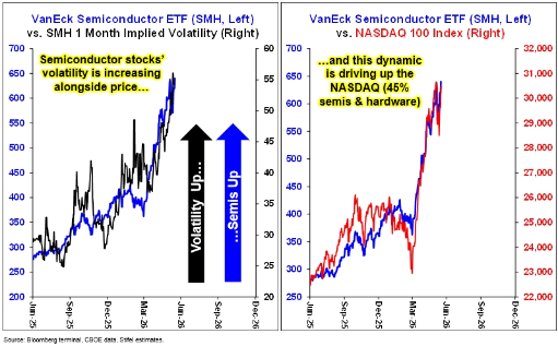
Carroll argues that history shows that when dispersion peaks at major tops in the index, it is a sign of a coming rotation. He says, “They go out with a bang.” Historically, it is a time to get away from whatever seems to be making everyone wealthy. He used this chart of the Van Eck Semiconductor ETF (SMH):
Source: Stifel.
Therefore, if you are wondering why we are positive about the companies in industries like oil and gas, homebuilders and regional banks, look no further than the chart below.
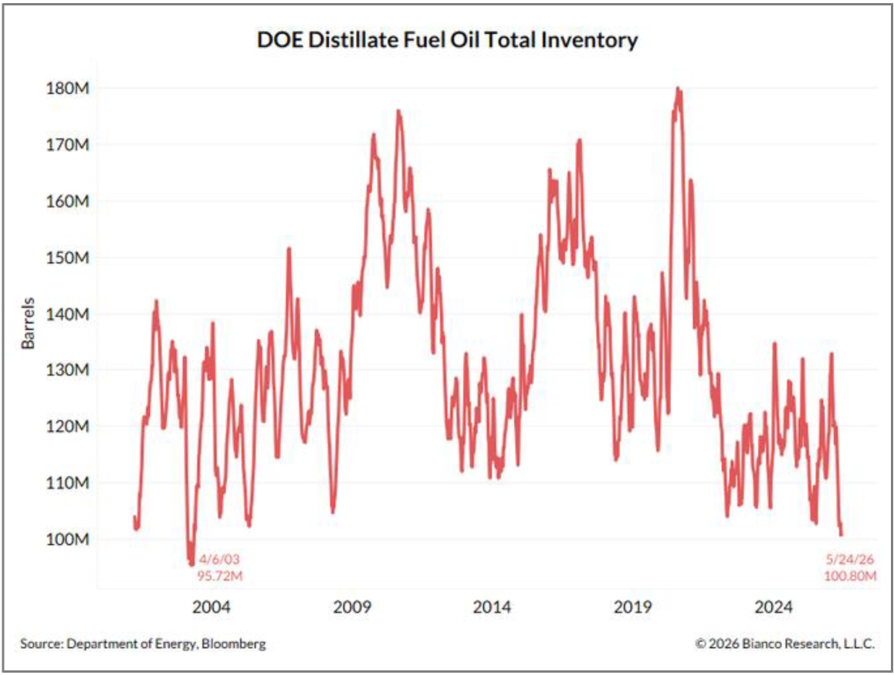
We expect homebuilders and regional banks to do quite well when money comes out of the popular technology trade of the day. Much like in 2000-2002 when there was a pretty good run in mundane industries and the DotCom mania ended.
Play The Long Game.



Comments
Log in or sign up to join the conversation.