

Energy stocks are still the year’s top-performing sector, but yesterday’s tech-led surge in equities — and energy’s stumble — suggest another leadership change may be brewing.
The S&P 500 Index soared on Tuesday (Aug. 4) to a record high, exceeding the previous peak (set in early June) by a wide margin. One day’s trading should be viewed cautiously, but it’s also tempting to view yesterday’s blowout rally as the release of pent-up bullish energy that’s been contained over the past month by renewed geopolitical risk linked to the Middle East — risk that may be, possibly, set to ease in the weeks and months ahead. If so, the main catalyst that’s supported energy shares this year may have crested.
Viewed from a year-to-date perspective, energy is still holding the top spot, based on a set of ETFs through Tuesday’s close (Aug. 4). The SPDR Energy ETF (XLE) is posting a 32.7% gain in 2026, slightly ahead of tech’s 30.1% rise, based on the SPDR Technology ETF (XLK). Both performances are far ahead of the market benchmark’s 13.7% increase.
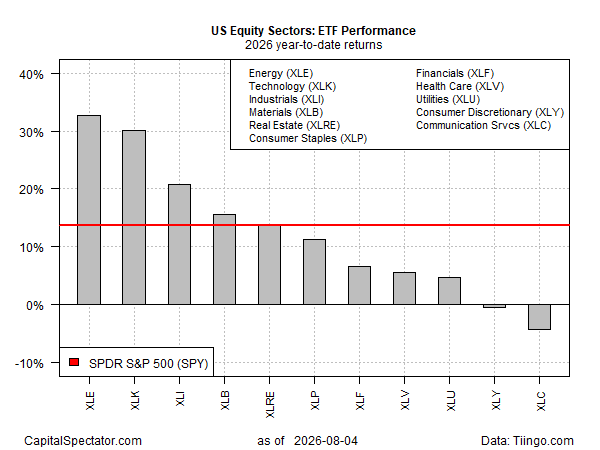
But yesterday’s market action for energy and tech stocks highlights a divergence. While tech (XLK) soared 5.0% on Tuesday, energy (XLE) dipped 0.5%. Set against the backdrop of reports that yet another U.S.–Iran peace deal may emerge this week, the crisis premium that’s lifted energy stocks may fade.
“We are in talks with the Iranians,” Treasury Secretary Bessent told CNBC on Tuesday. “There is a chance we may have a deal today or tomorrow to open the Strait and move towards a more normalized position in this conflict.”
President Trump confirmed the possibility, telling reporters on Tuesday that a deal could come as early as today. “It could happen. Tomorrow or the next day,” he said, speaking on Tuesday. “A lot of progress has been made.”
Skepticism is still recommended when it comes to the prospects for peace in the Middle East. One risk is that Iran isn’t the only factor affecting energy prices. Yemen’s Iran-backed Houthis reportedly struck a Saudi Arabian tanker in the Red Sea today, a reminder that this remains a multi-front conflict.
It’s reasonable to assume that Iran risk will remain a shape-shifting cloud that hangs over energy markets well into the future. A formal end to the fighting and full resumption of energy exports may not be forthcoming. But the political incentive for the White House to downsize the war and its macro effects ahead of the mid-term elections is strong, and growing by the day. That implies that gray-zone clashes that straddle the line between war and peace are the more likely path, moving these events off the front pages and helping Wall Street refocus elsewhere.
Yesterday’s market action offered a test of this theory as the AI-driven earnings narrative returned to the fore. Although there’s growing anxiety about AI’s costs and the extent of business opportunities with the technology, earnings data at the moment are strong enough to reanimate the tech bulls. FactSet (FDS) estimates that 86% of S&P 500 companies have reported actual earnings per share results in Q2 that beat analysts’ estimates.
A related benefit for market sentiment that flows from a less-acute Middle East crisis: softer inflation risk. Although it will take several months at a minimum to determine if pricing pressure will stabilize, ease or accelerate, some form of relative peace that facilitates higher energy exports through the Strait of Hormuz will favors forecasts of cooler inflation, which will give the Federal Reserve more space to delay rate hikes.
This relatively rosy scenario is precarious and could quickly fall apart since it rests on a shaky assumption: the worst of the Iran crisis has passed, which provides a backdrop for market sentiment to refocus on AI-related growth opportunities, real or imagined.
How long the sentiment shift lasts is unclear, but yesterday’s market surge suggests the crowd is again motivated to give optimism the benefit of the doubt.


Comments
Log in or sign up to join the conversation.