


Image: Bigstock
Retail giants Target (TGT - Free Report) and Walmart (WMT - Free Report) both topped Q2 earnings expectations this week and raised their full-year outlooks, but investors reacted very differently.
Target's turnaround gained further credibility following accelerating sales and traffic growth, while Walmart shares tumbled after softer-than-expected U.S. comparable sales and cautious near-term guidance overshadowed an otherwise solid quarter.
With that in mind, let's compare their latest results, valuations, and dividends to determine which stock offers the more attractive investment opportunity.
Target's Turnaround Gains Momentum
Target delivered one of its strongest reports in several quarters, with Q2 sales rising more than 5% year over year to $26.53 billion and topping estimates of $26.12 billion.
Comparable sales increased nearly 4%. Importantly, the improvement was largely traffic-driven, with comparable traffic rising 3.6%. Digital comparable sales increased 8.7%, fueled by more than 25% growth in same-day delivery.
On the bottom line, Target’s Q2 adjusted net income was $1.88 billion, including a $752 million tariff refund. Excluding the refund, this equated to adjusted earnings of $2.46 per share, up 20% YoY and comfortably exceeding expectations of $2.30.
When including the tariff refund, Target’s Q2 adjusted EPS more than doubled to $4.11.
Management subsequently raised its current full-year sales growth outlook to around 5% from annual revenue of $104.78 billion in FY25. More intriguingly, Target now expects FY26 adjusted EPS of $9.90-$10.90 (+30% growth). Excluding the $1.65 per share tariff-refund benefit, that implies roughly $8.25-$9.25, with the midpoint being $0.75 above Target's previous EPS guidance.
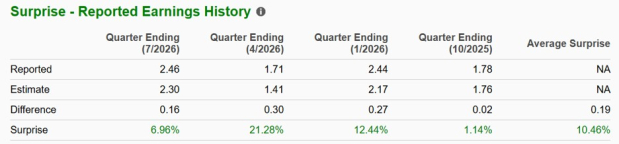
Image Source: Zacks Investment Research
Walmart Posts a Beat, but U.S. Sales Disappoint
Walmart's headline numbers were strong as well. Fiscal Q2 revenue increased nearly 6% to $187.93 billion and topped estimates of $186.23 billion.
Meanwhile, Walmart reported Q2 GAAP net income attributable to the company of $6.37 billion and adjusted earnings of $0.81 per share, which rose 19% YoY and comfortably topped EPS expectations of $0.73.
Global e-commerce sales jumped 23%, advertising revenue climbed 38%, and membership fee revenues rose 17%, highlighting Walmart's growing higher-margin revenue streams.
The concern was Walmart U.S. comparable sales excluding fuel, which rose just 2.6%, decelerating from 4.1% in Q1 and falling short of expectations. Pharmacy deflation created a sizable headwind, so the underlying result was somewhat better than the headline figure suggests, but investors were clearly expecting more from a stock carrying such a premium valuation.
Still, Walmart raised its current FY27 outlook, calling for constant-currency sales growth of 4%-5%, adjusted operating income growth of 7%-8.5%, and EPS of $2.80-$2.87 (+6% growth). However, softer Q3 guidance and management’s decision to invest heavily in keeping retail prices low contributed to the post-earnings selloff.
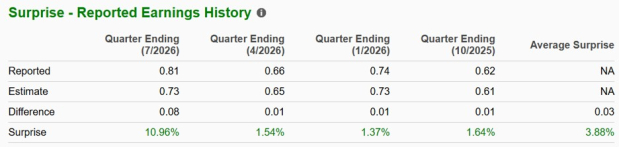
Image Source: Zacks Investment Research
Target Wins on Valuation and Dividend Yield
The valuation comparison arguably makes the biggest difference following their Q2 results. Target stock trades at 18X forward earnings, which isn't particularly cheap relative to its own history after its substantial year-to-date rally, but remains far below Walmart.
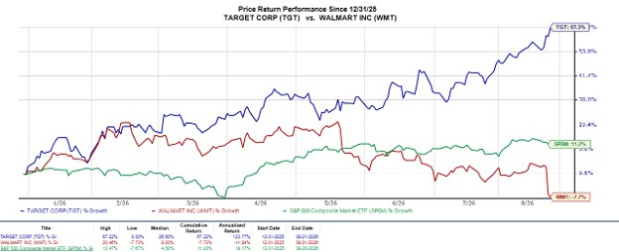
Image Source: Zacks Investment Research
Even after Walmart's roughly 9% post-earnings plunge, WMT still trades at 36X forward earnings and at a noticeable premium to the benchmark S&P 500’s 21X.
In comparison to Target, the premium reflects Walmart's superior scale, more defensive grocery exposure, consistent market-share gains, and rapidly growing e-commerce and advertising businesses.
That said, investors are paying twice Target's earnings multiple for those advantages.
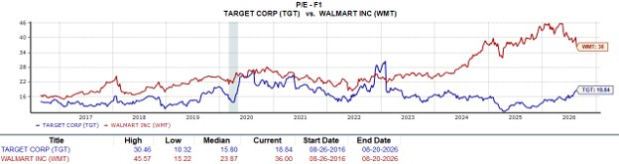
Image Source: Zacks Investment Research
Furthermore, Target has the clear advantage for income investors. Its recently increased $4.64 per share annual dividend yields around 3%, compared with Walmart's annual payout of $0.99 per share and roughly 1% yield.
Both are Dividend Kings with more than 50 consecutive years of annual dividend increases, but Target currently provides substantially more income.
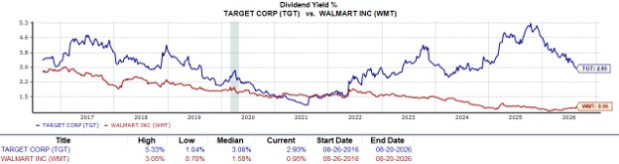
Image Source: Zacks Investment Research
Bottom Line: Target Looks Like the Better Investment After Q2
Walmart remains arguably the stronger business over the long term, thanks to its enormous scale, defensive sales mix, e-commerce momentum, and rapidly growing advertising and membership operations. However, Target looks like the more attractive investment at current valuations.
Target's 3.8% comparable-sales growth and 3.6% traffic increase offered encouraging evidence that its turnaround is gaining traction, while its 18X forward P/E multiple is far easier to justify than Walmart's 36X. Add Target's nearly 3% dividend yield, and investors are receiving much more income while paying a much lower valuation.
At the moment, Target stock sports a Zacks Rank #2 (Buy), reflecting a more favorable trend in EPS revisions, while Walmart stock lands a Zacks Rank #3 (Hold).

Comments
Log in or sign up to join the conversation.