

Swamimalai is one of the six sacred abodes of Lord Murugan in Tamil Nadu, and it tells a story unlike any of the others. Here, the son becomes the teacher — and the father, Lord Shiva himself, becomes the student. While most forms of Murugan are celebrated for valor, penance or divine love, Swamimalai's Murugan is honored for something rarer: wisdom so deep that even his own father came to learn from him.
This is why the temple holds such a special place among the Arupadaiveedu, the six sacred abodes of Murugan. It is not a site of war or victory, but of teaching — built around the idea that true wisdom has no regard for age, rank or relationship. This is the story behind why Swamimalai's Murugan is worshipped as Swaminatha, the Lord who taught even the guru of the universe — the same devotion behind the brass Swamimalai Murugan idol crafted at Idol Brass.
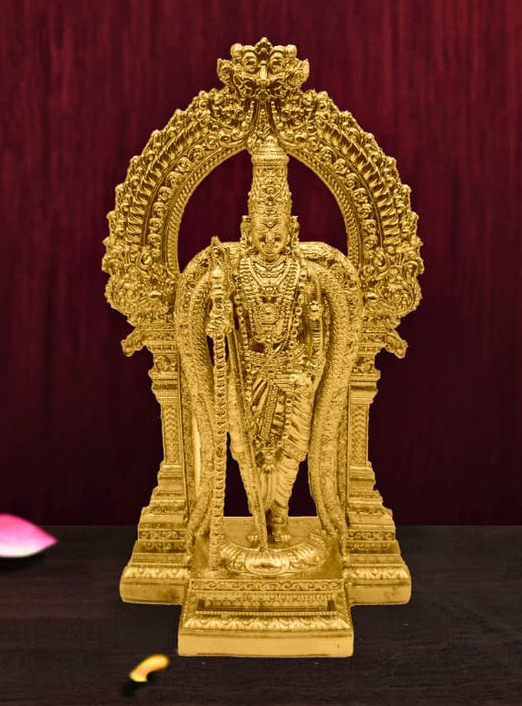
Who Is Swamimalai Murugan?
Swamimalai Murugan is a form of Lord Murugan, the youthful and radiant son of Shiva and Parvati, worshipped here specifically in his role as Swaminatha — "the Lord who is teacher." Unlike the Murugan of Thiruchendur, celebrated for slaying the demon Surapadman, or the Murugan of Palani, revered as an ascetic who renounced his possessions, the Murugan of Swamimalai is honored purely as a source of supreme spiritual wisdom.
The Sanatkumaras and the Question of Pranava
The story behind this form begins not with Murugan himself, but with the Sanatkumaras, the eternal child-sages, who once approached Brahma, the creator, to learn the meaning of the Pranava Mantra — the sacred syllable Om, said to contain the essence of all creation. Brahma, despite his exalted position, could not answer their question. His failure to explain something so fundamental set the stage for the very different kind of teacher who would step in next.
The Philosophy of Wisdom Beyond Rank
At the heart of the Swamimalai legend lies a deeply Tamil Shaivite idea: that spiritual knowledge is not granted by age, status or birthright, but by genuine understanding. This single principle — that even a child can be the true guru of the universe's creator — is what makes Swamimalai's Murugan so philosophically significant. It positions wisdom above hierarchy, suggesting that the capacity to teach flows from insight itself, not from position.
The Imprisonment of Brahma
Unable to answer the Sanatkumaras' question, Brahma's authority as creator was called into doubt. According to the legend, the young Murugan — already renowned for his boundless wisdom — confronted Brahma directly and asked him to explain the meaning of Pranava. When Brahma once again failed to answer, Murugan is said to have imprisoned him, taking over the responsibilities of creation himself until the matter could be resolved.
Murugan Becomes Guru to Shiva
News of Brahma's imprisonment reached Shiva, who came personally to intervene. Rather than simply reprimanding his young son, Shiva recognized the depth of wisdom Murugan possessed and asked to be taught the meaning of Pranava himself. Murugan obliged, explaining the sacred syllable to his own father with such clarity that Shiva acknowledged him as a true guru. It is this moment — a father humbly becoming a student of his son — that Swamimalai commemorates, and from which Murugan takes his name here as Swaminatha, "Lord of the Swamy."
Swamimalai Murugan Temple
The Swamimalai Murugan Temple stands on a small hillock near Kumbakonam in Tamil Nadu, on the northern bank of the Cauvery, and is counted among the Arupadaiveedu, the six principal abodes sacred to Murugan worship. Devotees climb sixty steps to reach the sanctum — a number deliberately chosen to represent the sixty-year cycle of the Tamil calendar, with each step traditionally associated with one year of that cycle.
The temple's identity is also closely tied to the region's long-standing tradition of bronze and panchaloha idol casting, as Swamimalai itself is one of Tamil Nadu's most renowned centers of traditional metal idol craftsmanship, home to generations of sthapathis who continue the ancient lost-wax casting method for temples across South India.
Spiritual Significance of Swamimalai Murugan
Wisdom beyond age or hierarchy — the central teaching of the legend, that true understanding does not depend on seniority.
Humility in leadership — Shiva's willingness to learn from his own son models spiritual humility at the highest level.
The power of Pranava (Om) — the story elevates the sacred syllable Om as the ultimate subject of divine knowledge.
Courage in pursuit of truth — Murugan's confrontation with Brahma reflects conviction in defending genuine understanding.
Continuity of craft and devotion — the region's living tradition of bronze idol-making mirrors the temple's own theme of knowledge passed carefully from one generation to the next.
Why Is Swamimalai Murugan Different from Other Murugan Forms?
Each of Murugan's six sacred abodes captures a distinct chapter of his character. Thiruchendur remembers him as a warrior who vanquished evil; Palani venerates him as an ascetic who turned away from worldly pride; Tiruttani and Pazhamudircholai celebrate his union with Valli, born of devotion and love. Swamimalai stands apart from all of these by focusing on Murugan not as a warrior, ascetic or romantic figure, but purely as a teacher — a role rarely given such central importance in Hindu iconography, and one that gives this particular form its lasting philosophical depth.
Conclusion
Swamimalai Murugan tells a story unlike any other in Hindu tradition — of a child teaching wisdom to his own father, and of knowledge triumphing over rank and age. As one of the six sacred abodes of Murugan, it continues to remind devotees that true understanding can come from the most unexpected sources, and that humility before wisdom is itself a divine quality worth honoring in daily life.
Comments
Log in or sign up to join the conversation.