

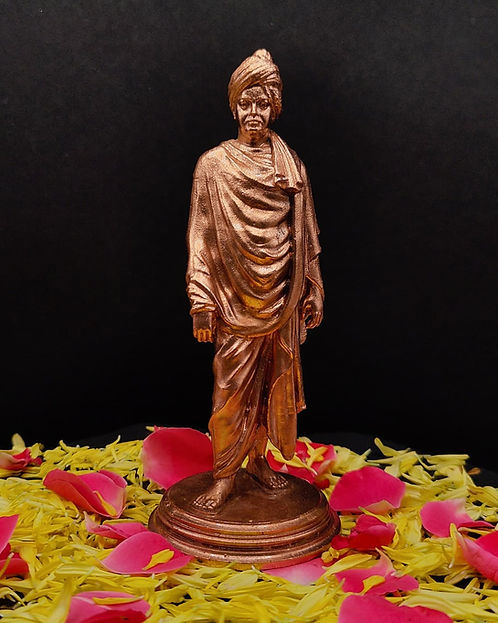
Swami Vivekananda - the monk who silenced a roaring Chicago crowd with nothing more than two words, "Sisters and Brothers" - remains one of the boldest, most electrifying figures to ever emerge from a small monastery in Bengal. His life reads less like a quiet spiritual biography and more like a fearless awakening: a sharp young skeptic who transformed into a global icon of discipline, intellect and unshakeable conviction. Today, a handcrafted Vivekanandar Idol carries that same electric spirit of courage and clarity into homes, study spaces and institutions.
For families who want more than a devotional object = something that also speaks to ambition, learning and inner strength - a bronze Vivekananda idol has become a quiet but powerful presence on study tables and in living rooms. This piece looks at his life, his ideas and why so many households are now choosing to bring him home through Idol Bronze.
Who Is Swami Vivekananda?
Birth and Early Life as Narendranath Datta
Swami Vivekananda was born Narendranath Datta on January 12, 1863, in Calcutta, into a family that valued both classical learning and rational thought. His father, Vishwanath Datta, was an attorney familiar with Persian and English literature, while his mother, Bhuvaneswari Devi, was deeply devout. This mix of intellectual rigor and spiritual devotion shaped Narendra from an early age - he was known as a sharp student, a trained singer and wrestler, and a young man who questioned religious authority rather than accepting it blindly.
Meeting Sri Ramakrishna Paramahamsa
The turning point in his life came through his meeting with Sri Ramakrishna Paramahamsa at the Dakshineswar Kali Temple. Where other visitors saw a simple priest, Narendra saw a man who claimed to have directly experienced the divine - and he tested this claim relentlessly with sharp, often skeptical questions. Ramakrishna's patience and evident spiritual realization gradually won over the young rationalist, and Narendra became his most devoted disciple, later taking the monastic name by which the world would come to know him: Vivekananda.
The Philosophical Significance of Vivekananda's Teachings
Practical Vedanta
Vivekananda's most lasting contribution to Indian thought is what he called "Practical Vedanta" - the idea that the ancient philosophy of the Upanishads was not meant for isolated contemplation alone, but for daily life. He taught that divinity exists within every being, and that serving the poor, the sick and the struggling was itself a form of worship, famously summarized in his call for "Daridra Narayana Seva," service to God in the poor.
A Message of Universal Tolerance
He also became one of the earliest global voices for religious harmony, insisting that all faiths were valid paths toward the same ultimate truth rather than competing claims to exclusive salvation. This idea of "acceptance" rather than mere "tolerance" between religions became central to how Vivekananda was received both in India and abroad.
The Making of a Global Spiritual Leader
The Wandering Monk: Parivrajaka Years
After Sri Ramakrishna's passing in 1886, Vivekananda and his brother monks formed a small monastic order at Baranagar Math. Soon after, he set out as a wandering monk, or Parivrajaka, traveling the length of India on foot and by train, living among maharajas and laborers alike, and studying the country's social conditions firsthand. This journey ended symbolically at the southern tip of India, at Kanyakumari, where he is said to have swum out to a rock and meditated for three days on India's future - the site now marks the Vivekananda Rock Memorial.
The Historic Chicago Address of 1893
That period of reflection led him to the 1893 Parliament of the World's Religions in Chicago, where his opening address began with the words "Sisters and Brothers of America" - a greeting so warm it drew a standing ovation before he had said anything else. In the days that followed, he spoke about Vedanta, universal brotherhood and religious harmony, introducing Hindu philosophy to a Western audience largely for the first time and establishing Vedanta Societies across the United States and Europe in the years after.
Founding the Ramakrishna Mission
Returning to India in 1897, Vivekananda channeled this momentum into founding the Ramakrishna Mission on May 1, 1897, an organization dedicated to combining spiritual practice with practical service - education, healthcare and disaster relief - a model that continues to operate across India and abroad today.
Belur Math and the Vivekananda Rock Memorial
Belur Math, on the western bank of the Hooghly River in West Bengal, serves as the headquarters of the Ramakrishna Math and Mission and the place where Vivekananda spent his final years. It was here that he passed away on July 4, 1902, at the age of thirty-nine. Alongside Belur Math, the Vivekananda Rock Memorial at Kanyakumari stands as the other great site associated with him - built in 1970 at the very rock where he meditated, it draws pilgrims and travelers who come to reflect on the same resolve that shaped his mission.
Spiritual Significance of Swami Vivekananda
Courage and self-reliance - his repeated call to "Arise, awake" continues to be read as an invitation to face life without fear.
Universal brotherhood - his Chicago address remains a reference point for interfaith respect and dialogue.
Service as worship - his idea that helping others is itself a spiritual practice, not separate from it.
Youth and education - his birthday, January 12, is observed in India as National Youth Day, recognizing his emphasis on discipline, strength and learning among young people.
Why Is Vivekananda Different from Other Spiritual Idols
Unlike mythological deities depicted through symbolic attributes and weapons, a Vivekananda idol represents a real historical figure whose message was about human potential rather than divine intervention. His statue is typically shown in monk's robes, standing in quiet composure - a form meant to inspire focus, discipline and clarity of thought rather than convey supernatural power. This makes him a distinctive presence in a home shrine, study space or office: as much a symbol of intellectual and moral aspiration as of devotion.
Conclusion
Swami Vivekananda's life was short, but his impact on how India and the world think about religion, service and self-belief has proven lasting. From a monastery in Bengal to a stage in Chicago, his message of courage, universal respect and practical spirituality still resonates well over a century later. A handcrafted bronze idol of Vivekananda offers a way to keep that message present in everyday life - a quiet, dignified reminder to think clearly, act with compassion, and never doubt one's own strength.
Comments
Log in or sign up to join the conversation.