

Surya Bhagavan, the radiant Sun God, is the one deity whom every devotee can see with their own eyes each morning, and a Surya Bhagavan bronze idol brings that daily blessing of light into the sacred space of a home or temple. Worshipped since the earliest hymns of the Rig Veda, Surya is honoured as the source of life, warmth, health and time itself. Every dawn, his chariot of seven horses is believed to rise across the sky, dispelling darkness and awakening the world.
From the Gayatri Mantra chanted at sunrise to the harvest festival of Pongal, the worship of Surya runs through the everyday life of Hindu tradition. His form has been cast in metal by South Indian artisans for centuries, and every detail of that form carries meaning. In this blog, we explore who Surya Bhagavan is, the symbolism behind his iconography, the legend of his radiance, the temples that honour him and why he holds a unique place among the Hindu deities. Brought to you by Idol Bronze.
Who Is Surya Bhagavan?
Surya, also called Aditya, Bhaskara, Ravi, Savitr and Dinakara, is the Hindu god of the Sun and the visible form of the divine light that sustains the universe. He is described in the Vedas as the "eye" of the cosmos, watching over the deeds of all beings, and he is honoured as the Pratyaksha Devata, the deity who is directly and daily visible.
Son of Sage Kashyapa and Aditi
Surya is the son of the sage Kashyapa and Aditi, the mother of the Adityas, which is why he is known by the name Aditya. Among the twelve Adityas, Surya is the most widely worshipped, and each of the twelve is associated with one month of the year.
Consorts and Children
Surya's consorts are Sanjna, the daughter of the divine architect Vishwakarma, and her shadow-form Chhaya. His children include Yama, the lord of dharma and death, and Yamuna, the sacred river. Vaivasvata Manu, the progenitor of the current age, and the twin Ashwini Kumaras, the divine physicians, are also his children, as are Shani, the planet Saturn, and Tapti, the river. In the epics, the warrior Karna is his son through Kunti, and the monkey king Sugriva is his son in the Ramayana.
Surya in the Vedas and the Navagrahas
The Rig Veda addresses Surya and his aspect Savitr in some of its most luminous hymns, and the Gayatri Mantra, one of the most sacred verses in Hinduism, is a prayer to the solar light. In later tradition, Surya leads the Navagrahas, the nine planetary deities, as the lord of the soul, vitality and authority. He is also one of the five deities of the Panchayatana worship, alongside Shiva, Vishnu, Devi and Ganesha.
Iconography and Symbolism of Surya Bhagavan
Every element in the form of Surya Bhagavan is symbolic, and the classical icon follows precise rules laid down in the Shilpa Shastras.
The Chariot of Seven Horses
Surya rides a golden chariot drawn by seven horses. According to the Puranas, they represent the seven Vedic metres: Gayatri, Brihati, Ushnih, Jagati, Trishtubh, Anushtubh and Pankti. They are also seen as the seven days of the week and the seven colours of sunlight. Together, they show that the whole rhythm of time and light moves under Surya's command.
Aruna, the Charioteer, and the Single Wheel
The chariot is guided by Aruna, the charioteer of the dawn, who is shown without legs. The wheel of the chariot symbolizes the wheel of time, and its twelve spokes are often read as the twelve months of the year, turning without pause.
Lotuses in Both Hands
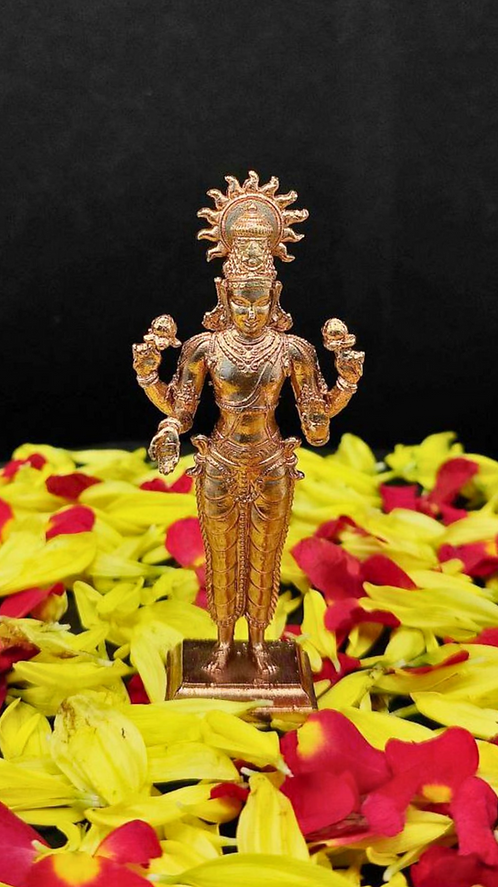
In the traditional South Indian form, Surya is depicted with two arms, each holding a lotus flower. The lotus stands for purity, spiritual awakening and the unfolding of consciousness, just as the flower opens with the rising sun. His raised hands, one holding each lotus on the shoulder level, form a distinctive and instantly recognizable pose.
Crown, Halo and Radiance
Surya wears a tall crown, the kiritamukuta, and is surrounded by the prabha, a halo of light. The halo represents the brilliance of the sun, which nothing in creation can outshine. The calm face beneath the crown shows that this great power is also benevolent.
Surya in the South Indian Bronze Tradition
South Indian temples have long honoured Surya in bronze, cast by the lost-wax method perfected under the Chola artisans. A wax model of the deity is coated in clay, heated so that the wax melts away, and the hollow is filled with molten metal. The finished bronze is chiselled and polished by hand, which lets the sculptor capture the crown, ornaments and lotus details with a precision that stone rarely allows.
The Legend of Surya Bhagavan
The most beloved story of Surya's origins is the tale of his marriage to Sanjna and the way his fierce brilliance was tempered. It unfolds in stages across the Puranas.
Sanjna Cannot Bear the Heat
Vishwakarma gave his daughter Sanjna in marriage to Surya. Though she loved her husband, the blazing brilliance of his form was more than she could endure. Each time she looked upon him, she closed her eyes, and it is said that her impatience grew with every passing year.
Chhaya Takes Her Place
Unable to stay, Sanjna created a shadow-double of herself, Chhaya, and asked her to remain with Surya in her place. She then left for her father's home. Chhaya lived as Surya's wife and bore him children, and for some time, Surya did not know that his true wife was gone.
Surya Learns the Truth
The truth came out when Chhaya treated Sanjna's children with less affection than her own, and Yama, the eldest son, spoke sharply to her. Surya sensed that something was wrong, and Chhaya, questioned by him, finally revealed the secret. Surya went in search of Sanjna, and her father Vishwakarma told him that she had gone away, unable to bear his fiery form.
Vishwakarma Trims the Sun's Brilliance
Vishwakarma proposed a remedy. He placed Surya on a lathe and carefully trimmed away part of his dazzling radiance, leaving the sun's glow bearable for the world. The shavings of this divine brilliance were fashioned into celestial weapons, including Vishnu's Sudarshana Chakra and Shiva's trident.
The Reunion as Horses
Surya then discovered that Sanjna had taken the form of a mare and was living in the northern lands. He approached her in the form of a stallion, and from this reunion, the twin Ashwini Kumaras were born. Sanjna returned to her husband, and Surya's tempered light has warmed the world ever since.
Surya and Hanuman
Another cherished story comes from the Ramayana. The young Hanuman, mistaking the sun for a ripe fruit, leapt into the sky to seize it. He later became Surya's student, learning the scriptures from the Sun God while facing him as he crossed the sky. This is why devotees see Surya as the divine teacher who blesses those who approach him with humility.
Surya Temples and Festivals
Surya has been honoured with grand temples across India, some of which are architectural wonders.
Konark Sun Temple, Odisha
The Konark Sun Temple, built in the 13th century under King Narasimhadeva I of the Eastern Ganga dynasty, is designed as a colossal stone chariot with twenty-four intricately carved wheels drawn by seven horses. It is a UNESCO World Heritage Site and one of the most famous monuments in India.
Suryanar Koil, Tamil Nadu
Suryanar Koil, near Kumbakonam in the Thanjavur region, is a Chola-era temple where Surya is the presiding deity. It is one of the Navagraha temples of Tamil Nadu, and devotees traditionally begin their Navagraha pilgrimage here.
Modhera and Arasavalli
The Sun Temple at Modhera in Gujarat, built in the 11th century by the Solanki dynasty, is celebrated for its exquisite stepped tank and carved pillars. The Arasavalli Sun Temple in Andhra Pradesh is one of the few ancient shrines where Surya continues to be actively worshipped, and it is known for the rays of the rising sun that touch the deity on specific days of the year.
Festivals of the Sun
Surya is celebrated at Makar Sankranti and Thai Pongal, when farmers thank the Sun God for the harvest by boiling fresh rice in an open courtyard. Ratha Saptami, observed in the month of Magha, marks the day on which Surya is believed to have begun his journey in his chariot. In Bihar, Jharkhand and eastern Uttar Pradesh, the four-day festival of Chhath Puja is dedicated to offering prayers to the setting and rising sun.
Spiritual Significance of Surya Bhagavan
Source of Life and Health
Surya is the sustainer of all living beings, and tradition associates him with vitality and good health. Sunrise practices such as Surya Namaskar, the twelve-step salutation to the sun, are a living expression of this reverence.
Remover of Darkness and Ignorance
In the Gayatri Mantra, devotees pray to the divine light to illuminate their minds. Surya's rising is a daily reminder that knowledge dispels ignorance, just as light dispels darkness.
Strength, Confidence and Leadership
In Vedic astrology, Surya rules the soul, authority and self-confidence, and worshipping him is said to strengthen these qualities. The Aditya Hridayam, a hymn taught by the sage Agastya to Lord Rama on the battlefield before his fight with Ravana, is recited to seek courage and victory.
A Discipline of Gratitude
Offering water to the rising sun, known as arghya, is a simple daily act of gratitude. It links the devotee to the natural rhythm of the day and reminds them of the source of all nourishment.
Why Is Surya Bhagavan Different from Other Deities?
He is the visible god: Surya is the Pratyaksha Devata, seen by all beings every day, without the need for an image.
He is both a deity and a celestial body: He is worshipped as a god and also leads the nine planets as the Sun.
He belongs to every tradition: Surya is honoured in the Vedas, the Puranas, the Panchayatana worship and the Navagraha shrines alike.
He is a giver of health and vitality: Many of his rituals and hymns are directly tied to well-being and energy.
He governs time itself: His chariot wheel and seven horses stand for the days, months and cycles that measure life.
He needs no festival to be remembered: Every sunrise is an occasion to offer him prayers.
Conclusion
Surya Bhagavan is the light behind all life, the cosmic eye that watches over the world and the deity whose presence is renewed with every sunrise. His seven horses, his lotuses and his radiant halo carry centuries of Vedic wisdom, while stories such as his union with Sanjna show that even the greatest power is made gentler by love. Whether remembered through the Gayatri Mantra, a temple pilgrimage or a bronze icon in a pooja room, Surya continues to inspire gratitude, discipline and hope.
Comments
Log in or sign up to join the conversation.