


The profit share hitting new records is getting to be almost like the sun coming up in the morning. The economy may not be working for everyone, but it has been doing very well, at least until recently, for people who own a great deal of stock. We are seeing near record-high price-to-earnings ratios against a record share of after-tax profit in GDP.
The share rose to 12.2 percent of GDP in the third quarter of this year. That’s up from 11.9 percent in the second quarter, and 10.7 percent in the 4th quarter of 2024. This increased share corresponds to an additional $460 billion a year going to corporate profits, or $3,300 per household.
Going back to 2000, the after-tax profit share of GDP was just 5.8 percent. The difference of 6.4 percentage points of GDP corresponds to another $2.1 trillion a year going to after-tax profits compared to a situation where distribution had not changed. This comes to $15,400 per household.
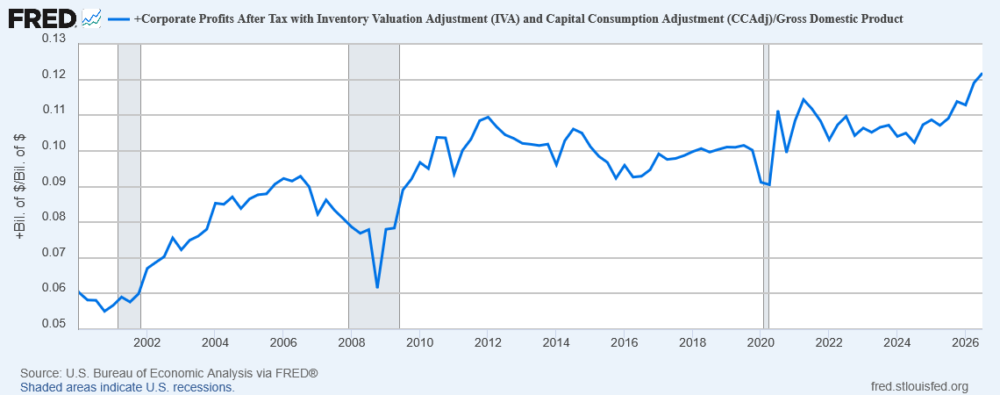
The rise in profit shares has been pretty much across the board. Still, there are some standouts. Between 2019, the year before the pandemic, and the second quarter of 2026 (we don’t have third quarter data yet), profits for computers and electronic products have risen 303 percent. Profits in the chemical industry (largely drugs) have risen 292 percent. In the fossil fuel industry, the rise has been 590 percent. In the information industry, they rose 270 percent. These figures should be compared to the increase in nominal GDP over this period of 53.5 percent.
Interestingly, profits in the food processing industry rose just 47.5, slightly trailing the growth in GDP. But people may still be seeing the hit at the supermarket. Profits in retail rose by 110.6 percent.
There are lots of stories that can be told about the rising profit share. Increased concentration is part of the story, as is the falling unionization rate. Longer and stronger patent and copyright monopolies also help to give more money to capital, especially in the prescription drug and software industry, as does the reduction in corporate taxes. Restoring the labor and tax share of capital must be a big part of the country’s political agenda if we want an economy that works for everyone.


Comments
Log in or sign up to join the conversation.