

In what can only be described as an anti-establishment vote and the biggest U.S. election surprise in a generation, Donald Trump has won the White House. While the pundits will be arguing for months on why the polls were dead wrong on the outcome, the fact that the Republicans wound up with control of the House and Senate in the process seems to say it all.
My take is America was sick of the ridiculous dysfunction in Washington and was ready for a change. And apparently ANY change would do!
As election night wore on, the global markets voiced their concern about yet another massive surprise vote result. Dow futures were down more than 800 points. S&P futures were plunging 5%. And analysts suggested that the implied open on Wall Street would be the worst seen since 9/11.
Just past midnight, the peso was diving. Bond yields were rising. Stock futures hit limit-down. And gold was higher. Anyone watching the financial channels late last night was reminded that markets don’t like surprises – or uncertainty. And with a Trump victory looking certain, both seemed to be the word of the night.
However, thinking investors quickly realized that in looking back at history, the big, ugly drops in the markets that were due largely to fear/uncertainty were usually reversed – and in fairly short order. The BREXIT vote was the latest example of this phenomenon. If you will recall, the S&P fell -5.33% in two days on word that the U.K. had voted to actually leave the EU. And then the big, bad dive wound up being reversed in just 3 days.
Thus, by dawn’s early light (which isn’t here yet in beautiful Evergreen, Colorado), the opportunity to “go the other way,” to be a contrarian (everybody is these days, right?), and to “buy the dip” appears to be trumping the fear and uncertainty of a Trump administration.
As for what to expect next in the markets, it’s frankly anybody’s guess and I won’t bore you with my prognostications. What we do know is that the Republicans appear to have received a mandate and that a big dose of fiscal stimulus is likely on the horizon.
This means more deficits, which, of course could cause the Fed to take a breath (expect this to become the focal point again once the election hullabaloo winds down). And if you feel like you know how the markets will react, feel free to have at it. For me, I’ll simply continue to watch what “is” happening in the markets and try my darndest to figure out how to stay on the right side of the big-picture trend.
From a shorter-term perspective, the chart below contains my key points and levels:
(Click on image to enlarge)
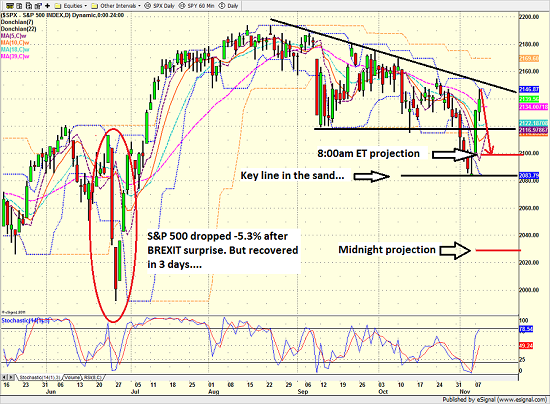
First, let’s note that stocks have been in a downtrend since mid-August and that this isn’t likely to change in the next few days.
Next, take a look at the discrepancy between the projected open as of midnight last night and 8:00am eastern time this morning. While the open isn’t gonna be pretty, it also isn’t going to be the biggest drop since 9/11 either. Heck, it may not even erase the “sigh of relief” rally seen over the past two days.
From a near-term perspective, last week’s low at around 2080 on the S&P is the key line in the sand. And from a longer-term perspective, it would be VERY bearish to see the venerable index breach the BREXIT closing low of 2000.
So there you have it. America was desperate for change – again, ANY kind of change. Now we will just have to figure out what that change is going to look like. Stay tuned, this ought to be interesting, to say the least.
Current Market Drivers
We strive to identify the driving forces behind the market action on a daily basis. The thinking is that if we can both identify and understand why stocks are doing what they are doing on a short-term basis; we are not likely to be surprised/blind-sided by a big move. Listed below are what we believe to be the driving forces of the current market (Listed in order of importance).
1. The State of the Election
2. The State of Global Central Bank Policies
3. The State of Global Economies
Thought For The Day:
An error is not a mistake until one fails to correct it. -Anonymous

Comments
Log in or sign up to join the conversation.