


Summer is typically when most workers are either on a long vacation, or take a long vacation, so it is not too unusual for companies to make major layoff announcements during the summer (seriously, it would just spoil everyone's fun). Nevertheless, some industries just never sleep and some are often a direct reflection of commodity price strengths and weaknesses. That was evidently the case this month and July showed that more jobs were cut than the average of the prior two months. Here are my thoughts for this month's data...
About the Challenger Jobs Cut Report
The firm of Challenger, Gray & Christmas creates this report on a monthly basis and it counts and categorizes announcements of corporate layoffs based on mass layoff data from state departments of labor. The job-cut report must be analyzed with caution. It doesn't distinguish between layoffs scheduled for the short-term or the long term, or whether job cuts are handled through attrition or actual layoffs. Also, the job-cut report does not include jobs eliminated in small batches over a longer time period. Unlike most economic data, this series is not adjusted for seasonal variation.
Investors find this data important since it is basically a rehash of the weekly jobless claims report but provides additional insight into where layoffs are occurring. There is industry and geographic (states) detail that is not available with weekly jobless claims.
Where Do We Stand Now?
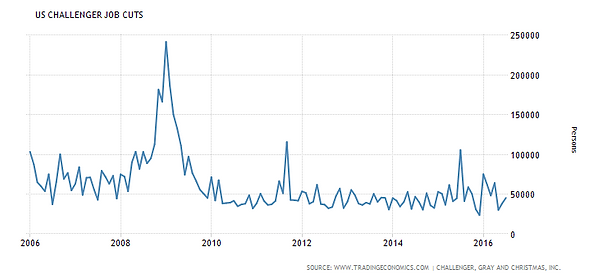
As you can see, there have not been any massive recession-induced job cuts since 2008-2009, but just a few noteworthy economic blips here and there. In this chart, a downward trend is best.
This report helps to point out the major discrepancies within different job sectors; at the moment, energy jobs remain incredibly volatile thanks to a strong U.S. dollar and cheaper fuel. During the month of July, the announced lay-off count jumped to 45,346 up from approximately the 34,000 average in the past two months.
Layoffs in the energy sector eased a bit in May and June, but surged yet again in July to 17,725 cuts. This is usual since the spring pop in oil prices, which has since faded, really did not do much to boost employment at all. Computer jobs - which are the 2nd largest industry - also added to the layoff count with 9,875 jobs cut for the highest level since April. The table below shows just how many jobs were cut year-to-date versus 2015 in all of the largest industries. Continued weakness in the oil sector leaves many wondering if the worst is truly over when it comes to eliminating jobs in the countries largest industry. Personally, I don't see oil making a roaring comeback in price in the next few years - supply is high, prices are low, and the dollar is strong - this all leads to more buying from the Middle East. However, low oil prices do help with the addition of jobs in many other sectors. Just because job cuts are high in some industries, they are more than offset by the hiring in other sectors.




Comments
Log in or sign up to join the conversation.