

Suka Brahma Maharishi, the son of sage Vyasa and one of the most revered figures in Hindu spiritual tradition, is honoured for having attained complete self-realisation from birth, and this handcrafted idol is available at Gold Plating Art Studio for those who wish to bring his presence into their space of study or meditation. Known simply as Suka Muni to devotees, he stands as the timeless example of a soul untouched by worldly attachment, revered above all as the narrator of the Bhagavata Purana.
Depicted as a serene young ascetic, often shown seated with a sacred text in hand, Suka Brahma Maharishi represents the pinnacle of renunciation and inner knowledge achieved through the grace of his father's tapasya. Gold Plating Art Studio continues the tradition of crafting figures like his for devotees who seek his blessing in their own pursuit of wisdom.
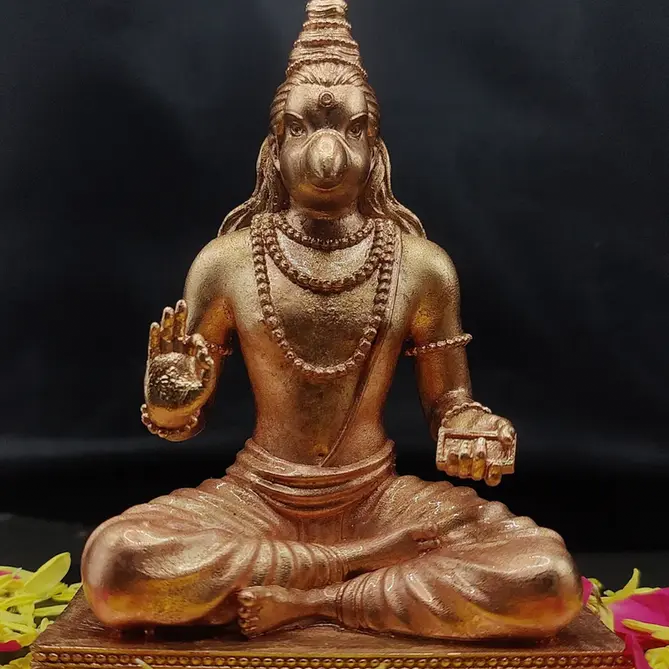
Who Is Suka Brahma Maharishi?
Suka Brahma Maharishi is revered in Hindu tradition as the son of the great sage Vyasa, the compiler of the Vedas and author of the Mahabharata. Unlike most sages who undergo years of discipline to attain liberation, Suka is described as having been born already established in supreme knowledge, a soul so complete in his realisation that he is counted among the rarest of India's spiritual figures, a jivanmukta, one liberated while still living.
Lineage and Place Among the Sages
As the son of Vyasa, Suka belongs to a lineage central to the transmission of Vedic and Puranic knowledge across generations. Where his father devoted his life to organising and recording sacred texts for the benefit of humanity, Suka is remembered instead for embodying their essence so completely that he needed no further instruction, choosing the path of renunciation from the very moment of his birth.
Titles and Names
He is addressed by devotees as Suka Muni, Shukadeva, and Suka Brahma Maharishi, the last title recognising both his standing as a great rishi and his attainment of Brahmajnana, direct knowledge of the ultimate reality, said to have been his from birth rather than earned through practice.
The Story of His Birth and Renunciation
Vyasa, desiring a worthy son to carry forward his knowledge, undertook long tapasya, and it is through this penance that Suka came into being, a birth tradition holds to be extraordinary rather than ordinary, setting him apart from the outset as a soul already free of the usual bonds of worldly attachment.
The Walk Into the Forest
From the moment of his birth, Suka showed no interest in the household life expected of him. As a young man, he simply turned and walked toward the forest, choosing the life of a wandering renunciate over any worldly path his father might have wished for him. Vyasa, moved by love for his son, ran after him calling his name through the trees, and it is said that the very trees of the forest, moved by Suka's presence, answered on his behalf, since Suka himself did not turn back.
A Sage Untouched by the World
Wherever Suka travelled, tradition holds that he passed through the world so lightly that even the natural discomforts others feel, such as at the sight of unclothed ascetics or bathing women, held no distraction for him, since his mind remained entirely absorbed in the ultimate reality. This detachment became one of the defining qualities associated with his name, held up as the standard against which true renunciation is measured.
Suka and the Bhagavata Purana
Suka Brahma Maharishi's most celebrated act came late in his wandering life, when he arrived at the deathbed of King Parikshit, who had been cursed to die within seven days from a serpent's bite. Rather than despair, Parikshit chose to spend his remaining time in the pursuit of liberation, and it was Suka who arrived, seemingly without being summoned, to guide him.
Seven Days of Sacred Narration
Over those seven days on the banks of the Ganga, Suka narrated the entire Bhagavata Purana to Parikshit, a discourse that has since become one of the most cherished scriptures in Vaishnava devotion, recounting the glories and incarnations of Vishnu, including the life of Krishna. This narration is remembered not merely as a story told to comfort a dying king, but as a complete path to liberation offered freely to anyone willing to listen with devotion.
Association with Badrinath
Tradition places Suka's meeting with his father Vyasa, and periods of his own retreat, in the Himalayan region near Badrinath, where caves associated with Vyasa and his circle are still visited by pilgrims today, tying Suka's story to one of the most sacred landscapes in Hindu pilgrimage.
Spiritual Significance of Suka Brahma Maharishi
The ideal of the liberated soul: Suka stands as the foremost example in Hindu tradition of a jivanmukta, someone who attains liberation while still in the body, offering hope that realisation is possible in this very life.
A guide for the dying and the seeking alike: His willingness to guide King Parikshit toward peace in his final days is remembered as an act of boundless compassion, offered without being asked.
The living voice of the Bhagavata Purana: Devotees regard hearing or reading the Bhagavata as hearing Suka's own words, making him present in the tradition every time the scripture is recited.
A model of true detachment: His indifference to worldly distraction, even in situations that would test other ascetics, continues to be cited as the measure of genuine renunciation.
Why Is Suka Brahma Maharishi Different from Other Sages?
Where most sages, including his own father Vyasa, achieve wisdom through years of study and discipline, Suka is remembered as having been born already complete in his realisation.
His path was one of instant and total renunciation rather than a gradual withdrawal from worldly life, walking away from his father's household the moment he was old enough to choose his own path.
Unlike sages remembered chiefly for composing texts or performing rituals, Suka's legacy rests almost entirely on a single act of oral transmission, the seven-day narration that became the Bhagavata Purana.
His story is unusual in placing a father, Vyasa, in the role of the one left behind, seeking his own son's guidance and blessing rather than the more common pattern of a son seeking his father's teaching.
Conclusion
Suka Brahma Maharishi remains one of the most singular figures in Hindu spiritual memory, a soul who arrived already free and chose to spend his life offering that freedom to others, most famously to a dying king on the banks of the Ganga. Bringing home a crafted image of Suka Muni is, for many devotees, a way of keeping his example of detachment and compassion close at hand in their own pursuit of wisdom.
Comments
Log in or sign up to join the conversation.